


In a poignant and powerful gesture, Imre Nagy, Hungary's former prime minister, was reburied in Budapest on June 16, 1989, marking a triumphant moment in the country's journey towards democracy and freedom. This symbolic act was a testament to the crumbling of the Communist regime, which had dominated Eastern Europe for decades.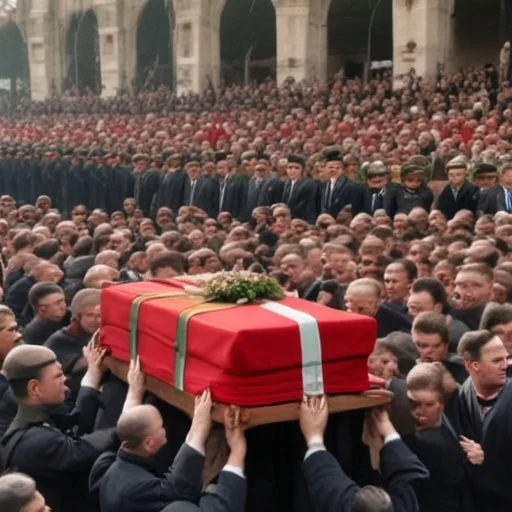
Imre Nagy, a Hungarian politician, played a pivotal role in the country's struggle for independence and democracy. Born in 1896, Nagy rose to prominence during World War II, becoming a prominent figure in the Hungarian resistance movement. His leadership during the 1956 Hungarian Revolution, which sought to overthrow the Soviet-backed government, earned him both admiration and notoriety.
Tragically, Nagy's defiance was met with brutal force, and he was executed in 1958 for his role in the uprising. His death was a devastating blow to the Hungarian people, who saw him as a beacon of hope in their struggle against oppression.
Fast-forward to 1989, when the winds of change swept across Eastern Europe. As Communist regimes began to crumble, Hungary embarked on a journey towards democratization. The reburial of Imre Nagy was seen as a crucial step in this process, a chance for the nation to confront its troubled past and forge a new path forward.
The ceremony, attended by thousands, was a cathartic moment for the Hungarian people. As Nagy's casket was lowered into the ground, the crowd erupted in cheers, tears, and applause, marking a triumphant moment in their struggle for freedom and democracy.
The reburial of Imre Nagy marked a significant turning point in Hungary's transition from Communism to democracy. The ceremony symbolized the nation's willingness to confront its past, acknowledge its mistakes, and forge a new path forward.
The event also had far-reaching implications for Hungarian politics, paving the way for the eventual democratization of the country and the collapse of the Soviet-backed government.
Imre Nagy's reburial had a profound impact on Hungarian culture and society. The event inspired a new generation of Hungarians to embrace democracy and freedom, fostering a sense of national pride and identity.
Nagy's legacy extends beyond Hungary's borders, serving as a beacon of hope for nations struggling under oppressive regimes. His story is a testament to the power of defiance and the human spirit's capacity for resistance.
"We will not be intimidated... we will not be oppressed. We will fight for our freedom, and we will win." - Imre Nagy, 1956
"Today, we bury not only a man, but an era. An era of fear, of silence, and of oppression. Today, we open the door to a new era, an era of freedom, of democracy, and of hope." - Miklós Németh, 1989
In 2010, the Hungarian government posthumously awarded Imre Nagy the Hungarian Hero's Medal, recognizing his role as a champion of democracy and freedom.
Nagy's reburial in 1989 marked the beginning of a new era of recognition for his contributions to Hungarian history. Today, he is hailed as a national hero, a symbol of resistance, and a beacon of hope for generations to come.
As the world reflects on the Revolutions of 1989, Imre Nagy's story serves as a powerful reminder of the human spirit's capacity for defiance, resilience, and ultimately, triumph.
The reburial of Imre Nagy was a culmination of years of secretly planning and negotiating by the Hungarian government and opposition leaders. Behind the scenes, Miklós Németh and his team worked tirelessly to ensure that the ceremony would be a symbol of national unity and a break from the communist past. The event was a masterclass in political theatre, with dignitaries from across the political spectrum in attendance.
The lead-up to the reburial was marked by a series of clandestine meetings between government officials and opposition leaders. It was a delicate balancing act, as both sides sought to ensure that the ceremony would be a success without jeopardizing the fragile democratic process. The stakes were high, but the reward was worth it – the reburial of Imre Nagy marked a turning point in Hungary's transition to democracy.

László Tűişö, the Hungarian poet and playwright, was a key figure in the reburial of Imre Nagy. His powerful eulogy at the ceremony cemented his place as a voice for the nation's conscience. Tűişö's words struck a chord with the Hungarian people, providing a sense of closure and redemption.
Tűişö's involvement in the reburial was more than just a symbolic gesture. He was a true champion of democracy and freedom, and his presence helped to legitimize the ceremony in the eyes of the Hungarian people. His eulogy was a masterful blend of poetry and politics, capturing the essence of Nagy's struggle and the significance of the reburial.
The reburial of Imre Nagy had a profound impact on Hungarian culture and society. The ceremony marked a turning point in the nation's struggle for freedom and democracy, inspiring a new generation of Hungarians to embrace these values. The event also sparked a renewed interest in Nagy's life and legacy, with his story serving as a beacon of hope for nations struggling under oppressive regimes.
In the years that followed, Nagy's legacy continued to inspire Hungarian artists, writers, and musicians. His story was immortalized in literature, music, and art, ensuring that his memory would live on for generations to come. The reburial of Imre Nagy marked a cultural shift in Hungary, as the nation began to come to terms with its troubled past and forge a new path forward.

The reburial of Imre Nagy was a calculated political move by the Hungarian government, designed to appeal to the nation's sense of nationalism and pride. By embracing Nagy's legacy, the government sought to distance itself from the communist past and establish a new narrative of democratic ideals and freedom.
The ceremony was a political masterstroke, as it allowed the government to co-opt the opposition's narrative of Nagy as a national hero. This strategic move helped to neutralize opposition criticism and bolster the government's legitimacy in the eyes of the Hungarian people. The reburial of Imre Nagy marked a significant turning point in Hungarian politics, as the nation began its transition to democracy.
The historiographical significance of Imre Nagy's reburial cannot be overstated. The event marked a shift in the way Hungarians remembered and interpreted their past, as the nation began to come to terms with its complex and troubled history. The reburial of Nagy served as a symbol of national redemption, allowing Hungarians to confront their past mistakes and forge a new path forward.
Historians would later interpret the reburial as a pivotal moment in Hungary's transition to democracy, a moment that marked a break from the communist regime and its oppressive policies. The event also served as a testament to the power of collective memory, as the Hungarian people sought to reclaim their history and forge a new narrative of national identity.