


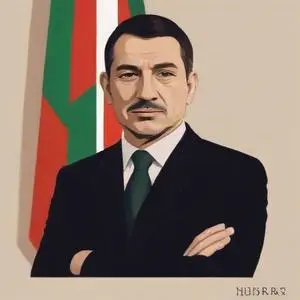
The 38th Prime Minister of Hungary, known for his nationalist and conservative policies, has been a dominant figure in Hungarian politics for over two decades, shaping the country's identity and relationship with the EU.
Viktor Orbn, a Hungarian lawyer and politician, has been a dominant figure in Hungarian politics for over three decades, serving as the Prime Minister of Hungary since 2010, with a previous term from 1998 to 2002. He is known for his nationalistic and conservative policies, which have been met with both praise and criticism from within Hungary and abroad.
Orbn was born on May 31, 1963, in Székesfehérvár, Hungary. He studied law at Eötvös Loránd University, where he became involved in the Hungarian dissident student movement. In 1989, he gained national recognition for a speech in which he openly demanded that Soviet armed forces leave Hungary, marking the beginning of his political career.
Orbn was first elected to the National Assembly in 1990, where he led the Fidesz party's parliamentary caucus until 1993. He became the party's leader in 1993, a position he has held ever since, with a brief break between 2000 and 2003. During his first term as Prime Minister, from 1998 to 2002, Hungary joined NATO, and the country experienced a decline in inflation and fiscal deficit.
Orbn returned to power in 2010 and has since been re-elected in 2014, 2018, and 2022. During his second term, he has implemented several controversial reforms, including amendments to the Constitution of Hungary and legislation that has been criticized for undermining judicial independence and press freedom. He has also been a vocal opponent of immigration and has clashed with the European Union over issues such as refugee quotas.
Orbn has been a strong advocate for Christian values and has frequently positioned himself as a defender of Hungarian national identity and sovereignty. He has also been critical of what he sees as the European Union's attempts to erode national sovereignty and promote a multicultural, liberal agenda.
Orbn's policies and rhetoric have been widely criticized by human rights groups, opposition parties, and international organizations, who accuse him of undermining democracy and the rule of law. He has also been accused of using anti-Semitic and xenophobic rhetoric to mobilize support among his base.
Orbn's legacy is likely to be shaped by his controversial policies and his impact on Hungarian democracy. While his supporters see him as a champion of national sovereignty and Christian values, his critics view him as a threat to democracy and the rule of law. Regardless, he remains one of the most influential and divisive figures in modern Hungarian politics.
1989: Delivered a speech demanding the withdrawal of Soviet troops from Hungary, marking the beginning of his political career.
1993: Became the leader of the Fidesz party.
1998: First elected as Prime Minister of Hungary.
2010: Returned to power as Prime Minister.
2020: Became the longest-serving Prime Minister in Hungarian history.
"The most important thing in life is to stop saying 'I wish' and start saying 'I will'."
Orbn's policies and rhetoric have had a significant impact on Hungarian society, shaping the country's political discourse and influencing its relationships with the European Union and other international organizations.
79 Years Old
Austrian businessman and politician who served as Chancellor of Austria from 1997 to 2000, known for his economic reforms and EU integration efforts.
65 Years Old
Hungary's 6th Prime Minister, a key figure in the country's transition to democracy, known for his economic reforms and leadership during the 2006 protests.
58 Years Old
The 7th Prime Minister of Hungary, a key figure in the country's economic reforms, known for his efforts to stabilize the economy during the 2008 financial crisis.
65 Years Old
Hungary's 6th Prime Minister, a key figure in the country's transition to democracy, known for his economic reforms and leadership during the 2006 protests.
