


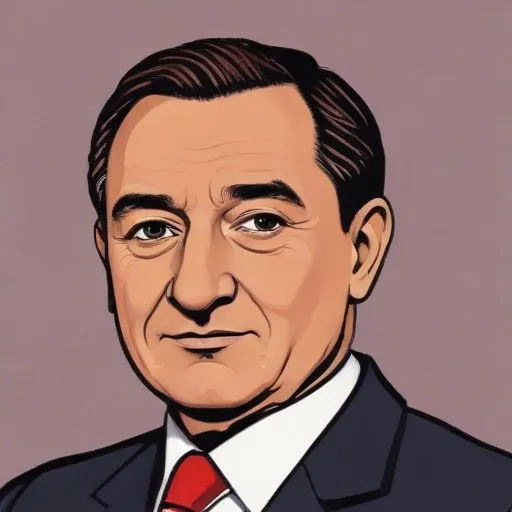
The 7th Prime Minister of Hungary, a key figure in the country's economic reforms, known for his efforts to stabilize the economy during the 2008 financial crisis.
Gordon Bajnai, a Hungarian entrepreneur and economist, is perhaps best known for his tenure as the Prime Minister of Hungary from 2009 to 2010. During this period, he implemented significant reforms, earning him a reputation as a visionary leader in Hungarian politics.
Bajnai's journey to the top began in 2007 when he served as Minister of Local Government and Regional Development. His impressive tenure paved the way for his next role as Minister of National Development and Economy in 2008. His experience in these positions laid the foundation for his eventual nomination as the country's Prime Minister.
In March 2009, following Prime Minister Ferenc Gyurcsány's resignation, Bajnai was nominated by the ruling Hungarian Socialist Party (MSZP) to become Hungary's next head of government. He took office on April 14, 2009, after the parliament passed a constructive motion of no-confidence against Gyurcsány. During his tenure, Bajnai focused on stabilizing the economy, which was facing significant challenges at the time.
Gordon Bajnai was born on March 5, 1968, in Szeged, Hungary. He grew up in Baja, Hungary, and graduated from the Budapest University of Economic Sciences (now Corvinus University) with a degree in International Relations in 1991. Bajnai's academic achievements were recognized with the Pro Universitate Award.
After leaving office, Bajnai returned to politics in 2012, establishing Together 2014, a coalition of left-wing and liberal political movements and civil organizations. Although the movement ultimately failed to unite opposition parties, Bajnai's efforts demonstrated his commitment to shaping Hungary's political landscape. Today, his legacy as a pragmatic and visionary leader continues to inspire Hungarians and economists worldwide.
65 Years Old
Hungary's 6th Prime Minister, a key figure in the country's transition to democracy, known for his economic reforms and leadership during the 2006 protests.
63 Years Old
The 38th Prime Minister of Hungary, known for his nationalist and conservative policies, has been a dominant figure in Hungarian politics for over two decades, shaping the country's identity and relationship with the EU.
58 Years Old
The 7th Prime Minister of Hungary, a key figure in the country's economic reforms, known for his efforts to stabilize the economy during the 2008 financial crisis.
95 Years Old
The 51st Prime Minister of Hungary, serving from 1987 to 1988, known for his role in transitioning Hungary from communism to democracy. He played a key part in introducing economic reforms and liberalizing the country's political system.
