


The Romanian Revolution, a pivotal moment in Eastern European history, came to a close on December 30, 1989, as the last remnants of street fighting and sporadic gunfire ceased in Bucharest. This marked the definitive end of Nicolae Ceaușescu's authoritarian regime, which had held the country in a grasp of fear and oppression for over two decades.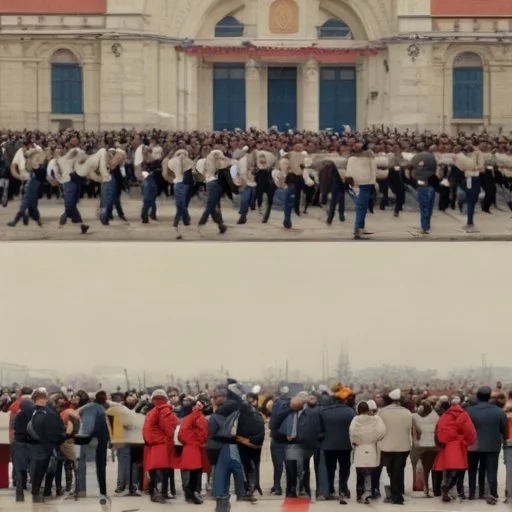
Long-simmering discontent among the Romanian people had been building against Ceaușescu's brutal regime, which had imposed severe economic hardship, censorship, and human rights abuses. The country's economy was in shambles, with widespread poverty, food shortages, and lack of basic necessities. The once-mighty industrial sector had collapsed, and the people were weary of the regime's empty promises.
In mid-December 1989, protests erupted in Timișoara, sparked by the regime's attempt to evict a popular dissident pastor. The demonstrations quickly spread to other cities, including Bucharest, where crowds of hundreds of thousands demanded Ceaușescu's resignation. As the protests turned violent, the army initially sided with the regime, but eventually, they switched allegiance to the people, paving the way for the dictator's downfall.
The Romanian Revolution's most significant outcome was the overthrow of Ceaușescu's regime, marking the end of communist rule in Romania. The event sent shockwaves throughout Eastern Europe, inspiring similar movements in other countries. The subsequent transition to democracy led to free elections, the establishment of a multi-party system, and a gradual shift towards a market-based economy.
The revolution had a profound impact on Romanian culture, as the country began to rediscover its own identity, free from the shackles of communist ideology. The event inspired a new wave of artistic expression, as writers, artists, and musicians began to explore themes of freedom, democracy, and national identity.
"I remember the sound of gunfire and screams, but also the sense of hope and liberation that filled the air. It was as if we had finally found our voice, and nothing could silence us again." – Ana Maria, a Bucharest resident who participated in the protests.
"We knew we were taking a risk, but we couldn't just stand by and watch our country crumble. We had to fight for our freedom, and it was worth every sacrifice." – Alexandru, a former student leader involved in the revolution.
The Romanian Revolution played a significant role in inspiring similar movements across Eastern Europe, contributing to the collapse of communist regimes in countries such as Czechoslovakia, Bulgaria, and East Germany. The event served as a catalyst for the reunification of Germany and the eventual dissolution of the Soviet Union.
The Romanian Revolution serves as a testament to the power of ordinary people standing up against tyranny, demanding their rights, and fighting for a better future. It reminds us that even in the darkest of times, there is always hope, and that collective action can bring about profound change.
Ion Iliescu, a former communist official turned reformist, played a crucial role in the Romanian Revolution. Born in 1930, Iliescu was a member of the Communist Party since his teenage years. However, as the regime's grip on power tightened, Iliescu began to distance himself from Ceaușescu's policies, advocating for reforms and greater democratization.
Iliescu's leadership during the revolution was marked by his ability to navigate the treacherous landscape of political intrigue. He skillfully managed to balance the demands of the protesters with the need to maintain order, ultimately paving the way for the collapse of the Ceaușescu regime.
The Romanian Revolution had a profound impact on the country's cultural landscape. With the collapse of communism, Romanian artists, writers, and musicians were finally free to express themselves without fear of censorship or persecution.
This new-found freedom led to a cultural renaissance of sorts, as creatives began to explore themes of national identity, democracy, and freedom. The revolution inspired a new wave of artistic expression, which continues to shape Romanian culture to this day.
The Romanian Revolution marked the beginning of a long and arduous process of economic transformation. With the collapse of communism, the country was forced to transition from a centrally planned economy to a market-based system.
The initial years were marked by economic turmoil, with hyperinflation, rationing, and widespread poverty. However, the introduction of market reforms and prudent economic management eventually led to stability and growth, paving the way for Romania's integration into the European Union.
The Romanian Revolution marked a significant turning point in the country's political history. With the collapse of communism, Romania embarked on a journey towards democratization, with Iliescu's National Salvation Front playing a dominant role in the early years.
However, the transition to democracy was not without its challenges. Power struggles between rival factions, corruption, and allegations of human rights abuses marred the early years of democratization. Despite these challenges, Romania persevered, eventually consolidating its democracy and establishing a stable political system.
The Romanian Revolution did not occur in a vacuum. The event was influenced by, and had an impact on, the broader geopolitics of Eastern Europe and the Soviet Union.
In the late 1980s, the region was experiencing a wave of protests and uprisings, as communist regimes began to falter. The Romanian Revolution was part of this larger phenomenon, and its success had significant implications for the region, contributing to the collapse of communist regimes in neighboring countries and the eventual dissolution of the Soviet Union.