


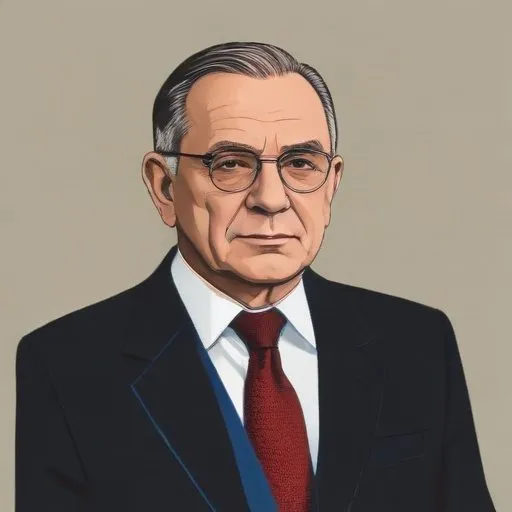
A Romanian engineer and politician who served as the country's second president, playing a key role in the country's transition from communism to democracy. He's known for his efforts to reform the economy and bring Romania into the European community.
Ion Iliescu is best known for his pivotal role in Romania's transition from communism to democracy, serving as the country's president from 1989 to 1996 and again from 2000 to 2004. During his presidency, Iliescu oversaw significant reforms, including the country's accession to NATO in 2004, and was instrumental in shaping Romania's modern political landscape.
Born on March 3, 1930, in Oltenia, Romania, Iliescu's early life was marked by turmoil. Abandoned by his mother as an infant, he was raised by his father, a railroad worker with communist sympathies. In 1931, his father left for the Soviet Union to attend the Congress of the Communist Party of the Soviet Union in Moscow.
Iliescu joined the Romanian Communist Party (PCR) in 1953 and quickly rose through the ranks, becoming a member of its Central Committee in 1965. However, his growing disillusionment with Nicolae Ceaușescu's regime led to his marginalization beginning in 1971.
Iliescu's fortunes changed dramatically with the fall of Ceaușescu's regime in 1989. He played a key role in the Romanian Revolution, becoming the country's president in December of that year. In May 1990, he became Romania's first freely elected head of state.
During his presidency, Iliescu oversaw the adoption of a new constitution, which was approved by popular referendum in 1991. He served two more terms, from 1992 to 1996 and from 2000 to 2004, implementing significant economic and political reforms.
Iliescu's presidency was marked by significant achievements, including:
Iliescu's presidency was not without controversy. In 2018, he was charged with committing crimes against humanity during the 1989 revolution. Although a judge rejected the case in 2020 due to irregularities in the indictment, the case was refiled, and Iliescu is currently awaiting trial.
Ion Iliescu's legacy is complex and multifaceted. While his presidency was marked by significant achievements, it was also marred by controversies and criticisms. Nevertheless, his role in Romania's transition to democracy and his commitment to reform and modernization have earned him a place in Romanian history.
Today, Iliescu remains the oldest living former Romanian president, a testament to his enduring impact on the country's politics and society.
"We must build a society where everyone has the freedom to express their opinions, to participate in the decision-making process, and to contribute to the development of our country."
"Romania's accession to NATO is a significant step towards strengthening our country's security and stability."
76 Years Old
Romania's 59th Prime Minister, a lawyer-turned-politician who served from 2000 to 2004, known for his role in the country's post-communist transition and EU integration efforts.
74 Years Old
Romanian captain and politician who served as the 4th President of Romania, known for his efforts to combat corruption and reform the country's political system. He was also a vocal critic of communism and worked to strengthen Romania's ties with the European Union.
67 Years Old
A Romanian educator and politician who served as the 5th President of Romania, known for promoting European integration and fighting corruption. He's a strong advocate for education and minority rights.
86 Years Old
A Romanian academic and politician who served as the country's President from 1996 to 2000, known for his efforts to reform and democratize Romania after the fall of communism. He played a key role in Romania's transition to a market economy and its integration into European structures.
