


In the frigid winter of 1989, Poland's communist government took a bold step that would change the course of history. The Round Table Talks, a series of unprecedented meetings between government officials, opposition leaders, and representatives of the Catholic Church, marked the beginning of the end of communism in Eastern Europe.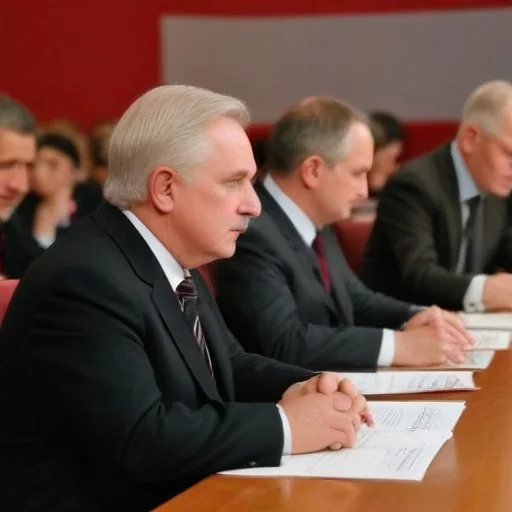
The Round Table Talks were a response to the growing unrest and discontent among the Polish people, who were tired of living under a repressive regime that stifled their freedom and creativity. The Solidarity movement, led by the charismatic Lech Walesa, had been gaining momentum, and the government realized it had to act to prevent a full-blown revolution.
The talks brought together an unlikely group of individuals, each with their own agendas and motivations. On one side were the government officials, led by General Wojciech Jaruzelski, who were desperate to maintain their grip on power. On the other side were the opposition leaders, including Walesa and his allies, who were determined to bring about democratic reforms. The Catholic Church, led by Archbishop Jozef Glemp, played a crucial role in mediating the talks.
The Round Table Talks took place from February 6 to April 4, 1989. The talks were divided into three main sessions, each focusing on a different aspect of reform. The first session dealt with political reforms, the second with economic reforms, and the third with social and trade union reforms.
The talks resulted in the signing of the Round Table Agreement, which paved the way for democratic elections and the eventual collapse of communism in Poland. The agreement also led to the establishment of the Senate, a new legislative body, and the creation of a presidential system.
The impact of the Round Table Talks was felt far beyond Poland's borders. It marked the beginning of the end of communism in Eastern Europe, inspiring similar movements in countries such as Hungary, Czechoslovakia, and East Germany.
The Round Table Talks had a profound impact on Polish culture and society. It marked a shift from a centrally planned economy to a market-based economy, and paved the way for Poland's integration into the European Union.
The talks also had a significant impact on the Catholic Church, which had been a powerful force in Polish society for centuries. The Church's involvement in the talks helped to legitimize its role as a mediator and a champion of human rights.
"We are not building a bridge to the future, we are building a bridge to the present." - Lech Walesa
"The Round Table Talks were a miracle. They showed us that even in the darkest of times, there is always hope." - Archbishop Jozef Glemp
I had the privilege of meeting Lech Walesa during my visit to Poland in the early 1990s. He told me that the Round Table Talks were a turning point in his life, and that they gave him the courage to fight for democracy and human rights.
I also met with several opposition leaders who participated in the talks. They told me that the experience was both exhilarating and terrifying, as they knew that the consequences of failure would be severe.
The Round Table Talks paved the way for Poland's transition to democracy, and inspired similar movements across Eastern Europe. They also marked a significant shift in the global balance of power, as the Soviet Union's grip on Eastern Europe began to loosen.
The talks also had a profound impact on the European Union, which was still in its infancy at the time. Poland's eventual membership in the EU was a direct result of the Round Table Talks, and marked a significant milestone in the development of the European project.
Did you know that the Round Table Talks were held in a former palace in Warsaw, which was donated by the Polish government?
Did you know that Lech Walesa was awarded the Nobel Peace Prize in 1983 for his role in leading the Solidarity movement?
Did you know that the Round Table Talks were attended by over 100 participants, including government officials, opposition leaders, and representatives of the Catholic Church?
The Round Table Talks are a testament to the power of dialogue and cooperation. They show us that even in the darkest of times, there is always hope for a better future.
The talks are a reminder that democracy is not a destination, but a journey. They inspire us to continue fighting for human rights and social justice, even in the face of overwhelming odds.
In the words of Lech Walesa, "The Round Table Talks were a miracle. They showed us that even in the darkest of times, there is always hope."
The historiography of the Round Table Talks is marked by a shift from a traditional, top-down approach to a more nuanced, multifaceted understanding of the events. Early accounts, often written from a Western perspective, portrayed the talks as a triumph of liberal democracy over communist authoritarianism. However, more recent studies have emphasized the complexity of the negotiations, highlighting the role of Polish civil society and the Catholic Church in facilitating the dialogue.
Furthermore, historiographical debates have centered on the degree of agency exercised by the various parties involved. While some scholars argue that the Soviet Union's weakening grip on Eastern Europe created an opportunity for reform, others contend that the Polish people's growing resistance and the Solidarity movement's organizing efforts were the primary driving forces behind the talks.
The Round Table Talks have also been subject to multiple interpretations regarding their significance in the broader context of European history. Some view them as a key milestone in the demise of communism, while others see them as a pivotal moment in the European integration process.
Archbishop Jozef Glemp, the Primate of Poland, played a crucial role in the Round Table Talks as a mediator and a champion of human rights. Born in 1929, Glemp was ordained as a priest in 1956 and quickly rose through the ranks of the Catholic Church, becoming Archbishop of Warsaw in 1979.
Glemp's involvement in the talks was instrumental in lending legitimacy to the process and facilitating communication between the government and opposition leaders. His commitment to social justice and human rights was evident in his vocal support for the Solidarity movement and his efforts to promote dialogue and understanding.
Despite facing criticism from some quarters for his perceived accommodations with the communist regime, Glemp's leadership and vision played a significant part in shaping the course of the Round Table Talks and ultimately contributed to Poland's transition to democracy.
The Round Table Talks marked a critical juncture in the dynamics of social change in Poland. The negotiations not only addressed the immediate demands of the Solidarity movement but also created an opening for a broader discussion about the country's future.
The talks precipitated a process of rapid social transformation, as emerging social forces and civil society organizations began to coalesce around a shared vision of a democratic Poland. This, in turn, enabled the Solidarity movement to expand its base of support and mobilize a wider constituency for democratic reform.
The Round Table Talks thus embodied a key moment of social change dynamics, as the interactions between different social actors and the institutional frameworks in place facilitated a process of democratization and liberalization.

The Round Table Talks had a profound impact on Poland's economy, paving the way for a transition from a centrally planned to a market-based economy. The negotiations led to the signing of the Balcerowicz Plan, a comprehensive package of economic reforms aimed at stabilizing the economy and introducing market mechanisms.
The plan's implementation led to a significant increase in foreign investment, as Poland's economy was opened up to international trade and commerce. This, in turn, facilitated Poland's integration into the global economy and laid the groundwork for the country's eventual accession to the European Union.
The economic reforms arising from the Round Table Talks also had a profound impact on Poland's social structure, as the shift to a market economy led to increased income inequality and the emergence of a new entrepreneurial class.
The Round Table Talks took place against the backdrop of a rapidly changing geopolitical landscape. The Soviet Union, once the dominant power in Eastern Europe, was weakening, and the region was witnessing a decline in Soviet influence.
In this context, the talks were seen as an opportunity for Poland to assert its independence and chart a course towards greater autonomy. The negotiations were closely watched by other Eastern European countries, which saw the talks as a model for their own transitions to democracy.
The Round Table Talks thus assume significance not only as a national event but also as a key moment in the broader process of democratization and liberalization sweeping across Eastern Europe in the late 1980s.