


The Battle of Assaye, fought on September 23, 1803, is remembered as one of the most decisive and brutal battles in Indian history, marking a significant turning point in the Second Anglo-Maratha War. This pivotal conflict pitted the British East India Company, led by Major General Wellesley, against the powerful Maratha Empire, with the British emerging victorious despite being severely outnumbered.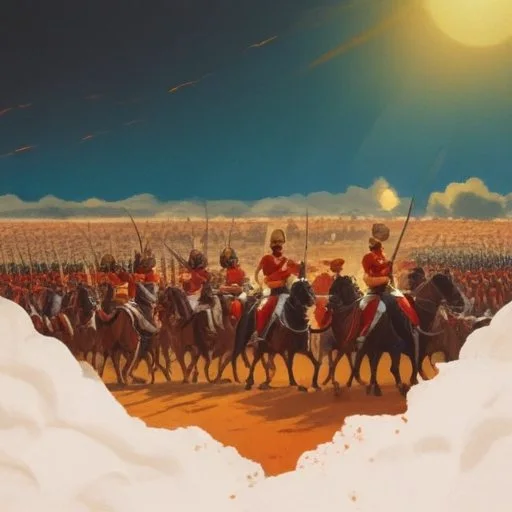
The Second Anglo-Maratha War was sparked by the East India Company's expansionist policies, which threatened the sovereignty of the Maratha Empire. The Marathas, who had once been a dominant force in India, had been weakened by internal conflicts and the rise of the British East India Company. The war was a clash of two empires, each seeking to assert its dominance over the Indian subcontinent.
The battle took place on the banks of the Kaitna River, near the town of Assaye in present-day Maharashtra, India. The British forces, consisting of 4,500 men, were vastly outnumbered by the Maratha army, which boasted over 40,000 soldiers. Despite the odds, the British held their ground, using their superior artillery and cavalry to devastating effect.
The battle was fierce and intense, with both sides suffering heavy casualties. The Marathas, however, were ultimately unable to withstand the British onslaught, and their lines began to break. As the day wore on, the Maratha army retreated, leaving behind thousands of dead and wounded soldiers.
The Battle of Assaye was a crushing defeat for the Maratha Empire, marking a significant shift in the balance of power in India. The British East India Company emerged as the dominant force, paving the way for their eventual colonization of the subcontinent.
The battle also had far-reaching consequences for the Maratha Empire, which never fully recovered from the defeat. The empire began to splinter, and internal conflicts continued to weaken its position.
The Battle of Assaye had a profound impact on Indian culture and society. The defeat of the Maratha Empire marked the beginning of the end of Indian independence, and the eventual colonization of the subcontinent.
The battle also influenced the development of Indian nationalism, as many Indians began to resist British rule and fight for independence.
The Battle of Assaye has been the subject of controversy and debate among historians and scholars. Some have questioned the British account of the battle, suggesting that the Maratha army was not as large as claimed, and that the British victory was not as decisive as reported.
Others have criticized the British for their brutal treatment of Indian prisoners and civilians, which was common practice during the colonial era.
"Assaye was a bloody and disastrous day for the Marathas, but it was a glorious and triumphant day for the British." - Major General Wellesley
"The Battle of Assaye was a harbinger of doom for the Maratha Empire, and a warning to all Indians of the dangers of British colonialism." - Indian historian, Rajendra Prasad
The Battle of Assaye is often compared to other key battles in Indian history, such as the Battle of Plassey and the Battle of Buxar. These battles, fought between the British East India Company and various Indian powers, marked significant turning points in the colonial era.
However, Assaye stands out as one of the most brutal and decisive battles of the era, with its outcome having far-reaching consequences for the Indian subcontinent.
One British soldier, Private Thomas Davis, wrote in his diary, "The noise of the cannons was deafening, and the screams of the wounded Marathas still haunt my dreams."
A Maratha soldier, who survived the battle, later recalled, "I saw my comrades fall around me, and I knew that our empire was doomed."
The Battle of Assaye paved the way for the eventual colonization of India by the British East India Company. The battle marked a turning point in the Second Anglo-Maratha War, and set the stage for the British conquest of India.
The legacy of Assaye can still be seen today, with the battle remembered as a symbol of Indian resistance to colonial rule.
The Battle of Assaye was a pivotal moment in Indian history, marking a significant turning point in the Second Anglo-Maratha War. The brutal and decisive battle had far-reaching consequences for the Indian subcontinent, paving the way for British colonization and shaping the course of Indian history.
The Second Anglo-Maratha War was a culmination of the growing tensions between the British East India Company and the Maratha Empire. The war was sparked by the Company's expansionist policies, which threatened the sovereignty of the Maratha Empire. The Marathas, who had once been a dominant force in India, had been weakened by internal conflicts and the rise of the British East India Company.
In the years leading up to the war, the British had been making gradual inroads into Indian territory, often through strategic alliances with local rulers. However, their aggressive expansionist policies eventually led to a confrontation with the Maratha Empire, which was determined to protect its independence.
The war raged on for several years, with both sides suffering heavy casualties. The British, however, had the advantage of superior firepower and military tactics, which ultimately proved decisive in the Battle of Assaye.

Major General Wellesley, also known as the Duke of Wellington, was a brilliant military strategist who led the British East India Company forces to victory at Assaye. Born in 1769, Wellesley was a member of the Anglo-Irish aristocracy and had a distinguished military career, serving in various campaigns around the world.
Wellesley's military genius was evident in his tactical deployment of troops at Assaye, where he successfully repelled the Maratha army's repeated attacks. His victory at Assaye earned him widespread acclaim and recognition, and he went on to become one of the most celebrated military commanders in British history.
Despite his military prowess, Wellesley was also known for his administrative skills, and he played a key role in shaping British policy in India during the early 19th century.
The Battle of Assaye is often compared to other key battles in Indian history, such as the Battle of Plassey and the Battle of Buxar. While these battles shared some similarities with Assaye, they were distinct in terms of their context and outcome.
Unlike Assaye, the Battle of Plassey was fought between the British East India Company and the Nawab of Bengal, Siraj-ud-Daula, in 1757. The battle marked the beginning of British rule in India and was a significant turning point in the country's history.
In contrast, the Battle of Buxar was fought in 1764 between the British and the combined forces of the Mughal Empire and the Nawab of Bengal. The battle was a decisive British victory, which led to the capture of Delhi and the eventual colonization of India.

The Battle of Assaye had a profound impact on Indian culture and society. The defeat of the Maratha Empire marked the beginning of the end of Indian independence, and the eventual colonization of the subcontinent.
The battle also influenced the development of Indian nationalism, as many Indians began to resist British rule and fight for independence. The legacy of Assaye can still be seen today, with the battle remembered as a symbol of Indian resistance to colonial rule.
Furthermore, the battle had a significant impact on Indian art and literature, with many artists and writers drawing inspiration from the conflict. The battle has also been the subject of numerous literary and artistic works, including novels, poems, and paintings.
The Battle of Assaye was a significant turning point in the Second Anglo-Maratha War, marking a shift in the balance of power in favor of the British East India Company. The battle had far-reaching consequences for the Indian subcontinent, paving the way for British colonization and shaping the course of Indian history.
The British victory at Assaye led to the eventual colonization of India, which had a profound impact on Indian politics and society. The battle marked the beginning of a new era of British dominance in India, which would last for nearly two centuries.
The political impact of the battle was felt not only in India but also in Britain, where it contributed to the growing debate about the morality and legitimacy of colonialism.