


The Second Boer War was a pivotal event in South African history, marked by brutal conflict, devastating loss of life, and far-reaching consequences that would shape the nation's future. Lasting from 1899 to 1902, this war was fought between the British-ruled Cape Colony and the Boer-ruled Transvaal and Orange Free State, with the world watching in awe as two powerful forces clashed.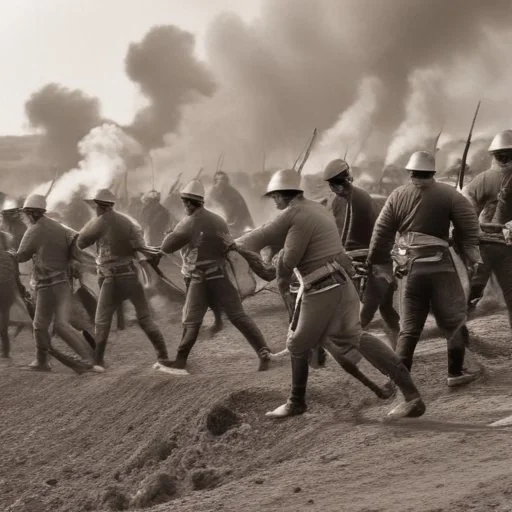
Long before the outbreak of war, tensions had been simmering between the British and the Boers, descendants of Dutch settlers who had arrived in South Africa centuries earlier. The discovery of diamonds in the 1860s and gold in the 1880s had brought a surge of British prospectors to the region, leading to a power struggle between the two groups.
The Boers, feeling threatened by the influx of outsiders, imposed harsh restrictions on the British miners, known as Uitlanders. This created a sense of resentment among the British, who saw the Boers as backward and uncivilized. The stage was set for a showdown, with both sides determined to assert their dominance over the region.
Two men would play a crucial role in shaping the course of the war: President Paul Kruger of the Transvaal Republic and General Sir Redvers Buller of the British Army.
Kruger, a stubborn and determined leader, was determined to preserve Boer independence and way of life. He was instrumental in mobilizing the Boer army and preparing for battle.
Buller, on the other hand, was a seasoned military commander with a reputation for bravery and tactical genius. He would lead the British forces into battle, determined to crush the Boer resistance and bring the region under British control.
The war began on October 11, 1899, when the Boers, under Kruger's leadership, mobilized their army and attacked the British-held town of Ladysmith.
The early years of the war saw a series of brutal battles, including the Siege of Ladysmith, the Battle of Magersfontein, and the Battle of Spion Kop. The British suffered a series of humiliating defeats, but they refused to give up.
In 1900, the British launched a major offensive, capturing key Boer cities and eventually forcing Kruger into exile. The war dragged on for another two years, with the Boers employing guerrilla tactics and the British responding with scorched-earth policies.
The war finally came to an end on May 31, 1902, with the signing of the Treaty of Vereeniging. The Boers had lost, but at a terrible cost: an estimated 25,000-30,000 Boer civilians had died, along with 22,000 British soldiers.
The war marked a new era for South Africa, with the British consolidating their power and the Boers forced to accept British rule. The war also led to a significant shift in the balance of power, with the British emerging as the dominant force in the region.
The Second Boer War was a deeply divisive conflict that split South African society along racial and ethnic lines. The war was fought along ideological lines, with the British representing progress, civilization, and imperialism, while the Boers embodied a more rustic, rural way of life.
The war also had a profound impact on the psyche of the South African people, leaving deep scars that would take generations to heal. It was a war that would shape the nation's identity and inform its relationships with the rest of the world.
In the end, the Second Boer War was a brutal and devastating conflict that left its mark on South African history. It was a war that would be remembered for generations to come, a testament to the enduring power of human conflict and the unquenchable desire for freedom and self-determination.
The Second Boer War was not an isolated conflict, but rather part of a broader pattern of imperialism and colonialism that defined the late 19th and early 20th centuries. Comparing the war to other contemporaneous conflicts, such as the Spanish-American War and the Philippine-American War, reveals striking similarities in terms of motivations, tactics, and outcomes. In each case, a powerful nation sought to expand its territory and influence at the expense of a weaker opponent. Furthermore, the war shares parallels with the Scramble for Africa, a period of intense European colonization of the African continent.

Lord Kitchener, a British general and statesman, played a crucial role in the latter stages of the war. Known for his military prowess and administrative skills, Kitchener was instrumental in developing the British strategy of concentration camps, which would ultimately prove decisive in defeating the Boers. Despite his military successes, Kitchener's name would become synonymous with the atrocities committed against Boer civilians. His legacy remains controversial to this day.
The Second Boer War had a profound impact on South African culture, contributing to the development of a unique and resilient national identity. The war spurred the growth of Afrikaans as a distinct language and cultural force, as well as the emergence of a strong sense of Afrikaner nationalism. In the aftermath of the war, Afrikaner poets, writers, and artists began to produce works that reflected their experiences and emotions. These cultural expressions helped to shape the nation's collective memory and inform its sense of self.
The Second Boer War was not simply a regional conflict, but rather a key episode in the global struggle for power and influence during the late 19th and early 20th centuries. The war was closely watched by other European powers, such as Germany and France, which saw it as an opportunity to challenge British dominance. In the years leading up to World War I, the war would serve as a catalyst for the formation of new alliances and the escalation of tensions between European nations.
The Second Boer War had significant economic consequences for all parties involved. The war disrupted trade and commerce, leading to widespread economic hardship and instability. In the aftermath of the war, the British government invested heavily in rebuilding and developing the South African economy, leading to a period of rapid growth and industrialization. However, this growth came at a cost, as the war also exacerbated existing social and economic inequalities in South Africa.