


On a sweltering summer day in 1819, the fate of South America hung in the balance as Simón Bolívar, the Liberator, led his fearless troops into the Battle of Boyacá, a clash that would etch his name in the annals of history and shake off the yoke of Spanish rule in Colombia.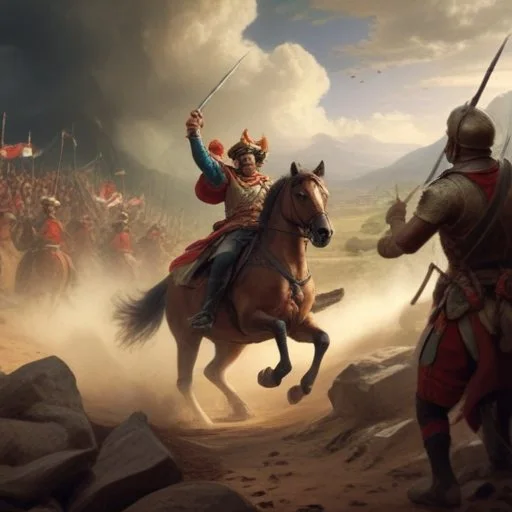
In the wake of Napoleon's downfall, the Spanish Empire teetered on the brink of collapse, and Bolívar saw an opportunity to strike a blow for independence. Assembling a multinational force of Venezuelans, Colombians, and British volunteers, Bolívar set his sights on the Spanish stronghold of Boyacá, a strategic valley nestled in the Andean highlands.
On August 7, 1819, the armies clashed in a frenzy of artillery fire, musket volleys, and cavalry charges. Bolívar's men, buoyed by their leader's infectious optimism and tactical genius, held their ground against the Spanish forces, whose superior numbers were offset by their lack of cohesion and morale.
The Spanish forces, reeling from the unexpected defeat, fled in disarray, leaving behind arms, ammunition, and their shattered dignity. Bolívar's army, jubilant in their victory, had secured a pivotal triumph that would resound throughout the continent.
The Battle of Boyacá ignited a wave of liberation that would spread across South America, inspiring similar uprisings in Venezuela, Ecuador, Peru, and Bolivia. Bolívar's unwavering commitment to the cause of independence had galvanized the region, paving the way for the creation of the Gran Colombia, a short-lived but influential republic that would eventually fragment into modern-day Colombia, Venezuela, Ecuador, and Panama.
Simón Bolívar's victory at Boyacá cemented his reputation as the Liberator, a champion of freedom and justice who had orchestrated a continent-wide uprising against the Spanish Empire. His legacy would inspire generations of Latin American leaders, writers, and intellectuals, shaping the course of the region's history and earning him a revered place in the pantheon of national heroes.
As the great Liberator himself once declared, ""The freedom of our lands is sacred, and we must defend it with our lives."
The site of the Battle of Boyacá, now a national monument, bears witness to the struggles and sacrifices of a bygone era. Today, it stands as a testament to the indomitable spirit of Bolívar and his men, a beacon of hope and freedom that continues to inspire countless Colombians and Latin Americans.
In the words of the revered Colombian poet, Rafael Pombo, ""The Battle of Boyacá was not just a battle, but a consecration of our national soul."
The road to the Battle of Boyacá was paved with a series of smaller skirmishes and battles that tested the mettle of Bolívar's troops. One such battle was the Battle of Vargas Swamp, fought on July 25, 1819, just weeks before the Battle of Boyacá. Although a tactical victory, the battle was marked by heavy casualties on both sides, and it was here that Bolívar's men began to realize the true cost of their struggle for independence.
In the aftermath of Vargas Swamp, Bolívar regrouped his forces and devised a new strategy to defeat the Spanish. He realized that a direct assault on the Spanish stronghold of Boyacá would be suicidal, so he opted for a surprise attack on the Spanish flank. This clever maneuver would prove to be the decisive factor in the Battle of Boyacá.

Colonel James Rooke: The Briton Who Fought for Bolívar
Among the many foreign volunteers who fought alongside Bolívar's troops was Colonel James Rooke, a British mercenary who would play a crucial role in the Battle of Boyacá. Rooke was a veteran of the Napoleonic Wars and had fought in several battles in Europe before joining Bolívar's army. His military expertise and bravery proved invaluable to Bolívar, who entrusted him with leading the cavalry charge that decided the outcome of the battle.
Rooke's decision to fight for Bolívar's cause was motivated by a desire for adventure and a sense of justice. He was deeply impressed by Bolívar's charisma and vision of a united and independent South America, and he saw the struggle as a way to make a meaningful contribution to the continent's liberation.
The Battle of Boyacá in Colombian Folklore
The Battle of Boyacá has become an integral part of Colombian folklore, with the event being commemorated in songs, poems, and stories. One popular folk tale tells of a young woman named María, who, disguised as a man, fought alongside Bolívar's troops and was killed in the battle. Her bravery and sacrifice have become a symbol of Colombian patriotism and are still celebrated today.
The battle has also inspired numerous works of art, including the famous painting "La Batalla de Boyacá" by Colombian artist Pedro Nel Gómez. The painting, which depicts the climactic moment of the battle, has become an iconic representation of Colombian identity and is displayed prominently in the country's national museum.

The Political Ramifications of the Battle of Boyacá
The Battle of Boyacá was a watershed moment in the struggle for Colombian independence, but its impact extended far beyond the borders of the country. The battle sent shockwaves throughout the Spanish Empire, forcing the Spanish authorities to reevaluate their strategies for maintaining control over their colonies.
The battle also had significant implications for the development of the Gran Colombia, a short-lived republic that would eventually fragment into modern-day Colombia, Venezuela, Ecuador, and Panama. Bolívar's vision of a unified South America was given a significant boost by the battle, and it paved the way for the creation of the Gran Colombia in 1821.
The Geopolitical Context of the Battle of Boyacá
The Battle of Boyacá took place against the backdrop of a rapidly changing global landscape. The Napoleonic Wars had weakened the Spanish Empire, creating an opportunity for independence movements to emerge across South America.
The battle was also influenced by the simmering rivalry between the Spanish Empire and the British Empire, which had long sought to expand its influence in the region. Bolívar's decision to accept British volunteers into his army was seen as a pragmatic move to counterbalance Spanish power, and it reflected the complex web of alliances and rivalries that characterized the geopolitics of the era.