


In a daring and decisive military campaign, Israeli forces claimed dominion over the coveted Golan Heights, a strategic plateau overlooking the Jordan River Valley, in a mere five days. This lightning-fast conquest, which took place in June 1967, would forever alter the region's geopolitical landscape, cementing Israel's presence in the area and igniting a long-standing territorial dispute with Syria.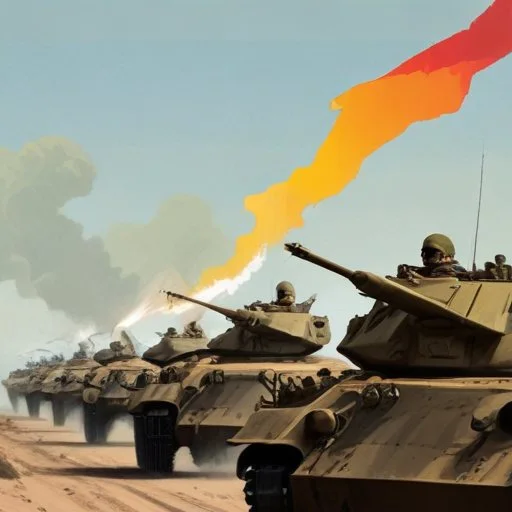
In the years leading up to the Six-Day War, tensions between Israel and its Arab neighbors had been escalating. Border disputes, skirmishes, and retaliatory raids had become increasingly frequent, creating a volatile atmosphere that threatened to boil over into full-scale conflict.
At the forefront of the Israeli campaign stood a triumvirate of stalwart leaders: Prime Minister Levi Eshkol, Defense Minister Moshe Dayan, and Chief of Staff Yitzhak Rabin. Their combined strategic acumen and military prowess would prove decisive in the face of Syrian resistance.
June 5, 1967: The war begins as Israeli Air Force jets launch a surprise attack on Egyptian airfields, crippling their adversary's air capabilities.
June 6, 1967: Israeli ground troops, including the vaunted Golani Brigade, push into the Golan Heights, meeting fierce resistance from Syrian forces.
June 9, 1967: Israeli forces breach Syrian defenses, capturing key towns and strongpoints, including the strategic Quneitra crossing.
June 10, 1967: The war ends with Israel in control of the Golan Heights, having secured a crushing victory over Syrian forces.
The capture of the Golan Heights had far-reaching consequences, solidifying Israel's position in the region and granting the nation a significant strategic advantage. The move also sparked a decades-long dispute with Syria, which continues to this day.
The swift and decisive victory galvanized Israeli society, fostering a sense of national pride and unity in the face of adversity. The campaign also inspired a surge in patriotism, with many Israelis rallying behind the military effort.
The capture of the Golan Heights remains a contentious issue, with many in the international community viewing the move as an illegal occupation. Israel, however, maintains that the territory was seized in a defensive war, and that its continued control is necessary for national security.
"The Golan Heights is ours, and we will not relinquish it." – Moshe Dayan, Israeli Defense Minister
"We fought a just war, and we won." – Yitzhak Rabin, Israeli Chief of Staff
The Six-Day War, and Israel's capture of the Golan Heights, marked a turning point in the Middle East conflict, ushering in a new era of tension and confrontation between Israel and its Arab neighbors. This Brief but intense conflict would serve as a blueprint for future battles, shaping the region's military strategies and diplomatic landscape.
For those who fought on the Golan Heights, the memory of the war remains etched in their collective consciousness, a testament to the bravery and sacrifice of Israeli soldiers. As one veteran recalls, "We were a handful of brave men, facing an enemy entrenched in the hills. But we were driven by a sense of duty, and a determination to defend our homeland."
The capture of the Golan Heights has had far-reaching implications, influencing the trajectory of Middle East politics and diplomacy. The region's complex dynamics, shaped in part by this pivotal event, continue to evolve, as nations and peoples grapple with the consequences of this fateful war.
Hidden beneath the rubble of the Golan Heights lies the forgotten city of Quneitra, a once-thriving metropolis that served as the Syrian Army's regional headquarters. Founded in the Ottoman era, Quneitra's strategic location overlooking the Jordan River Valley made it a prized possession for regional powers.
In the years leading up to the Six-Day War, Quneitra had grown into a bustling commercial center, with its marketplaces filled with merchants from across the Middle East. The city's residents, a mix of Arab and Druze populations, lived in relative harmony, their daily lives untouched by the escalating tensions between Israel and Syria.

Moshe Dayan, Israel's enigmatic Defense Minister, remains an enduring symbol of Israeli military prowess. Born in 1915, Dayan's early life was marked by a passion for the Hebrew language and a deep connection to the land of Israel.
As a young soldier, Dayan fought alongside the British during World War II, where he lost an eye in combat. This physical scar would become a defining feature of his public persona, reinforcing his reputation as a battle-hardened warrior.
The Six-Day War saw Israel capture two strategically vital regions: the Golan Heights and the Sinai Peninsula. While both areas shared a common fate as spoils of war, their historical contexts and subsequent impact on the region differ significantly.
The Sinai Peninsula, seized from Egypt, posed a significant economic burden on Israel, with the region's lucrative oil fields and Suez Canal access becoming a major point of contention.

The swift capture of the Golan Heights sparked a cultural awakening in Israel, as the nation's artistic and literary communities responded to the triumph with renewed creativity.
In the war's aftermath, Israeli novelists, poets, and playwrights drew inspiration from the conflict, crafting works that explored themes of nationalism, identity, and the human cost of war.
The Golan Heights, situated at the crossroads of the Middle East, has long been a focal point of regional tensions. Bordering Lebanon, Syria, Jordan, and Israel, the plateau's strategic importance is undeniable.
The region's complex web of alliances and rivalries, combined with the Cold War's broader geopolitical landscape, created an environment in which a small spark could ignite a global conflict.