


The Katyn massacre, a haunting testament to the brutality of the Soviet regime, was born from a single, chilling order signed by six high-ranking members of the Soviet politburo, including the infamous Joseph Stalin. This fateful decree would condemn 25,700 Polish intellectuals, including 14,700 prisoners of war, to a gruesome fate, leaving an indelible mark on the annals of history.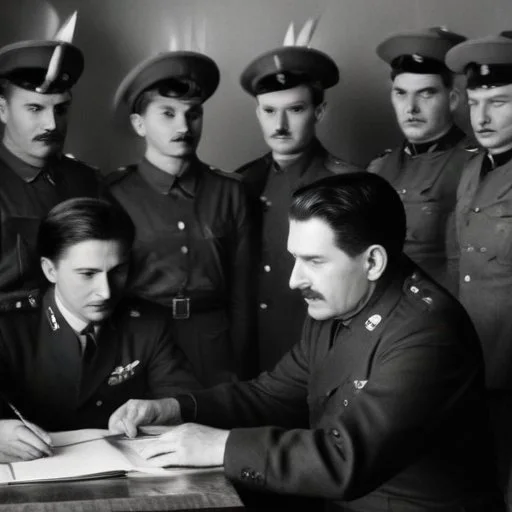
In the aftermath of the German-Soviet invasion of Poland in 1939, the Soviet Union annexed eastern Poland, and the NKVD (Soviet secret police) rounded up Polish intellectuals, officers, and members of the elite classes. These prisoners were detained in three special camps, where they awaited an uncertain fate.
On March 5, 1940, the six politburo members, including Stalin, Voroshilov, Molotov, Mikoyan, Beria, and Kaganovich, signed the order, sealing the fate of the Polish prisoners. This decree, hidden from the world for decades, was only declassified in 1990, when the Soviet Union officially acknowledged the massacre.
In the following weeks, the NKVD carried out the executions, mostly by gunshot to the back of the head, in the Katyn Forest, near Smolensk, Russia. The bodies were then hastily buried in mass graves, often with their hands tied behind their backs. The meticulous planning and ruthless efficiency of the massacre sent shockwaves through the Polish community, leaving a deep scar that would take decades to heal.
In the years that followed, the Soviet Union falsified the evidence, blaming the Germans for the atrocity. The lie was so convincing that even the Polish government-in-exile was deceived. It wasn't until 1943, when German forces discovered the mass graves, that the truth began to unravel. However, the Soviet Union continued to deny responsibility until the 1990s.
The Katyn massacre had profound implications for Polish-Soviet relations, fostering a sense of mistrust and tension that persisted for decades. The event also became a powerful symbol of resistance against Soviet oppression, inspiring generations of Poles to fight for their freedom and independence.
Stanisław Swianiewicz, a Polish officer who survived the massacre, wrote a poignant account of the events, detailing the brutal treatment of the prisoners and the endless uncertainty that hung over them like a specter of death. His testimony, along with others, provides a haunting glimpse into the human cost of the Katyn massacre.
The Katyn massacre serves as a stark reminder of the dangers of totalitarianism and the importance of protecting human rights. Today, the event is commemorated by memorials and museums in Poland and around the world, ensuring that the tragedy is never forgotten and that its lessons are learned for generations to come.
The Katyn massacre is a somber reminder of the devastating consequences of unchecked power and the importance of preserving human dignity in the face of oppression.
As we reflect on this dark chapter in history, we are reminded that even in the darkest of times, there is always hope for redemption and forgiveness. The Katyn massacre serves as a poignant reminder of the importance of protecting human life, democratic values, and the pursuit of truth.
The Soviet Union's annexation of eastern Poland in 1939 was not an isolated event, but rather a culmination of their long-standing territorial ambitions. The Molotov-Ribbentrop Pact, a non-aggression agreement between the Soviet Union and Nazi Germany, had secretly divided Eastern Europe into Soviet and German spheres of influence. The pact effectively gave the Soviet Union a free hand to annex Eastern Poland, which they did on September 17, 1939.
The subsequent occupation of Poland led to widespread repression, with the Soviet authorities seeking to eradicate any potential threats to their rule. The NKVD, the Soviet secret police, played a pivotal role in this process, arresting and imprisoning thousands of Polish citizens, including intellectuals, politicians, and members of the military.
The imprisonment of these individuals was not an ad-hoc decision, but rather a deliberate strategy to decapitate the Polish nation and prevent any potential resistance to Soviet rule. The Soviet authorities were determined to erase Poland's cultural and intellectual heritage, and the imprisonment of these individuals was a crucial step in this process.
Lavrentiy Beria, the ruthless head of the NKVD, was the mastermind behind the Katyn massacre. Born in 1899 in Georgia, Beria rose through the ranks of the Soviet secret police, earning a reputation for his cunning and brutality.
Beria's role in the Katyn massacre was instrumental, as he oversaw the planning and execution of the operation. He was responsible for selecting the victims, coordinating the logistics of the massacre, and ensuring that the operation was carried out with utmost secrecy.
Beria's motivations for the massacre were twofold. Firstly, he sought to eliminate any potential threats to Soviet rule in Poland. Secondly, he aimed to demonstrate his loyalty to Stalin, who had recently appointed him as the head of the NKVD.
The Katyn massacre had a profound impact on Polish culture, leading to a surge in nationalist sentiment and anti-Soviet feelings. The tragedy became a powerful symbol of resistance against Soviet oppression, inspiring generations of Poles to fight for their freedom and independence.
In the decades that followed, the Katyn massacre was commemorated in numerous works of literature, art, and music. Polish writers, such as Czesław Miłosz and Tadeusz Borowski, wrote poignant accounts of the tragedy, while artists and musicians created works that honored the victims.
The cultural impact of the Katyn massacre was not limited to Poland alone. The tragedy resonated with people across the world, serving as a stark reminder of the atrocities that could be committed by totalitarian regimes.
The Katyn massacre was a stark manifestation of the ideological differences between the Soviet Union and Poland. The Soviet authorities viewed Poland as a bourgeois state that needed to be transformed into a socialist society, whereas the Poles saw themselves as a distinct nation with their own cultural and historical heritage.
The massacre was, in many ways, a product of the Soviet Union's ideological dogma, which emphasized the need for class struggle and the elimination of "enemies of the state." The Soviet authorities believed that the Polish intellectuals and officers were a threat to the spread of communism, and therefore, they needed to be eliminated.
The Katyn massacre served as a stark reminder of the dangers of ideological extremism, highlighting the need for democratic values and human rights to be protected at all costs.
The Katyn massacre was not an isolated event, but rather part of a broader pattern of violence and repression that characterized the Soviet Union's relations with Eastern Europe. The Soviet authorities saw Eastern Europe as a vital sphere of influence, and they were willing to use any means necessary to maintain their control over the region.
The massacre was also a reflection of the Soviet Union's deep-seated fear of Polish nationalism, which had long been a thorn in the side of the Soviet authorities. The Poles had a long history of resistance against foreign occupation, and the Soviet authorities were determined to crush this spirit of resistance once and for all.
The Katyn massacre had significant geopolitical implications, contributing to the souring of relations between the Soviet Union and the Western powers. The massacre was seen as a brutal reminder of the Soviet Union's disregard for human life and its willingness to use violence to achieve its goals.