


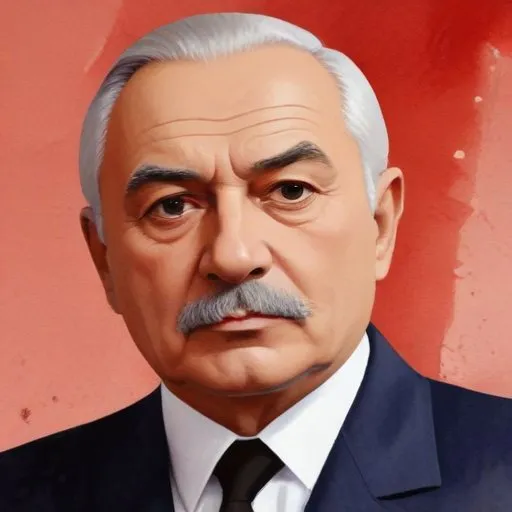
A skilled politician who played a crucial role in Soviet politics, serving as the head of state and a close ally to Soviet leaders, including Stalin and Khrushchev. He's known for his adaptability and ability to navigate the treacherous waters of Soviet politics.
Anastas Ivanovich Mikoyan, a Soviet politician and revolutionary, is renowned for being the only Soviet figure to maintain his position at the highest levels of power from the era of Lenin to Brezhnev. Born on November 13, 1895, in the village of Sanahin, Armenia, Mikoyan's illustrious career spanned over six decades, leaving an indelible mark on Soviet politics and international relations.
Mikoyan joined the Bolsheviks in 1915 and actively participated in the Baku Commune following the October Revolution of 1917. His early involvement in the Communist Party earned him a spot on the Central Committee in 1923, where he remained a prominent figure for decades to come.
Mikoyan's political prowess was evident in the 1920s, when he became the party's boss in the North Caucasus. This tenure was followed by his election to the Politburo in 1935, solidifying his position as a key player in Soviet politics. He served as foreign trade minister from 1926 to 1930 and again from 1938, demonstrating his versatility and adaptability in governance.
During World War II, Mikoyan played a pivotal role as a member of the State Defense Committee, working closely with Stalin to coordinate the Soviet war effort. His leadership and strategic thinking contributed significantly to the Soviet Union's ultimate victory.
Following the war, Mikoyan's fortunes took a turn for the worse. He lost his position as minister in 1949 and faced criticism from Stalin at the 19th Party Congress in 1952. However, after Stalin's death in 1953, Mikoyan sided with Khrushchev in the subsequent power struggle, demonstrating his cunning and ability to adapt to changing circumstances.
Under Khrushchev, Mikoyan played a crucial role in shaping Soviet foreign policy. He made several pivotal trips to the United States and communist Cuba, exercising his exceptional diplomatic skills to further Soviet interests. His efforts in de-Stalinization, aimed at reversing the excesses of Stalin's regime, helped to reform the Soviet system.
In 1964, Khrushchev's ousting brought Brezhnev to power, and Mikoyan briefly served as Chairman of the Presidium of the Supreme Soviet, the nominal head of state. His forced retirement in 1965 marked the end of an era, but his contributions to Soviet politics and international relations continue to be felt today.
"The Soviet system is not a system of government, it is a system of justice."
Anastas Mikoyan's remarkable career, marked by adaptability, cunning, and diplomacy, has left an indelible mark on Soviet politics and international relations. His ability to navigate the treacherous landscape of Soviet power struggles, while maintaining his commitment to communist ideology, continues to inspire and intrigue scholars and historians today.
Mikoyan's contemporaries, such as Stalin, Khrushchev, and Brezhnev, were often defined by their authoritarianism and ruthlessness. In contrast, Mikoyan's diplomatic skills, adaptability, and commitment to reform set him apart as a unique figure in Soviet politics.

Did you know that Mikoyan was an ethnic Armenian, and his family was of modest means?
Mikoyan received numerous awards and honors for his service to the Soviet Union, including the Order of Lenin and the Order of the October Revolution.
Mikoyan's experiences and insights have contributed significantly to our understanding of Soviet politics, international relations, and the complexities of communism. His legacy continues to shape academic discourse and inspire new generations of scholars.
Mikoyan's remarkable resilience, adaptability, and commitment to reform serve as a powerful reminder of the importance of perseverance and dedication in the face of adversity.
Born in 1878
The Soviet Union's ruthless leader who ruled with an iron fist, implementing policies that led to widespread famine and purges, while also playing a crucial role in defeating Nazi Germany in World War II.
Born in 1890
A Soviet Minister of Foreign Affairs who played a crucial role in shaping the country's foreign policy during World War II and the early Cold War era, known for his diplomatic skills and signature cocktails.
Born in 1899
Soviet Union's ruthless secret police chief, responsible for millions of deaths and brutal suppressions during Stalin's regime, known for his cunning and feared reputation.
Born in 1894
The Soviet leader who initiated reforms and denounced Stalin's regime, known for his bold policies and iconic shoe-banging incident at the UN.
Born in 1879
Founded the Red Army and played a crucial role in the Russian Revolution, shaping the course of modern communism. A key figure in 20th-century politics and ideology.
Born in 1895
Soviet politician who served as Premier of the Soviet Union during the Khrushchev era, known for his role in implementing economic reforms and reducing Stalin-era repression.
Born in 1909
Soviet Minister of Foreign Affairs who played a crucial role in shaping the country's foreign policy during the Cold War, known for his diplomatic skills and ability to navigate complex international relations.
