


The Soviet Presidium and the Communist Party Central Committee's decision to accept Nikita Khrushchev's voluntary request to retire from his offices in 1964 marked the end of an era in Soviet politics. This event, known for its subtle yet significant implications, brought about a new chapter in the Soviet Union's history, one that would be characterized by a shift in power dynamics and a reevaluation of the country's domestic and foreign policies.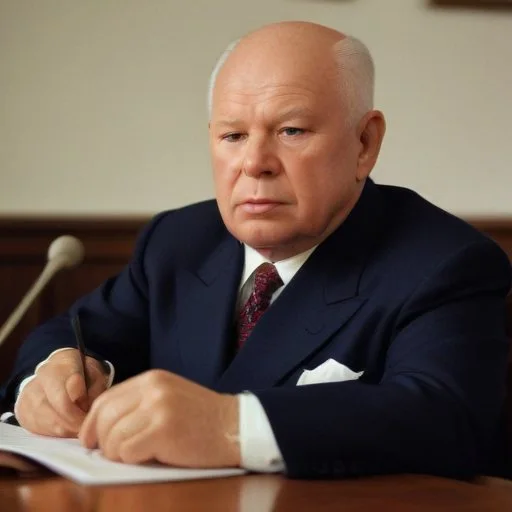
Khrushchev, a prominent figure in Soviet politics, rose to power in the aftermath of Stalin's death in 1953. He was instrumental in introducing reforms aimed at liberalizing the Soviet economy and society, earning him the title of "mastermind behind Soviet reforms." However, his erratic behavior, failed agricultural policies, and increasing isolation from the Party ultimately led to his downfall.
The Presidium and Central Committee, two of the most powerful institutions in the Soviet Union, played a crucial role in Khrushchev's forced retirement. Leonid Brezhnev and Alexei Kosygin, two of Khrushchev's most trusted allies, led the charge against him, convincing their comrades that it was time for a change. By accepting Khrushchev's voluntary retirement, the Soviet leadership effectively ousted him, marking the end of an era and ushering in a new era of Soviet politics.
The aftermath of Khrushchev's retirement saw a significant shift in power dynamics within the Soviet Union. Leonid Brezhnev, who played a key role in Khrushchev's ousting, went on to become the General Secretary of the Communist Party, a position he held until 1982. This marked the beginning of a new era in Soviet politics, characterized by a more conservative approach to domestic and foreign policies.
Khrushchev's retirement had significant cultural and social implications, both within the Soviet Union and abroad. The event was closely watched by the international community, with many viewing it as a sign of the Soviet Union's commitment to reform and liberalization.
In conclusion, the Soviet Presidium and the Communist Party Central Committee's decision to accept Nikita Khrushchev's voluntary request to retire from his offices marked a significant turning point in Soviet politics. This event, characterized by its subtlety and complexity, highlights the importance of collective leadership and the dangers of authoritarian rule, providing valuable lessons for politicians and policymakers around the world.
Khrushchev's rise to power was marked by his reputation as a fierce critic of Stalin's regime. He was known for his introspective and emotional personality, often wearing his heart on his sleeve.
Despite his liberal policies, Khrushchev was also infamous for his erratic behavior, often making impulsive decisions that put the Soviet Union on a path of unpredictability.
His leadership style was a mix of authoritarianism and populism, earning him both admiration and criticism from the Soviet people.

Khrushchev's reforms had a profound impact on Soviet culture, ushering in a era of relative liberalization and cultural thaw.
The relaxation of censorship laws led to a resurgence of Soviet literature and art, with writers like Aleksandr Solzhenitsyn and Andrei Sakharov gaining international recognition.
The reforms also paved the way for the emergence of new cultural icons, such as the Soviet rock band, Zemlyane.
The events leading up to Khrushchev's forced retirement were marked by a fierce power struggle within the Soviet Presidium.
Brezhnev and Kosygin, two of Khrushchev's closest allies, began to secretly gather support among the Party ranks, exploiting Khrushchev's growing unpopularity.
The final blow came when Khrushchev's own speeches and policies were used against him, portraying him as erratic and unfit for leadership.

The aftermath of Khrushchev's retirement saw a significant shift in the Soviet Union's foreign policy, with Brezhnev adopting a more hardline approach to relations with the West.
The event was closely watched by the international community, with many viewing it as a sign of the Soviet Union's commitment to reform and liberalization.
The Soviet Union's relations with Eastern European satellite states also underwent a significant transformation, with a renewed emphasis on collective security and socialist solidarity.
In 1956, Khrushchev delivered a secret speech to the 20th Party Congress, denouncing Stalin's cult of personality and detailing the atrocities committed during his rule.
The speech, which was not made public until 1989, revealed the deep-seated fears and insecurities of the Soviet leadership, highlighting the dangers of authoritarian rule.
The speech also underscored Khrushchev's own ambivalence towards Stalin's legacy, reflecting the complexities and contradictions of the Soviet system.