


On a fateful day in May 1588, a behemoth of a fleet set sail from Lisbon, Portugal, changing the tides of history forever. The Spanish Armada, boasting an unprecedented 130 ships and 30,000 men, embarked on a perilous journey to claim the English throne, leaving destruction and chaos in its wake.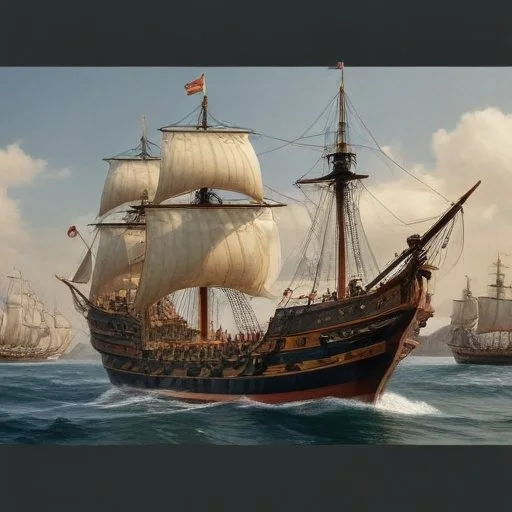
Assembled by King Philip II of Spain, the Armada was a demonstration of naval power and engineering prowess. The sheer scale of the fleet was awe-inspiring, with towering galleons, agile pinnaces, and sturdy merchant vessels, all outfitted with state-of-the-art artillery and manned by seasoned sailors and soldiers. The Armada was an instrument of war, designed to intimidate and overwhelm its enemies.
The Armada's daunting task was to escort the Duke of Parma's army from the Netherlands to invade England, a mission that would overthrow the "heretic" Queen Elizabeth I and restore Catholic dominance. The Spanish monarchy was determined to crush the Protestant uprising and assert its authority over the British Isles.
The Spanish Armada's crushing defeat marked a turning point in naval warfare, as the English navy's innovative tactics and superior seamanship proved decisive. The debacle cost Spain dearly, with thousands of lives lost, ships sunk or captured, and a crippling blow to its economy and prestige. The Armada's failure paved the way for England's rise as a dominant maritime power, forever altering the course of history.
The Spanish Armada's ill-fated expedition serves as a testament to the unpredictable nature of war and the unforgiving power of the sea. This maritime masterpiece of devastating proportions continues to captivate and educate, a poignant reminder of humanity's unrelenting pursuit of power and dominance.
The Spanish Armada's failure had a devastating impact on the Spanish economy. The estimated cost of the Armada's construction and maintenance was around 10 million ducats, a staggering amount that drained the Spanish treasury. The losses incurred during the campaign, including the sinking or capture of over 30 ships, further exacerbated the economic burden. The failure of the Armada led to a significant decline in Spanish economic power, making it difficult for the country to recover from the financial strain.
In addition, the Armada's defeat led to a decline in Spanish trade and commerce. The English navy's dominance of the seas meant that Spanish merchant ships were vulnerable to attack and seizure, resulting in a significant loss of revenue. The decline of Spanish trade and commerce had a ripple effect on the entire European economy, leading to a period of economic instability in the late 16th century.

Alejandro Farnese, the Duke of Parma, was a seasoned military commander who played a crucial role in the Spanish Armada's invasion plans. Born in 1545, Farnese was a member of the esteemed House of Farnese and was known for his tactical genius and military prowess. He had fought in several battles against the Dutch and was instrumental in planning the Armada's invasion of England.
Despite his impressive military credentials, Farnese was unable to execute the invasion plans due to the Armada's defeat. He died in 1592, four years after the Armada's failure, and his legacy was forever marred by the disaster.
The Spanish Armada's defeat marked a significant turning point in the development of naval warfare. The English navy's innovative tactics, which included the use of smaller, faster ships and incendiary devices, proved to be highly effective against the Spanish galleons. This led to a shift in naval warfare strategies, with an increased focus on speed and maneuverability.
The Armada's failure also led to significant advances in ship design and construction. The development of more agile and seaworthy ships enabled navies to operate in more treacherous waters, leading to a expansion of maritime trade and exploration.
The Spanish Armada's invasion plans were not only driven by a desire to overthrow Queen Elizabeth I but also by a broader geopolitical context. The late 16th century was a time of intense rivalry between European powers, with Spain, England, France, and Portugal vying for dominance.
The Armada's failure marked a significant shift in the balance of power, with England emerging as a major naval power. This led to a period of increased tensions between England and Spain, which would continue for centuries to come.
Historiographical accounts of the Spanish Armada's defeat have often been influenced by nationalist and ideological biases. English historians have traditionally portrayed the Armada's defeat as a triumph of Protestant England over Catholic Spain, while Spanish historians have viewed it as a tragic defeat that marked the beginning of Spain's decline.
In recent years, historians have sought to move beyond these nationalist narratives, instead focusing on the complex interplay of factors that contributed to the Armada's defeat. This more nuanced approach has led to a greater understanding of the event's significance and its impact on European history.