


On March 28, 1939, the city of Madrid, battered and bruised, finally surrendered to the Nationalist forces led by Generalissimo Francisco Franco, marking the end of a grueling three-year siege. This pivotal event in the Spanish Civil War marked the beginning of a long and tumultuous era in Spanish history, as Franco's regime would go on to impose a ruthless dictatorship that would last for nearly four decades.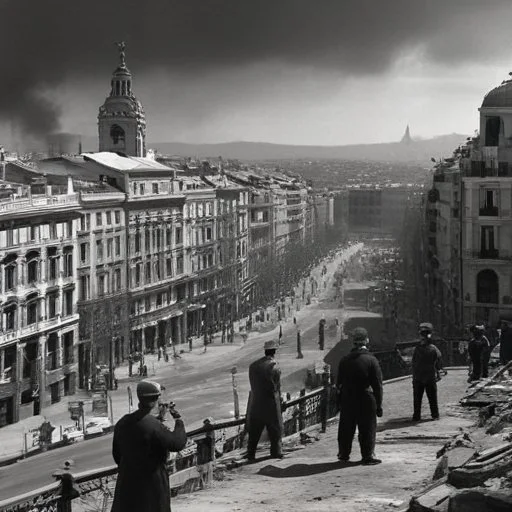
The Spanish Civil War, sparked in 1936, was a complex and multifaceted conflict that pitted the democratically-elected government of the Second Spanish Republic against the Nationalist forces, comprised of monarchists, fascists, and conservatives. Franco, a skilled and ambitious military leader, emerged as the dominant figure of the Nationalist camp, determined to crush the Republican government and establish a authoritarian regime.
In November 1936, Franco's forces laid siege to Madrid, intent on capturing the strategic capital and crushing the Republican government. The siege lasted for three long years, with both sides suffering heavy losses and civilians caught in the crossfire. The city was reduced to rubble, with food and supplies scarce, and the once-vibrant streets became a testament to the devastating power of war.
Aside from Franco, other key figures played crucial roles in the Nationalist camp, including General Emilio Mola, General Juan Yagüe, and the German and Italian military advisors who provided crucial support. Meanwhile, the Republican government, led by Prime Minister Juan Negrín, received aid from the Soviet Union and international volunteers, including the famous International Brigades.
After three years of relentless bombardment, the Republican defenses finally collapsed, and Franco's forces poured into the city. The fall of Madrid marked the effective end of the Spanish Civil War, with the remaining Republican strongholds soon falling to the Nationalist forces. Franco's regime was consolidated, and a dark era of repression and dictatorship began.
The conquest of Madrid and the subsequent establishment of Franco's regime had far-reaching consequences for Spain and beyond. The war led to the deaths of an estimated 500,000 people, with many more forced into exile or silenced by the regime's brutal suppression of dissent. The legacy of Franco's dictatorship continues to shape modern Spanish politics and society, with ongoing debates about memory, justice, and accountability.
"Madrid, the capital of the Spanish Republic, has fallen... The blood of its people has fertilized the soil of our glorious Spain." - Francisco Franco, March 28, 1939
As the dust settled on the ruins of Madrid, Franco's words echoed through the city, a cold and calculating reminder of the brutal price paid for his victory. The conquest of Madrid remains a powerful symbol of the devastating consequences of war, dictatorship, and the unbridled pursuit of power.
The siege of Madrid was a brutal and relentless campaign that lasted for 872 days, making it one of the longest siege in modern history. The Nationalist forces, led by General Franco, employed a scorched earth policy, targeting civilian populations and infrastructure to weaken the Republican government. The city's defenses were breached multiple times, but the Republican forces, aided by the International Brigades, managed to hold on until the very end.
The fall of Madrid marked a turning point in the Spanish Civil War, as it paved the way for the Nationalist forces to capture the remaining Republican strongholds. The city's surrender was followed by a wave of executions, imprisonments, and forced exiles, as Franco's regime sought to eliminate any opposition to its rule.
The siege of Madrid also had a profound impact on the city's civilian population, with an estimated 20,000 civilians killed and many more displaced. The city's infrastructure was severely damaged, with entire neighborhoods reduced to rubble. The siege also had a devastating impact on the city's cultural heritage, with many historical landmarks and cultural institutions destroyed or looted.

General Emilio Mola was a key figure in the Nationalist camp, serving as the chief strategist and tactician during the siege of Madrid. A seasoned military leader, Mola was known for his cunning and brutality, earning him the nickname "The Butcher of the North."
Mola's role in the siege of Madrid was instrumental, as he orchestrated the initial assault on the city and continued to lead the Nationalist forces until his death in 1937. His military prowess and strategic thinking were instrumental in breaking the Republican defenses, paving the way for Franco's eventual victory.
Despite his crucial role in the Nationalist victory, Mola's legacy is tarnished by his brutal tactics and human rights abuses. He remains a controversial figure in Spanish history, symbolizing the darker aspects of the Spanish Civil War.
The conquest of Madrid had a profound impact on Spanish culture, as Franco's regime sought to erase the cultural and intellectual heritage of the Second Republic. The regime's censorship and repression led to a brain drain, as many prominent artists, writers, and intellectuals fled the country or were forced into exile.
The fall of Madrid also marked the beginning of a dark era for Spanish cinema, as the regime imposed strict censorship and control over the film industry. Many filmmakers were forced to flee the country, and those who remained were forced to produce propaganda films that promoted the regime's ideology.
Despite the regime's efforts to suppress it, Spanish culture continued to thrive in exile, with many artists and intellectuals continuing to produce works that reflected the values and ideals of the Second Republic. The legacy of Spanish culture continues to be felt today, with many artists and intellectuals drawing inspiration from the country's rich cultural heritage.
The fall of Madrid marked a significant turning point in Spanish politics, as Franco's regime consolidated its power and established a authoritarian state. The regime's suppression of dissent and opposition led to a decades-long period of political repression, during which many Spaniards were forced to live in fear of persecution.
The conquest of Madrid also had far-reaching consequences for European politics, as it marked the beginning of a period of fascist and authoritarian regimes that would dominate the continent for decades to come. The regime's close ties with Nazi Germany and Fascist Italy further solidified its position as a key player in the Axis powers.
Despite the regime's efforts to suppress it, opposition to Franco's rule continued to simmer, with many Spaniards continuing to resist the regime's authoritarianism and demanding greater political freedoms.
The conquest of Madrid was not an isolated event, but rather part of a broader geopolitical context that saw the rise of fascist and authoritarian regimes across Europe. The regime's close ties with Nazi Germany and Fascist Italy further solidified its position as a key player in the Axis powers.
The fall of Madrid also had significant implications for the global balance of power, as it marked the beginning of a period of fascist and authoritarian dominance that would last for decades to come. The regime's suppression of dissent and opposition led to a wave of refugees and exiles, many of whom fled to the Soviet Union and other countries.
The conquest of Madrid also had significant implications for the Spanish-American War, as it paved the way for Franco's regime to establish close ties with the United States and other Western powers.