


Rome, the Eternal City, was left scarred and battered on May 6, 1527, as Spanish and German troops stormed its gates, marking the end of an era – the Renaissance. This brutal event, which lasted for eight days, was a catastrophic culmination of power struggles, unpaid mercenary wages, and the Holy Roman Emperor's broken promises.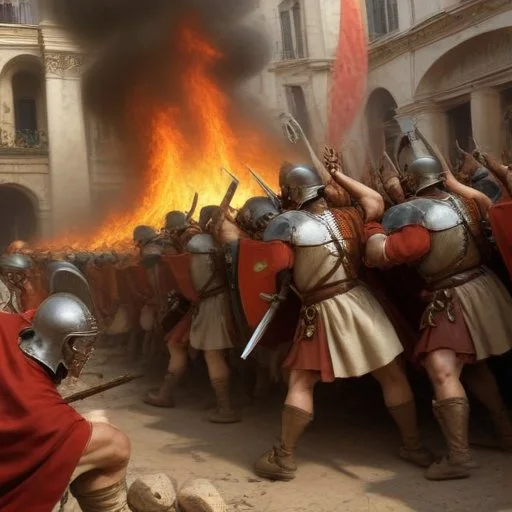
The ingredients for disaster were in place long before the fateful day. Charles V, the Holy Roman Emperor, had promised his mercenary forces a handsome sum for their services, but defaulted on his payments, leaving them to seek compensation in Rome's riches. The city, already vulnerable due to the weak leadership of Pope Clement VII, was now at the mercy of these unpaid and hungry soldiers.
As the Spanish and German troops poured into Rome, the city's defenses crumbled. The once-majestic walls, which had withstood countless sieges, were breached, and the troops surged in, driven by greed and chaos. The Pope, trapped in the Castel Sant'Angelo, pleaded for mercy, but his cries fell on deaf ears.
For eight days, Rome burned, its cultural treasures looted or destroyed. The Vatican Library, a repository of ancient knowledge, was ravaged, and priceless artifacts were lost forever. The city's inhabitants, caught in the crossfire, were subjected to unspeakable atrocities, as the troops ran amok, leaving a trail of destruction in their wake.
The Sack of Rome marked the end of the Renaissance, an era of cultural and artistic revival that had flourished in Italy for over a century. The city, once the beacon of humanism, was now a shadow of its former self, its beauty and grandeur lost forever. The event sent shockwaves throughout Europe, and the repercussions were felt for generations to come.
The Sack of Rome was not just a mindless act of violence; it was the result of a complex web of power struggles, ambition, and greed. Charles V, Pope Clement VII, and the mercenary leaders all played a role in this tragic event, each driven by their own agendas and desires.
The Sack of Rome left an indelible mark on history, serving as a stark reminder of the devastating consequences of unchecked power and ambition. The event inspired a new generation of artists, writers, and thinkers, who would go on to shape the course of European history.
The Sack of Rome was more than just a brutal event; it was the end of an era, a poignant reminder of the transience of human achievement and the devastating consequences of unchecked power. As the dust settled on the ravaged city, the world was left to ponder the fragility of civilization and the impermanence of greatness.
Pope Clement VII, the ruler of the papal states, was a key figure in the events leading up to the Sack of Rome. His weak leadership and vacillation in the face of Charles V's demands created an opportunity for the imperial forces to strike. Despite his pleas for mercy, the Pope was trapped in the Castel Sant'Angelo, powerless to stop the carnage. and his failure to forge alliances with other Italian city-states ultimately sealed Rome's fate.
However, Pope Clement VII's actions were not entirely without merit. He was a patron of the arts and a supporter of the Renaissance humanists. His court attracted scholars and artists from across Europe, and he was known for his intelligence and diplomatic skills. Despite these qualities, his leadership during the crisis was ineffective, and he was eventually forced to surrender to Charles V.
The Sack of Rome had a profound impact on Renaissance art and culture. The destruction of the city's cultural treasures and the displacement of artists and intellectuals led to a diaspora of talent across Europe. Many artists, including Michelangelo and Raphael, fled Rome and settled in other cities, spreading their skills and influencing local art styles. The trauma of the Sack also inspired a new wave of artistic innovation, as artists sought to express the horror and devastation they had witnessed.
The event also led to a shift in the patronage of the arts, as the Medici family's dominance in Florence began to wane. The Sack of Rome marked the beginning of a new era of artistic and cultural development, as European cities competed for the services of the best artists and intellectuals.
The Sack of Rome was not an isolated event, but rather a symptom of the larger geopolitical tensions in Europe during the 16th century. The Holy Roman Empire, under Charles V, was engaged in a bitter struggle with the French monarchy for dominance over the continent. The Italian city-states, including Rome, were caught in the middle of this conflict, and their fragile alliances and city-state politics made them vulnerable to external pressures.
The Sack of Rome was also influenced by the rise of the Ottoman Empire, which had been making inroads into Eastern Europe and the Mediterranean. The fear of Ottoman expansion created an atmosphere of tension and instability, which contributed to the outbreak of violence in Rome.

The Sack of Rome was a culmination of a complex web of power struggles between the Holy Roman Empire, the Papal States, and the Italian city-states. Charles V, the Holy Roman Emperor, sought to assert his dominance over the Italian peninsula, while the Pope and the Italian city-states resisted his encroachment. The imperial forces, led by Charles III, Duke of Bourbon, were determined to capture Rome and assert the Empire's authority.
The Sack of Rome was also motivated by a desire to plunder the city's riches and treasures. The mercenary forces, led by the condottiero Georg von Frundsberg, were owed back wages by Charles V and saw the Sack as an opportunity to claim their dues. The event was a brutal reminder of the fragility of power and the ease with which it could be overturned.
The Sack of Rome resulted in the destruction of the Vatican Library, one of the greatest cultural treasures of the Renaissance. The library, which was housed in the Vatican Palace, contained a vast collection of ancient manuscripts and books. The imperial forces, driven by greed and chaos, plundered the library, destroying or selling many of its precious volumes.
Among the losses were irreplaceable manuscripts of ancient Greek and Roman authors, as well as rare texts on mathematics, astronomy, and medicine. The destruction of the Vatican Library was a devastating blow to the intellectual and cultural life of Europe, and its impact was felt for centuries to come.