


In the scorching summer of 1936, the world witnessed a monumental moment in sports history as Jesse Owens, an African American athlete from the United States, clinched his fourth gold medal at the Berlin Summer Olympics, etching his name in the annals of history. This remarkable feat not only shattered records but also defied the notions of racial supremacy propagated by the host country, Nazi Germany.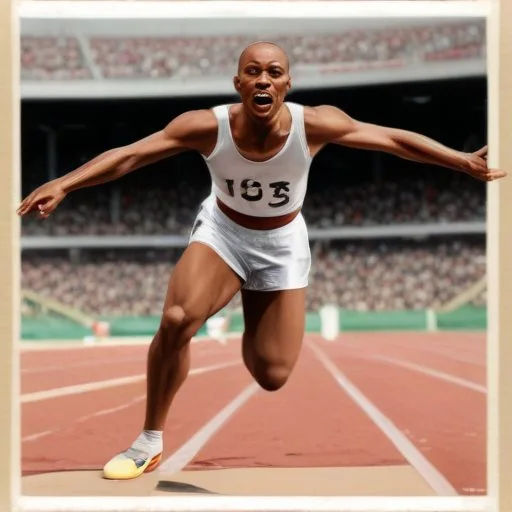
Jesse Owens, a talented athlete from Ohio, began making waves in the track and field world during his college days at Ohio State University. His impressive performances earned him a spot in the 1936 US Olympic team, which was bound for Berlin, Germany. The stage was set for Owens to take on the best athletes from around the world and prove his mettle.
The 1936 Summer Olympics, held from August 1 to August 16, 1936, witnessed Owens' mesmerizing performances in the track and field events. He won his first gold medal in the 100-meter dash, clocking an impressive 10.3 seconds, thus setting a new world record. Next, he dominated the 200-meter dash, securing his second gold medal, and followed it up with a stunning performance in the 4x100-meter relay, bagging his third gold medal.
The long jump event, held on August 4, 1936, was Owens' last hurdle to clear. With a remarkable leap of 26 feet 5.25 inches, he secured his historic fourth gold medal, leaving the crowd in awe. This achievement not only cemented Owens' status as a legendary athlete but also delivered a powerful rebuke to the Nazi regime's ideology of Aryan supremacy.
Jesse Owens' quadruple gold medal win had far-reaching implications, transcending the realm of sports. His triumph served as a beacon of hope and inspiration for African Americans, who faced rampant discrimination and racism in the United States. Owens' achievement also sparked a wave of pride and solidarity among people of color worldwide, resonating as a symbol of resistance against oppression.
"I always loved running. It was something you could do by yourself, and under your own power. You could go in any direction, fast or slow as you wanted, fighting the wind if you felt like it, seeking out new sights just on the strength of your feet and the openness of the spaces in front of you."
- Jesse Owens
Jesse Owens' historic quadruple gold medal win at the 1936 Summer Olympics continues to inspire generations of athletes, scholars, and social activists. His remarkable achievement serves as a poignant reminder of the power of human resilience, determination, and the indomitable spirit. As we reflect on this momentous occasion, we honor the legacy of Jesse Owens, an American hero who continues to ignite hope and pride in the hearts of people worldwide.
The 1936 Summer Olympics in Berlin, Germany, were initially awarded to the city in 1931, before the Nazi Party rose to power. However, when the Nazis came to power in 1933, the International Olympic Committee (IOC) faced pressure to withdraw the games. Nevertheless, the IOC decided to let the games proceed, hoping that the Olympics would help to mollify the Nazi regime's aggressive behavior. This decision has been widely criticized, with many arguing that it was a mistake to allow the Nazis to host the games, given their discriminatory policies and aggressive militarism.
Despite these concerns, the 1936 Olympics went ahead, with many countries participating, including the United States, Great Britain, and France. The games themselves were notable for their grandeur and spectacle, with the Nazis using the event to showcase their military might and promote their ideology. However, the Olympics also provided a platform for athletes like Jesse Owens to challenge the Nazi regime's racist ideology, as he went on to win four gold medals in spectacular fashion.

Jesse Owens: The Humble Athlete
Jesse Owens was a remarkable athlete, known for his humility and kindness off the track. Despite his incredible success, he remained modest and unassuming, never seeking to draw attention to himself. This humility was reflected in his interactions with his competitors, many of whom he befriended and respected, regardless of their nationalities or backgrounds.
Owens' humility was also reflected in his relationships with his coaches and teammates. He was deeply respectful of his coaches, who helped him to develop his skills and reach his full potential. He was also a loyal teammate, always willing to support and encourage his fellow athletes, even in the face of adversity.
Jesse Owens' quadruple gold medal win at the 1936 Olympics has been compared to other notable achievements in sports history, including Bob Beamon's long jump record at the 1968 Olympics and Michael Phelps' eight gold medals at the 2008 Olympics. While these achievements are certainly impressive, Owens' win stands out for its historical significance and cultural impact.
In many ways, Owens' achievement was more remarkable than Beamon's or Phelps', given the context in which he competed. The 1936 Olympics were held in Nazi Germany, a country that was actively promoting racist and anti-Semitic ideologies. Owens' win was therefore not only a sporting achievement but also a powerful rebuke to the Nazi regime's discriminatory policies.
Jesse Owens' quadruple gold medal win at the 1936 Olympics had a profound impact on African American culture and identity. His achievement helped to challenge racist stereotypes and promote greater understanding and respect between different racial and ethnic groups.
Owens' win also inspired a generation of African American athletes, who saw him as a role model and a source of inspiration. Many of these athletes went on to achieve great success in their own right, including athletes like Jackie Robinson, who broke baseball's color barrier in 1947.
The 1936 Olympics were deeply political, with the Nazi regime using the games to promote their ideology and showcase their military might. The Olympics were also seen as an opportunity for the Nazis to demonstrate their superiority over other nations, particularly in terms of athletic achievement.
Jesse Owens' quadruple gold medal win was therefore a powerful rebuke to the Nazi regime's ideology, as it showed that a black American athlete could outperform the supposedly "master" Aryan athletes. Owens' achievement was seen as a symbol of resistance against oppression, and it helped to galvanize opposition to the Nazi regime around the world.