


The Treaty of Fontainebleau, signed on April 11, 1814, is renowned for bringing an end to the War of the Sixth Coalition against Napoleon Bonaparte, thereby compelling him to abdicate unconditionally for the first time in his tumultuous career as the French Emperor.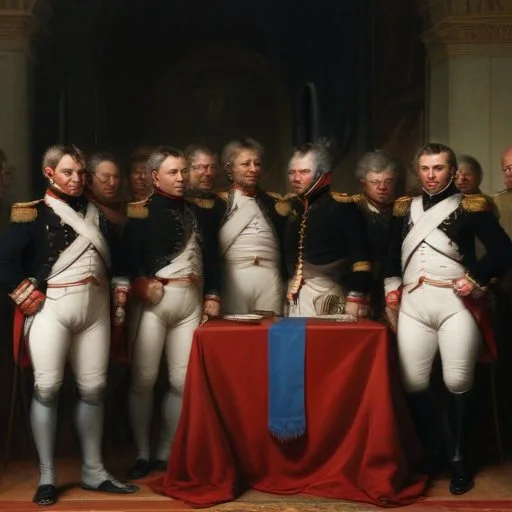
This landmark treaty, negotiated at the Château de Fontainebleau in France, marked a significant turning point in Napoleon's reign, which had been characterized by a series of conquests, reforms, and power struggles that had reshaped the European landscape.
In the early 19th century, Europe was in the midst of a protracted period of turmoil, with various coalitions forming and dissolving in response to Napoleon's expansionist policies. The Sixth Coalition, comprising Austria, Prussia, Russia, and their allies, had been formed in 1813 with the explicit goal of defeating Napoleon and restoring the pre-Revolutionary boundaries of Europe.
The war had raged on for over a year, with both sides suffering heavy casualties and Napoleon's empire beginning to show signs of strain. The Coalition's relentless pressure had gradually pushed Napoleon's forces back, ultimately isolating him and forcing him to accept the inevitability of defeat.
The Treaty of Fontainebleau was the culmination of intense negotiations between Napoleon and the Coalition powers. Its terms were unequivocal: Napoleon would relinquish his throne, and the French Empire would be dismantled. In exchange, he would be granted sovereignty over the island of Elba, a small but strategically located territory in the Mediterranean.
The treaty also stipulated that Napoleon's family would be treated with dignity, and that he would retain the title of Emperor, albeit in a greatly diminished capacity. Furthermore, the treaty paved the way for the restoration of the Bourbon monarchy in France, with Louis XVIII, the brother of the executed King Louis XVI, being reinstated as the rightful ruler of France.
The Treaty of Fontainebleau had far-reaching consequences for Europe and the world at large. Napoleon's abdication marked the end of an era of French dominance, and the Congress of Vienna, which convened later that year, would go on to redraw the continent's political map, establishing a new balance of power that would last for nearly a century.
The treaty also had significant implications for the development of modern Europe, as it led to the emergence of a new generation of nationalist movements and the eventual unification of Germany and Italy.
The Treaty of Fontainebleau also had a profound impact on European culture and society. Napoleon's reign had been marked by a cultural flowering, with many notable artists, writers, and intellectuals drawing inspiration from his vision of a unified Europe.
The treaty's signing marked the beginning of a new era of cultural exchange and cooperation, as the Coalition powers began to rebuild and restore their war-torn societies. The Congress of Vienna, in particular, would play a crucial role in fostering a sense of European unity and cooperation, laying the groundwork for the development of modern international relations.
The Treaty of Fontainebleau was not without its controversies, however. Many French citizens felt that Napoleon had been unfairly treated, and that the treaty was a humiliating capitulation to the Coalition powers.
Moreover, the treaty's provision granting Napoleon sovereignty over Elba was seen by some as a betrayal of the French people, who had grown weary of his authoritarian rule and desired a more democratic form of government.
Despite these criticisms, the treaty remained a significant milestone in European history, marking the beginning of a new era of peace and cooperation that would last for generations to come.
Napoleon Bonaparte, the French Emperor who ruled Europe with an iron fist, was a complex and enigmatic figure. Born on August 15, 1769, in Corsica, France, Napoleon's early life was marked by ambition and a desire for power.
Despite his meteoric rise to power, Napoleon's personal life was marked by turmoil and tragedy. His marriage to Joséphine de Beauharnais, whom he loved dearly, ended in divorce, and his subsequent marriage to Marie-Louise of Austria was marked by infidelity and discord.
Napoleon's leadership style was authoritarian, and he ruled France with a mix of charisma and brute force. Despite his Machiavellian tactics, Napoleon remains one of the most fascinating and studied figures in European history.

Napoleon Bonaparte's reign had a profound impact on European culture, shaping art, literature, and music for generations to come. The Emperor's patronage of the arts led to a flourishing of cultural institutions, including the Louvre Museum, the Paris Opera, and the École des Beaux-Arts.
The Napoleonic era saw the rise of Romanticism, with writers like Victor Hugo, François-René de Chateaubriand, and Madame de Staël drawing inspiration from Napoleon's vision of a unified Europe.
Napoleon's love of classical antiquity led to a renewed interest in Greek and Roman art and architecture, influencing the development of neoclassicism in art and architecture.
The Treaty of Fontainebleau, which marked Napoleon's unconditional surrender, has been compared to other significant abdications in history, including the fall of Charles I of England in 1649 and the abdication of Czar Nicholas II of Russia in 1917.
Like Napoleon, these leaders were forced to relinquish power due to growing opposition and external pressure. However, Napoleon's abdication was unique in that it marked the end of an era of French dominance and the beginning of a new era of European cooperation.
Unlike Charles I, who was executed after his trial, Napoleon was granted exile on the island of Elba, where he would remain until his escape in 1815.

The Treaty of Fontainebleau was the culmination of years of coalition-building and strategic maneuvering by the European powers. The Sixth Coalition, comprising Austria, Prussia, Russia, and their allies, had been formed in 1813 with the explicit goal of defeating Napoleon and restoring the pre-Revolutionary boundaries of Europe.
The Coalition's strategy of encirclement and attrition had gradually pushed Napoleon's forces back, isolating him and forcing him to accept the inevitability of defeat.
The Treaty of Fontainebleau marked a significant shift in the balance of power in Europe, paving the way for the Congress of Vienna and the redrawing of the European political map.
The Treaty of Fontainebleau has been viewed through different lenses by historians, reflecting their diverse perspectives on Napoleon's reign and the significance of the event.
Some historians, like the German historian Leopold von Ranke, have seen the treaty as a necessary correction to Napoleon's expansionist policies, marking the beginning of a new era of European cooperation.
Others, like the French historian Jules Michelet, have viewed the treaty as a tragic turning point, marking the end of a glorious era of French dominance and the beginning of a period of decline.