


The Irish War of Independence, a conflict that ravaged the Emerald Isle for two years, came to a standstill on this day as a fragile truce took hold. The ceasefire, negotiated by Irish Republican Army (IRA) leader Michael Collins and British Prime Minister David Lloyd George, marked a crucial step towards eventual independence for Ireland.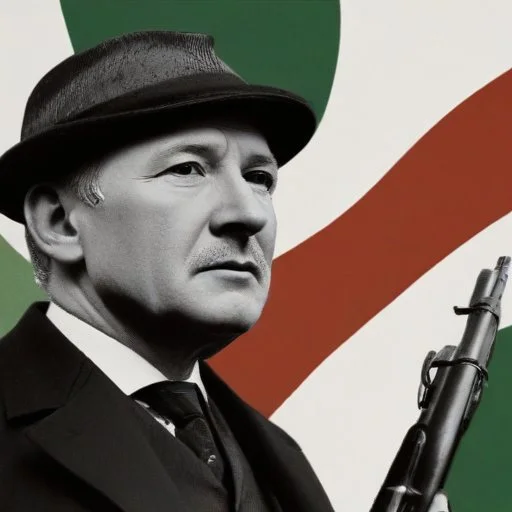
The Irish War of Independence was a culmination of centuries of British rule and domination over Ireland. The Irish people, fueled by a desire for self-governance and freedom, had been engaged in various forms of rebellion against British rule since the 17th century. The Irish Republican Brotherhood, a radical group that sought complete independence from Britain, played a significant role in shaping the country's fight for freedom.
The Irish War of Independence was marked by guerrilla warfare, ambushes, and brutal reprisals from both sides. The IRA, led by Collins, had been waging a relentless campaign against British forces, using tactics such as boycotts, sabotage, and armed attacks. The British, determined to crush the rebellion, employed counter-insurgency measures, including internment without trial, curfews, and martial law.
Two men played a crucial role in negotiating the truce: Michael Collins, the charismatic IRA leader, and David Lloyd George, the British Prime Minister.
Michael Collins, known as the "Big Fellow," was a mastermind of guerrilla warfare and a pragmatist who recognized the need for a negotiated settlement. His tactical genius and ability to evade capture earned him a reputation as a hero among the Irish people.
David Lloyd George, a seasoned politician and leader of the British Liberal Party, was under pressure to end the conflict and restore order to Ireland. His willingness to negotiate with Collins reflected a growing awareness of the need for a political solution to the conflict.
The truce, while tentative, paved the way for eventual independence for Ireland. The Anglo-Irish Treaty, signed in December 1921, established the Irish Free State, a Dominion of the British Empire. While the treaty fell short of full independence, it marked a significant step towards self-governance for Ireland.
The truce also sparked divisions within the IRA, with some members opposed to the treaty and others supporting Collins' pragmatic approach. The resulting Irish Civil War (1922-1923) would claim the lives of many, including Collins himself, but ultimately led to the consolidation of power by the pro-treaty forces.
The legacy of the truce continues to resonate in Ireland and beyond, serving as a testament to the power of negotiation and compromise in the face of conflict. As Collins once said, "We have a chance to make Ireland a nation once more, to give our people a home, a country, and a flag."
Arthur Griffith: The Unsung Hero of Irish Independence
While Michael Collins is often credited as the key figure in the Anglo-Irish Treaty, another Irish leader played a crucial role in the negotiations: Arthur Griffith. Griffith, the founder of Sinn Féin, was a visionary who advocated for a dual-monarchy system, where Ireland would remain connected to the British Crown but have its own parliament.
Griffith's ideas heavily influenced the Anglo-Irish Treaty, and his diplomatic skills helped to build bridges between the Irish and British delegations. Despite his significant contributions, Griffith remains a relatively unknown figure in Irish history, overshadowed by the charisma of Collins.

The Historiography of the Irish War of Independence
The Irish War of Independence has been the subject of intense historical debate, with varying interpretations of the conflict's causes, course, and consequences. Historians such as Tom Garvin and Michael Hopkinson have emphasized the role of social and economic factors in shaping the rebellion, while others, like J.J. Lee, have stressed the importance of political and ideological motivations.
Recently, historians have also explored the role of women and marginalized groups in the conflict, highlighting the often-overlooked contributions of individuals like Constance Markievicz and Cumann na mBan.
The Geopolitical Context of the Anglo-Irish Treaty
The Anglo-Irish Treaty was not only a significant event in Irish history but also had far-reaching implications for British foreign policy. The treaty marked a shift in British strategy, as the government began to recognize the importance of Dominion status and self-governance for its colonies.
In the aftermath of the treaty, the British Empire began to devolve power to its colonies, paving the way for the eventual dissolution of the empire. The Anglo-Irish Treaty thus becomes a significant milestone in the development of modern international relations.

The Economic Imperative of Independence
The Irish War of Independence was, in part, a response to the economic exploitation of Ireland by Britain. For centuries, Ireland had been forced to export its natural resources, while Britain reaped the benefits. The Irish Republic, established in 1919, sought to redress this economic imbalance and create a self-sufficient economy.
The Anglo-Irish Treaty, while falling short of full independence, did grant Ireland greater control over its economic affairs, paving the way for the development of indigenous industries and the growth of the Irish economy.
The Cultural Legacy of the Truce
The truce that ended the Irish War of Independence had a profound cultural impact on Ireland and beyond. The event inspired a new wave of Irish writers, artists, and musicians, who saw the struggle for independence as a symbol of national rebirth.
The truce also resonated with independence movements around the world, providing a beacon of hope for those fighting against colonial rule. Today, the truce remains an powerful symbol of the human desire for freedom and self-determination.