


The United States Senate's rejection of the Treaty of Versailles for the second time on March 19, 1920, marked a watershed moment in American history, one that would have far-reaching consequences for the country's role in global affairs. This decisive blow to President Woodrow Wilson's vision for a League of Nations would ultimately leave the United States isolated from the international community, as the rest of the world moved forward without American participation.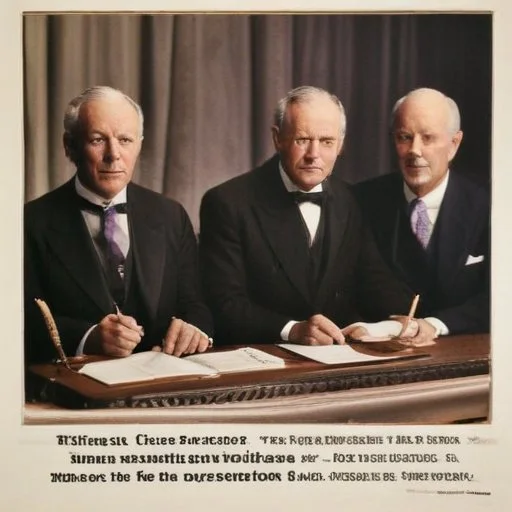
In the aftermath of World War I, the world was reeling from the devastation and loss of life. As the leading Allied powers gathered in Paris to negotiate the terms of the peace treaty, a strong sense of nationalism and isolationism was brewing in the United States. The American public, weary of foreign entanglements, was wary of committing to a binding international agreement that could limit the country's sovereignty.
At the heart of the debate were two visionaries with fundamentally different views on America's role in the world. President Woodrow Wilson, a staunch proponent of international cooperation, saw the League of Nations as a crucial step towards preventing future wars and promoting global stability. On the other hand, Republican Senator Henry Cabot Lodge, a fierce nationalist, believed that any international agreement would undermine American sovereignty andlimit the country's ability to act unilaterally.
The Senate's rejection of the Treaty of Versailles had significant consequences for the United States and the world. The country's decision to opt out of the League of Nations marked the beginning of a new era of isolationism, one that would last for decades to come. The League, weakened by the absence of American participation, proved ineffective in preventing the rise of fascist and nationalist movements in Europe, ultimately contributing to the outbreak of World War II.
The Senate's rejection of the Treaty of Versailles also had a profound impact on American public opinion. As the country turned inward, away from international cooperation, a sense of nationalism and xenophobia began to take hold. This shift in public opinion would have far-reaching consequences, influencing American foreign policy for generations to come.
The bitter partisan battle over the Treaty of Versailles left a legacy of rancor and division in its wake. The debate had exposed deep fault lines in American politics, pitting internationalists against isolationists, and Republicans against Democrats. The controversy would continue to simmer, influencing American foreign policy debates for decades to come.
President Wilson, who had staked his reputation on the success of the Treaty of Versailles, was devastated by the Senate's rejection. According to his biographer, Ray Stannard Baker, Wilson was "crushed, defeated, and bitter" in the aftermath of the vote. The defeat marked a turning point in Wilson's presidency, one that would ultimately contribute to his declining health and eventual incapacitation.
The Senate's rejection of the Treaty of Versailles served as a cautionary tale for future American leaders. The episode highlighted the dangers of isolationism and the importance of international cooperation in preventing global conflicts. As the world struggled to come to terms with the devastation of World War II, American leaders would draw valuable lessons from this bitter episode in American history.
In conclusion, the Senate's rejection of the Treaty of Versailles for the second time marked a pivotal moment in American history, one that would have far-reaching consequences for the country's role in global affairs. As the world continues to grapple with the challenges of international cooperation and global governance, this episode serves as a powerful reminder of the dangers of isolationism and the importance of collective action in promoting peace and stability.
Henry Cabot Lodge: The Architect of Isolationism
Henry Cabot Lodge was a Republican senator from Massachusetts who emerged as a powerful force against President Wilson's vision for the League of Nations. Lodge's steadfast opposition to the Treaty of Versailles was rooted in his deep-seated nationalism and fear of American involvement in international affairs.
Lodge's influence extended beyond the Senate, as he worked tirelessly to mobilize public opinion against the treaty. He rallied Republican senators, orchestrated public campaigns, and even wrote articles to sway public opinion.
Despite his opposition to the League, Lodge was not an isolationist in the classical sense. He believed in selective engagement with the world, advocating for American involvement in regional organizations and bilateral treaties. Nevertheless, his actions ultimately contributed to the rise of isolationism in the United States.
The Birth of Isolationist Culture
The Senate's rejection of the Treaty of Versailles marked a turning point in American culture, as the nation began to withdraw from international engagement. This shift was accompanied by a rise in nationalist sentiment, xenophobia, and anti-immigrant attitudes.
The 1920s witnessed a resurgence of nativist movements, such as the Ku Klux Klan, which capitalized on the anti-foreigner sentiment. The Sacco and Vanzetti trial, which took place in 1921, further exacerbated anti-immigrant feelings.
This cultural backlash against internationalism had far-reaching consequences, influencing American foreign policy and shaping public opinion for generations to come.
The Global Consequences of American Isolationism
The United States' decision to opt out of the League of Nations had significant consequences for global affairs. The League, weakened by the absence of American participation, struggled to enforce its authority and prevent aggressions.
The power vacuum created by American isolationism allowed fascist and nationalist movements in Europe to flourish. Germany, in particular, capitalized on the League's impotence, remilitarizing the Rhineland and aggressive expansion.
The consequences of American isolationism were dire, contributing to the outbreak of World War II and the subsequent loss of millions of lives.
The Political Fallout of the Treaty's Rejection
The Senate's rejection of the Treaty of Versailles had significant political implications, both domestically and internationally. The crisis exposed deep fault lines within the Democratic Party, ultimately contributing to President Wilson's declining health and political fortunes.
The Republican Party, on the other hand, emerged from the crisis with a newfound sense of unity and purpose. The party capitalized on the public's growing disenchantment with internationalism, using it to their advantage in subsequent elections.
The rejection of the treaty also marked a shift in the balance of power within the US government, with the Senate asserting its authority over the executive branch.
Historians and the Treaty of Versailles
Historians have long debated the significance of the Senate's rejection of the Treaty of Versailles. Some have argued that the rejection was a catastrophic mistake, dooming the League of Nations to failure and paving the way for World War II.
Others have seen the rejection as a necessary corrective, preventing the United States from becoming entangled in European politics and preserving its sovereignty.
Recent historical interpretations have emphasized the role of domestic politics and the rise of isolationism in shaping the outcome of the treaty.