


The Vietnam War, a conflict that lasted over a decade, was marked by a pivotal event in 1973 when the U.S. Congress placed a $1 billion limit on military aid to South Vietnam. This significant reduction in aid reflected the growing discontent among Americans, who were increasingly frustrated with the war's mounting costs and uncertain outcomes.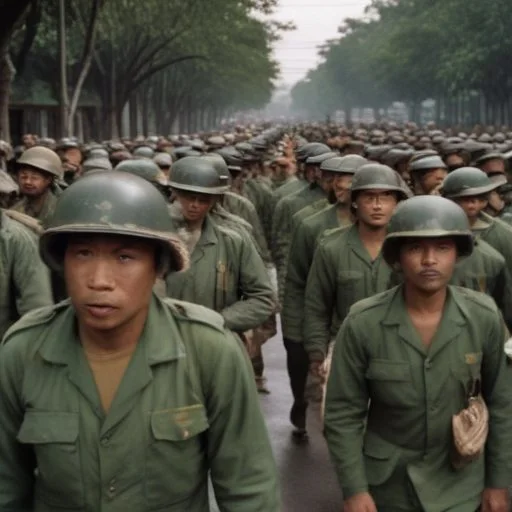
The Vietnam War, a protracted conflict between the communist North Vietnam and the anti-communist South Vietnam, had been underway since the early 1960s. The United States, fearing the spread of communism in Southeast Asia, had gradually increased its military involvement in the war. By the late 1960s, the U.S. had deployed thousands of troops to Vietnam, and the war had become a divisive issue in American politics.
As the war dragged on, the American public began to question the U.S. involvement in Vietnam. The rising cost of the war, both in terms of lives lost and dollars spent, had become a major concern. The U.S. government's handling of the war, including the use of chemical agents like Agent Orange and the bombing of civilian targets, had sparked widespread protests and opposition.
The $1 billion limit on military aid to South Vietnam was a symbolic shift in the U.S. government's approach to the war. It marked a recognition that the war was not winnable, and that the U.S. could no longer afford to pour vast resources into a conflict with no clear end in sight. The limit also reflected a growing sense of isolationism in the U.S., as Americans began to question the country's role as a global policeman.
The decision to limit military aid to South Vietnam was the result of a complex interplay of political and diplomatic forces. Key figures involved included:
The decision to limit military aid to South Vietnam was the culmination of a series of events, including:
The $1 billion limit on military aid to South Vietnam had significant consequences, including:
The Vietnam War, and the decision to limit military aid to South Vietnam, had significant cultural and social impacts, including:
The $1 billion limit on military aid to South Vietnam was a pivotal moment in the Vietnam War, marking a shift in U.S. foreign policy and a recognition that the war was not winnable. The decision had significant consequences, both for the U.S. and for Vietnam, and continues to shape U.S. foreign policy to this day.
One of the key figures involved in the decision to limit military aid to South Vietnam was Senator Mike Mansfield, a Democrat from Montana. Mansfield had long been critical of the war and had introduced legislation to limit U.S. involvement. He was a strong advocate for congressional oversight and believed that the executive branch had overstepped its authority in conducting the war.
Mansfield's opposition to the war was not based on partisan politics, but rather on his conviction that the U.S. had no clear strategy for victory and that the conflict was draining the country's resources. He worked closely with other lawmakers to build a coalition of like-minded individuals who shared his concerns about the war.
Mansfield's leadership on this issue was instrumental in galvanizing opposition to the war and paved the way for the eventual withdrawal of U.S. troops from Vietnam. His commitment to congressional oversight and accountability set an important precedent for future foreign policy decisions.
The Vietnam War had a profound impact on American culture, shaping the country's music, film, and literature for decades to come. The war inspired some of the most iconic protest songs of the 1960s and 1970s, including Bob Dylan's "Blowin' in the Wind" and John Lennon's "Give Peace a Chance."
The war also influenced the work of prominent writers and filmmakers, such as Norman Mailer and Francis Ford Coppola. Mailer's novel "The Armies of the Night" is a semi-autobiographical account of his experiences at the 1967 March on the Pentagon, while Coppola's "Apocalypse Now" is a haunting exploration of the war's psychological toll on American soldiers.
The war's cultural impact extended beyond the arts, as well. It helped to galvanize the anti-war movement and inspired a generation of activists to challenge traditional authority and Push for social change.
The Vietnam War had a significant impact on the U.S. economy, with the cost of the conflict estimated to be over $111 billion by the time it ended in 1975. The war absorbs a significant portion of the federal budget, diverting resources away from domestic programs and contributing to inflation and budget deficits.
The war also had a profound impact on the U.S. economy's industrial base, as the production of military equipment and supplies became a major driver of economic growth. This led to the development of a "military-industrial complex," as President Dwight Eisenhower warned, where the interests of the military and industry became increasingly intertwined.
The war's economic impact was felt long after the conflict ended, as the U.S. struggled to rebuild its economy and address the social and economic problems that had been exacerbated by the war.

The Vietnam War took place against the backdrop of the Cold War, a global struggle for supremacy between the United States and the Soviet Union. The war was seen by many as a key battleground in this struggle, with the U.S. attempting to prevent the spread of communism in Southeast Asia.
The war was also influenced by the rise of nationalism in Vietnam, as the country sought to throw off the yoke of colonialism and assert its independence. The North Vietnamese government, backed by China and the Soviet Union, saw itself as the vanguard of this nationalist movement, while the U.S. and its allies viewed the conflict as a struggle against communist aggression.
The war's geopolitical context was further complicated by the presence of other regional actors, including Japan, South Korea, and Thailand, which played important roles in the conflict.
The decision to limit military aid to South Vietnam marked a significant shift in U.S. foreign policy, as the country began to move away from its traditional role as a global policeman. This shift was driven in part by the growing realization that the war was not winnable, and that the U.S. could no longer afford to pour vast resources into a conflict with no clear end in sight.
The limits on military aid also reflected a growing sense of isolationism in the U.S., as Americans began to question the country's role in international affairs. This isolationism was driven in part by the war weariness and the growing perception that the U.S. had overextended itself in Vietnam.
The war's impact on U.S. foreign policy was felt long after the conflict ended, as the country struggled to rebuild its relationships with its allies and redefine its role in the world.