


The Easter Offensive, a pivotal event in the Vietnam War, marked a bold and unexpected move by North Vietnamese forces as they burst across the Demilitarized Zone (DMZ) into South Vietnam, catching the South Vietnamese army and their American allies off guard. This massive assault, one of the largest of the war, aimed to crush the South Vietnamese army and reunify the country under communist rule.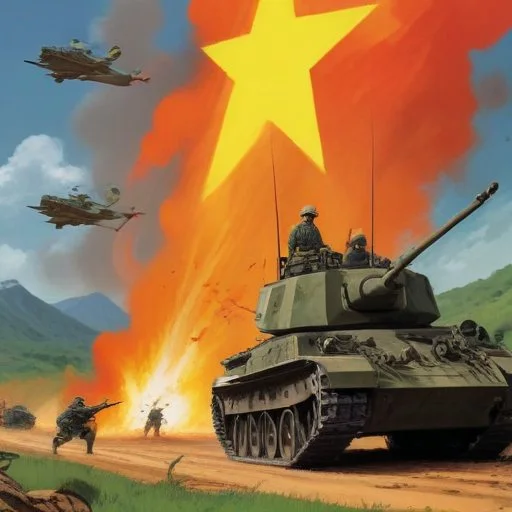
The Vietnam War, a Cold War-era conflict, was fought between the communist North Vietnam and the anti-communist South Vietnam. The demilitarized zone (DMZ), a 2.5-mile-wide buffer zone, separated the two nations. The Geneva Accords of 1954, which ended the First Indochina War, had divided Vietnam into North and South, promising nationwide elections in 1956 to reunify the country. However, the elections were never held, and the division persisted.
On March 30, 1972, North Vietnamese forces, backed by Soviet-made tanks and artillery, launched a surprise attack across the DMZ, marking the start of the Easter Offensive. This bold move caught the South Vietnamese army and their American allies off guard, sparking a brutal and grueling conflict that would last for months. The North Vietnamese army, led by General Vo Nguyen Giap, had been secretly mobilizing troops and supplies for months, preparing for a decisive blow.
The Easter Offensive had significant outcomes and impacts on the Vietnam War:
The Easter Offensive had significant cultural and social influences:
The Easter Offensive, a pivotal event in the Vietnam War, marked a turning point in the conflict. The surprise attack and subsequent counterattack had significant outcomes and impacts, influencing the war's trajectory and ultimately contributing to the Paris Peace Accords of 1973. The Easter Offensive serves as a powerful reminder of the human cost of war and the importance of diplomacy in resolving conflicts.
General Vo Nguyen Giap, the mastermind behind the Easter Offensive, was a highly respected and decorated North Vietnamese general. Born on August 25, 1911, Giap rose through the ranks of the North Vietnamese army, earning a reputation as a brilliant strategist and tactician.
Giang's military career spanned over three decades, during which he played a crucial role in several key battles, including the Battle of Dien Bien Phu, which led to the defeat of the French colonial forces in 1954. His experience and expertise made him the ideal candidate to lead the Easter Offensive.
Giap's leadership style was characterized by his ability to inspire loyalty and dedication in his troops. He was known for his simplicity, humility, and willingness to listen to his officers, which earned him the respect and admiration of his comrades.
In response to the Easter Offensive, the Nixon administration was faced with a dilemma: how to respond to the surprise attack without escalating the conflict further. President Nixon's decision to increase bombing raids on North Vietnam was a calculated move to weaken the North Vietnamese army and prevent a complete takeover of South Vietnam.
The mining of Haiphong harbor, a major port city, was a strategic move to disrupt North Vietnam's supply lines and restrict the flow of Soviet-made tanks and artillery. This move, however, was met with widespread criticism, with many arguing that it was a disproportionate response to the North Vietnamese attack.
The Nixon administration's response to the Easter Offensive marked a shift in the war's narrative, with the United States taking a more aggressive stance against North Vietnam. This, in turn, fueled anti-war sentiment in the United States, leading to increased protests and demonstrations.
The Easter Offensive had a significant impact on popular culture, with the war becoming a central theme in music, film, and literature. The offensive coincided with a growing anti-war movement in the United States, with many artists using their platform to protest the conflict.
Songs such as "What's Going On" by Marvin Gaye and "Fortunate Son" by Creedence Clearwater Revival became anthems for the anti-war movement, while films like "Apocalypse Now" and "Platoon" captured the brutal realities of war.
The Easter Offensive also inspired a generation of writers, including Tim O'Brien and Larry Heinemann, who drew upon their experiences in Vietnam to create powerful works of literature.
In the weeks leading up to the Easter Offensive, there were signs that something was amiss. Intelligence reports suggested that North Vietnamese forces were mobilizing along the DMZ, but the extent of their plans remained unclear.
The South Vietnamese army, meanwhile, was on high alert, with many of its troops deployed along the border. Despite this, the North Vietnamese army was able to achieve complete surprise, catching the South Vietnamese and American forces off guard.
In hindsight, it is clear that the Easter Offensive was a meticulously planned operation, with North Vietnamese forces secretly mobilizing troops and supplies for months. The element of surprise was a crucial factor in the initial success of the offensive.
The Easter Offensive took place against the backdrop of a complex and volatile geopolitical landscape. The Cold War was in full swing, with the United States and the Soviet Union engaged in a global struggle for ideological supremacy.
The conflict in Vietnam was a key battleground in this struggle, with the United States committed to preventing the spread of communism in Southeast Asia. The Easter Offensive, therefore, was seen as a direct challenge to American influence in the region.
Meanwhile, the Soviet Union was providing significant military and economic aid to North Vietnam, viewing the conflict as an opportunity to expand its influence in Asia. The Easter Offensive, therefore, was a critical moment in the global Cold War narrative.