


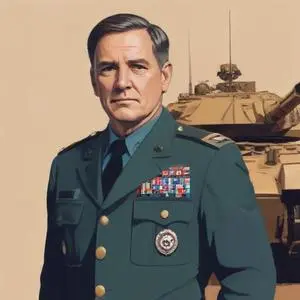
A decorated four-star general who played a crucial role in the Vietnam War, leading US military forces to victory in several key battles and later becoming the Army's Chief of Staff.
Creighton Abrams, a renowned United States Army general, is best known for commanding military operations in the Vietnam War from 1968 to 1972, and later serving as the Chief of Staff of the United States Army from 1972 until his untimely death in 1974.
Abrams' impact on modern warfare is still felt today, with his innovative tactics and leadership style leaving a lasting mark on the US military. His vision for a more agile and adaptable military led to the development of new doctrines and strategies that continue to influence military operations around the world.
Abrams graduated from the United States Military Academy at West Point in 1936, where he demonstrated early on his exceptional leadership skills and aptitude for armored warfare. Rising through the ranks, he became an armor officer early in his career, serving with the 1st Cavalry Division and later with the 4th Armored Division during World War II.
During World War II, Abrams played a crucial role in the Battle of the Bulge, leading Combat Command B of the 4th Armored Division to several key victories. His bravery and tactical prowess earned him rapid promotion, and by the age of 27, he had risen to the rank of lieutenant colonel.
In 1968, Abrams was appointed as the commander of US military operations in Vietnam, where he implemented a series of reforms aimed at revitalizing the war effort. His leadership and strategic thinking helped to turn the tide of the war, and he is credited with improving the morale and effectiveness of US troops.
After his success in Vietnam, Abrams was appointed as the Chief of Staff of the US Army, where he continued to drive innovation and reform. He played a key role in modernizing the US military, introducing new technologies and tactics that would shape the course of future conflicts.
In recognition of his outstanding service, the US Army named its new main battle tank, the M1 Abrams, after him in 1980. The IG Farben building in Germany was also named after Abrams from 1975 to 1995. Throughout his career, Abrams received numerous awards and honors, including the Distinguished Service Medal, the Legion of Merit, and the Bronze Star Medal.
Abrams' life and legacy serve as a testament to his unwavering commitment to military excellence and his vision for a more agile and adaptable military. His influence continues to shape modern warfare, and his memory remains an inspiration to military leaders around the world.
Born in 1890
Led the Allied forces to victory in World War II and later served as President, maintaining peace and prosperity during the Cold War era. He's known for his strategic leadership and diplomatic skills.
Born in 1885
A renowned military leader who played a crucial role in World War II, particularly in the Allied victory in Europe, known for his bold tactics and unapologetic style.
Born in 1893
Led the US Army in World War II and became the last five-star general, playing a crucial role in shaping post-war American military strategy. He's also known for his humble and unassuming leadership style.
Born in 1908
The 36th President of the United States, a skilled politician and leader, played a crucial role in passing landmark civil rights legislation, including the Civil Rights Act and Voting Rights Act.
Born in 1913
The 37th President of the United States, a polarizing figure who led the country through significant domestic and foreign policy changes, infamous for his involvement in the Watergate scandal.
Born in 1923
A renowned diplomat and strategist who played a pivotal role in shaping global politics during the Cold War era, known for his Realpolitik approach and brokering peace agreements .
89 Years Old
The first African American to serve as Secretary of State, he played a crucial role in shaping US foreign policy during the Gulf War and War on Terror. He's also known for his diplomatic efforts and leadership in the military.
81 Years Old
Led a coalition of forces to a swift and decisive victory in the Iraq War, and was a key figure in the War on Terror.
