


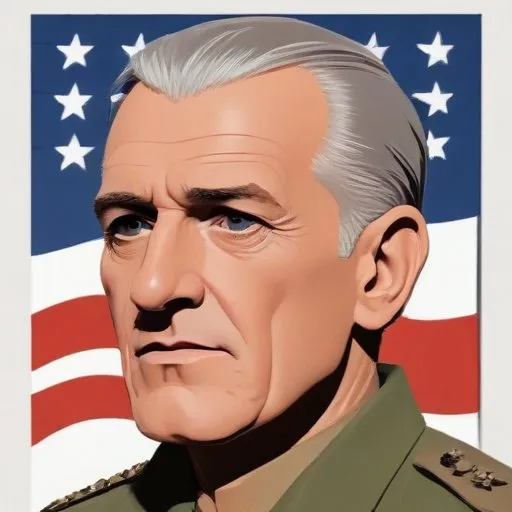
Led a coalition of forces to a swift and decisive victory in the Iraq War, and was a key figure in the War on Terror.
Tommy Franks is a retired United States Army general, best known for leading the attack on the Taliban in Afghanistan in response to the September 11 attacks and overseeing the 2003 invasion of Iraq, resulting in the overthrow of Saddam Hussein. As the Commander of the United States Central Command, Franks played a pivotal role in shaping the course of modern warfare and international relations.
Born Tommy Ray Bentley on June 17, 1945, in Wynnewood, Oklahoma, Franks was adopted by Ray and Lorene Pete Parker Franks. He attended Midland High School and graduated from Robert E. Lee High School in Midland, Texas, a year ahead of First Lady Laura Bush. Franks attended the University of Texas at Austin, where he was a brother of Delta Upsilon International Fraternity, but dropped out after two years due to poor grades and lack of motivation.
Franks' decision to join the United States Army proved to be a turning point in his life. Through the military, he was able to enroll at the University of Texas at Arlington, where he graduated with a Bachelor of Business Administration degree in 1971. He also holds a Master of Science in Public Administration from the Shippensburg University of Pennsylvania and is a graduate of the Armed Forces Staff College and the Army War College.
Franks enlisted in the United States Army in 1965 and attended Basic Training at Fort Leonard Wood, Missouri. He received his Advanced Individual Training as a cryptologic analyst at Fort Devens, Massachusetts. Standing out among his peers in outstanding marksmanship and leadership qualities, Private First Class Franks was selected to attend the Artillery and Missile Officer Candidate School, Fort Sill, Oklahoma.
Throughout his military career, Franks held various command positions, including Commander of the 1st Cavalry Division, Commanding General of the III Corps, and Vice Chief of Staff of the United States Army. His last army post was as the Commander of the United States Central Command, overseeing United States military operations in a 25-country region, including the Middle East.
Franks' approach to warfare was characterized by his emphasis on speed, surprise, and decisive action. He believed in the importance of adapting to changing circumstances and leveraging technology to gain a strategic advantage. Franks' leadership style was marked by his ability to inspire confidence and motivate his troops, earning him the respect and admiration of his peers and subordinates alike.
Franks' role in shaping the course of modern warfare has had far-reaching consequences for international relations, global security, and the conduct of warfare. His leadership during the Afghanistan and Iraq wars has influenced the development of military strategy and tactics, highlighting the importance of adaptability, technology, and decisive action.
Franks' leadership and service to his country have left an indelible mark on modern history. His commitment to public service and his dedication to the welfare of his troops have inspired generations of military leaders and civilians alike. Today, Franks continues to be involved in various public service initiatives, sharing his expertise and experience to shape the course of international relations and global security.
80 Years Old
The 43rd President of the United States, a Republican leader who launched wars in Afghanistan and Iraq, and implemented significant tax cuts. He's also known for his response to the 9/11 attacks.
85 Years Old
The 46th Vice President of the United States, a powerful and influential figure in American politics, known for his strong conservative stance and role in shaping the country's foreign policy during the War on Terror.
94 Years Old
The 13th United States Secretary of Defense, a high-ranking government official, oversaw the US military during the Iraq War and was known for his controversial decisions and quotes. He's infamous for his "known unknowns" phrase.
89 Years Old
The first African American to serve as Secretary of State, he played a crucial role in shaping US foreign policy during the Gulf War and War on Terror. He's also known for his diplomatic efforts and leadership in the military.
82 Years Old
A key architect of the Iraq War, he served as Deputy Secretary of Defense under President George W. Bush and later as President of the World Bank.
84 Years Old
A four-star general who served as the Chairman of the Joint Chiefs of Staff from 2001 to 2005, playing a key role in shaping US military strategy during the Iraq War.
80 Years Old
The first Marine to serve as Chairman of the Joint Chiefs of Staff, he played a key role in shaping US military strategy in the War on Terror. He's also known for his outspoken views on social issues.
75 Years Old
A four-star general who led US Central Command during the Iraq War, known for his expertise in Middle Eastern affairs and counterinsurgency strategy.
