


In the waning days of the Vietnam War, the North Vietnamese Army launched a daring assault on the strategic town of Ban M Thut, a crucial stronghold in the South Vietnamese defense. This pivotal battle marked the beginning of the end for the embattled government of South Vietnam, as the North Vietnamese forces advanced relentlessly towards their ultimate prize: the capture of Saigon, the capital city.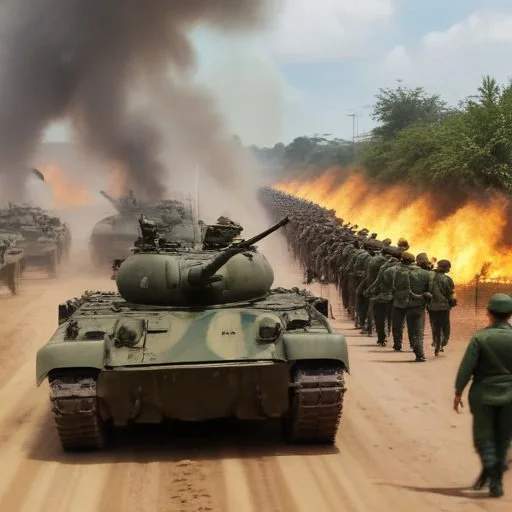
By the early 1970s, the war had been raging for over a decade, with the United States providing military and economic aid to the government of South Vietnam in its fight against the communist North. However, as American involvement began to wane, the North Vietnamese Army saw an opportunity to strike a decisive blow against its beleaguered foe.
The North Vietnamese Army, led by General Văn Tiến Dũng, devised a bold plan to capture Ban M Thut, a key town in the Central Highlands that controlled the vital Route 14, a crucial supply line for the South Vietnamese military. The campaign, named after the revered North Vietnamese leader Ho Chi Minh, was a masterclass in military strategy, combining innovative tactics with sheer numerical superiority.
In early March 1975, the North Vietnamese Army launched a series of probing attacks against Ban M Thut, testing the defenses of the South Vietnamese military. As the North Vietnamese forces continued to build up their strength, the South Vietnamese defenders found themselves increasingly outnumbered and outgunned. Despite valiant efforts to hold the line, the South Vietnamese army was ultimately forced to withdraw, leaving the town to the mercy of the North Vietnamese.
The fall of Ban M Thut sent shockwaves throughout South Vietnam, as the government's grip on power began to slip. As the North Vietnamese Army continued its relentless advance, city after city fell to the communist forces. On April 30, 1975, the inevitable finally occurred: the capture of Saigon, the capital city, marking the end of the war and the reunification of North and South Vietnam under communist rule.
One South Vietnamese soldier, who wished to remain anonymous, recalled the desperation of the final days of the battle: "We knew we were fighting a losing battle, but we refused to give up. We fought for every inch of ground, but in the end, it was just too much for us to hold."
In the aftermath of the war, General Văn Tiến Dũng would reflect on the campaign, saying: "The Ho Chi Minh Campaign was a testament to the bravery and determination of the North Vietnamese people. We fought for our freedom, and in the end, we emerged victorious."
The Ho Chi Minh Campaign serves as a powerful reminder of the human cost of war and the importance of understanding the complexities of military strategy. Today, the town of Ban M Thut stands as a symbol of the enduring legacy of the Vietnam War, a poignant reminder of the sacrifices made by soldiers on both sides of the conflict.
As we reflect on the events of that fateful spring, we are reminded of the importance of preserving the memories of those who fought and died in the war, and of the ongoing efforts to promote reconciliation and understanding between nations.
The Central Highlands, where Ban M Thut is located, has been a contested region throughout Vietnamese history. The area was initially inhabited by various ethnic minority groups, who were later displaced by the Vietnamese during the 18th century. The French colonization of Vietnam in the late 19th century saw the establishment of rubber plantations and other economic interests in the region.
During the Vietnam War, the Central Highlands became a key battleground, with the North Vietnamese Army (NVA) using the region as a conduit to supply their forces in the south. The US military responded by establishing a network of bases and outposts, including the strategically important Ban M Thut.
The region's unique geography, characterized by dense forests and rugged terrain, made it an ideal location for guerrilla warfare and ambushes.
General Văn Tiến Dũng, the mastermind behind the Ho Chi Minh Campaign, was a seasoned military strategist who rose through the ranks of the North Vietnamese Army. Born in 1917, Dũng joined the Viet Minh, a communist-led independence movement, at the age of 19. He quickly distinguished himself as a skilled and innovative commander, playing a key role in the Viet Minh's fight against French colonial forces.
Dũng's military career was marked by a series of daring operations, including the 1954 Battle of Dien Bien Phu, which led to the French withdrawal from Vietnam.
His experience and expertise made him the perfect candidate to lead the Ho Chi Minh Campaign, a bold plan to capture Ban M Thut and ultimately reunify North and South Vietnam.
The Ho Chi Minh Campaign and the Tet Offensive, two pivotal events in the Vietnam War, share similarities in their military strategies. Both campaigns involved large-scale troop mobilizations, rapid advances, and surprise attacks. However, there are significant differences in their objectives and outcomes.
The Tet Offensive, launched in 1968, was a series of coordinated attacks on urban areas, aimed at weakening the South Vietnamese government and its American allies.
In contrast, the Ho Chi Minh Campaign focused on capturing strategic towns and supply lines, ultimately leading to the fall of Saigon and the reunification of North and South Vietnam.
Both campaigns demonstrate the adaptability and resilience of the North Vietnamese military, which was able to adjust its tactics in response to changing circumstances.
The Ho Chi Minh Campaign took place within the broader context of the Cold War, with the United States and the Soviet Union vying for influence in Southeast Asia. The Vietnam War was seen as a key battleground in the struggle against communism, with the US providing military and economic aid to the government of South Vietnam.
The North Vietnamese government, backed by China and the Soviet Union, sought to reunify the country under communist rule.
The Ho Chi Minh Campaign was a decisive victory for the North Vietnamese, marking a significant shift in the balance of power in Southeast Asia and beyond.
The campaign's outcome had far-reaching implications for international relations, as the US grappled with the implications of its defeat and the rise of communist influence in the region.
The Ho Chi Minh Campaign and the subsequent fall of Saigon had a profound impact on Vietnamese politics, leading to the reunification of North and South Vietnam under communist rule.
The campaign marked the end of the Vietnam War and the beginning of a new era in Vietnamese history, with the communist government establishing a new political order.
The US withdrawal from Vietnam was a significant blow to American prestige, leading to a period of introspection and reevaluation of US foreign policy.
The Ho Chi Minh Campaign's political legacy continues to shape Vietnamese politics and international relations today.