


The arrival of US Marines at Da Nang on March 8, 1965, marked a pivotal moment in the Vietnam War, signaling a significant escalation of American involvement in the conflict. This deployment of 3,500 Marines from the 9th Marine Regiment would change the course of the war and have lasting impacts on the region and the world.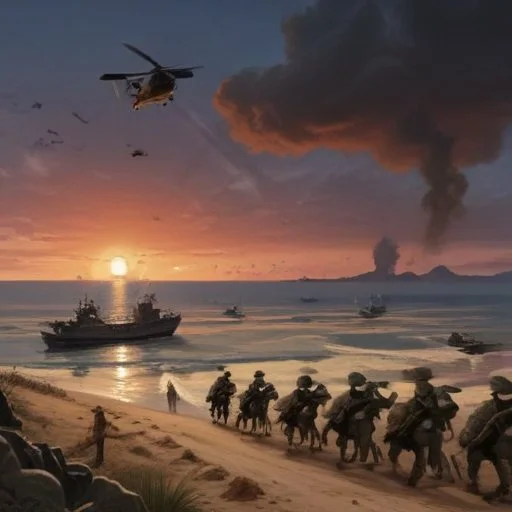
In the early 1960s, the United States had begun providing military aid to South Vietnam to combat the growing threat of communism. However, by 1964, the situation had deteriorated, and the US government decided to take a more active role. The Gulf of Tonkin incident in August 1964, in which North Vietnamese forces allegedly attacked a US Navy destroyer, provided the rationale for increased US involvement.
The Marines' primary objective was to secure the Da Nang Air Base, a strategic location that would provide a foothold for future operations. The airbase was critical for both military and supply operations, and its control would give the US a significant advantage in the region. The Marines were also tasked with securing the surrounding areas, including the city of Da Nang, to prevent enemy forces from encroaching on the airbase.
The Marines arrived at Da Nang in the early morning hours of March 8, 1965, aboard amphibious landing craft. The operation was code-named "Starlite," and it marked the first time US combat troops had set foot in Vietnam. The initial deployment consisted of two battalions: the 1st Battalion, 3rd Marines, and the 2nd Battalion, 9th Marines.
The deployment of US Marines to Da Nang had far-reaching consequences, including:
"The landing was eerily quiet. We expected enemy fire, but there was none. It was as if the Viet Cong had vanished into thin air." - Private First Class James Wilson, 1st Battalion, 3rd Marines.
The Marines who participated in the Da Nang landing were awarded several accolades, including the Navy Unit Commendation, the Meritorious Unit Commendation, and the Vietnamese Cross of Gallantry.
The bravery and sacrifice of the Marines who landed at Da Nang inspired a generation of Americans to serve their country. The deployment also highlighted the importance of camaraderie and esprit de corps, as the Marines worked together to overcome the challenges of combat.
The deployment of US Marines to Da Nang set the stage for future conflicts, including the Battle of Ia Drang, the Tet Offensive, and the eventual withdrawal of US forces from Vietnam. The lessons learned during the Vietnam War continue to influence US military strategy and tactics to this day.
The arrival of US Marines at Da Nang marked a pivotal moment in the Vietnam War, one that would have lasting impacts on the region, the US military, and the world. As we reflect on this event, we are reminded of the bravery, sacrifice, and camaraderie that define the men and women who serve in the United States Marine Corps.
The decision to deploy Marines to Da Nang was not taken lightly. In the months leading up to the deployment, the US government had been considering various options to escalate its involvement in the conflict. One of the key factors that influenced the decision was the advice of General Maxwell D. Taylor, the US Ambassador to South Vietnam. Taylor, a seasoned diplomat and military strategist, had been advocating for a more robust response to the growing communist threat in the region. In a series of confidential memos, Taylor argued that the situation in South Vietnam was dire and that a show of force was necessary to demonstrate American commitment to the region.
Another crucial factor was the deteriorating security situation in Da Nang. In early 1965, the city was on the verge of falling to the North Vietnamese Army (NVA) and the Viet Cong (VC). If Da Nang were to fall, the entire region would be at risk of being overrun by communist forces. The US government saw the deployment of Marines as a way to prevent this from happening and to safeguard the airbase, which was critical for supporting military operations in the region.
General Lewis Walt: A Marine's Marine
General Lewis Walt, the commanding general of the 9th Marine Regiment, was a highly decorated and respected Marine officer. Born in 1913, Walt enlisted in the Marine Corps in 1934 and rose through the ranks to become one of the most senior officers in the Corps. He saw action in World War II, the Korean War, and Vietnam, earning numerous awards and decorations for bravery and leadership.
Walt was known for his unwavering commitment to his Marines and his unshakeable confidence in their abilities. He was a true leader, inspiring his troops to perform to the highest standards, even in the face of overwhelming odds. Under his command, the 9th Marine Regiment became one of the most feared and respected units in the Marine Corps.
The Helicopter Revolution
The deployment of Marines to Da Nang marked a significant shift in military tactics. For the first time, helicopters played a critical role in transporting troops and supplies over long distances. The introduction of helicopters like the UH-1 Huey and the CH-46 Sea Knight revolutionized military logistics, enabling troops to be deployed quickly and efficiently to remote areas.
The use of helicopters also had a profound impact on the psychological dynamics of the conflict. The sudden appearance of helicopters in the skies above Da Nang was a powerful symbol of American military power, striking fear into the hearts of enemy forces.
The Cultural Significance of Da Nang
Da Nang, the city that was once a sleepy coastal town, became a symbol of American involvement in Vietnam. The deployment of Marines to Da Nang marked a turning point in the war, as the city became a hub of military activity and a magnet for international attention.
The cultural impact of Da Nang was felt far beyond the shores of Vietnam. The city became a cultural touchstone, symbolizing the complexities and contradictions of American foreign policy in the 1960s. From anti-war protests to patriotic rallies, Da Nang became a rallying cry for those on both sides of the debate.
The Geopolitical Context of the Vietnam War
The deployment of Marines to Da Nang took place against the backdrop of a complex and rapidly changing geopolitical landscape. The Cold War was at its height, with the United States and the Soviet Union locked in a struggle for global influence.
The Vietnam War was seen as a key front in this struggle, with the United States seeking to prevent the spread of communism in Southeast Asia. The deployment of Marines to Da Nang was part of a broader strategy to contain communism and maintain American influence in the region.