


In the early morning hours of January 31, 1968, Viet Cong guerrillas launched a surprise attack on the United States embassy in Saigon, catching the Americans off guard and sending shockwaves around the world. This daring assault, known as the Tet Offensive, marked a pivotal moment in the Vietnam War, exposing the vulnerabilities of the US military and sparking widespread anti-war sentiments.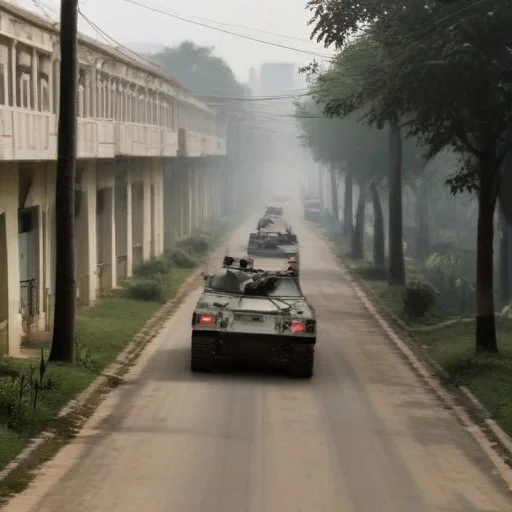
Saigon, the capital of South Vietnam, was a city of contrasts, where traditional Vietnamese culture coexisted with modern American influences. The city's streets were lined with bustling markets, exotic cafes, and ornate temples, but beneath the surface, tensions simmered. The Viet Cong, a communist guerrilla organization, had been waging a guerrilla war against the South Vietnamese government and its American allies for years.
At 2:45 am on January 31, a team of Viet Cong guerrillas, disguised as South Vietnamese soldiers, breached the perimeter of the US embassy compound. The initial attack was swift and intense, with the guerrillas firing rockets and grenades at the embassy building. The Americans, caught off guard, responded slowly, but eventually, they regained control of the compound.
The embassy attack was just one of many coordinated assaults on key targets across South Vietnam, including military bases, government buildings, and major cities. The Viet Cong launched attacks on 36 of South Vietnam's 44 provincial capitals, as well as on several major US military bases, including the Marine Corps base at Khe Sanh.
The Tet Offensive caught the US military and the Johnson administration off guard, shattering the illusion of progress in the war. The audacity and scale of the attacks stunned the American public, eroding support for the war and fueling anti-war protests. The US military responded with force, but the Viet Cong's bold move had already achieved its objective: to demonstrate that the war was far from won.
The Tet Offensive resulted in heavy casualties on both sides. The US military suffered over 1,100 fatalities, while the Viet Cong lost an estimated 20,000-30,000 fighters. The offensive also sparked a refugee crisis, with hundreds of thousands of civilians displaced.
The Tet Offensive marked a turning point in the Vietnam War, galvanizing anti-war sentiment and prompting a re-evaluation of US involvement. In the aftermath, President Lyndon B. Johnson announced that he would not seek re-election, and the US began to shift its strategy, placing greater emphasis on Vietnamization, a policy of gradually transferring military responsibility to the South Vietnamese government.
The Tet Offensive remains a significant episode in the Vietnam War, a powerful symbol of the Viet Cong's determination and the US military's vulnerabilities. It serves as a reminder of the devastating human toll of war and the importance of seeking diplomatic solutions to conflicts.
General Vo Nguyen Giap was a renowned Vietnamese general and politician who played a crucial role in the Viet Cong's military strategy during the Vietnam War. Born in 1911 in Quang Binh Province, Vietnam, Giap was drawn to revolutionary politics at an early age and joined the Indochinese Communist Party in 1930.
Giap's military career spanned over three decades, during which he fought against French colonialism and later against the United States. He is often credited with developing the Viet Cong's guerrilla warfare tactics, which proved effective against the US military's superior firepower.
Giap's leadership and strategic thinking were instrumental in planning and executing the Tet Offensive. His ability to coordinate a large-scale attack on multiple fronts caught the US military off guard and dealt a significant blow to their morale.
The Tet Offensive took place during a time of great geopolitical tension. The Cold War was at its peak, with the United States and the Soviet Union engaged in a proxy war in Vietnam. The US government saw the war as a crucial front in the fight against communism, while the Soviet Union and China provided military and economic aid to North Vietnam.
The Tet Offensive was also influenced by the growing anti-war movement in the United States. As the war dragged on, public opinion began to turn against the US involvement, and the attack on the US embassy in Saigon was seen as a symbol of the war's futility.
The Tet Offensive marked a turning point in the war, as the US began to question its role in Vietnam and started to shift its strategy towards a more diplomatic approach.
The Tet Offensive had a profound impact on American culture, shaping the way people perceived the war and their role in it. The attack on the US embassy in Saigon was a wake-up call, forcing Americans to confront the harsh realities of war.
The Tet Offensive inspired a wave of anti-war protests and activism, with many young Americans questioning the government's motives and the morality of the war. The event also influenced music, art, and literature, with many creatives using their work to express their opposition to the war.
The Tet Offensive also had a significant impact on Vietnamese culture, as it marked a turning point in the country's struggle for independence and reunification.
In recent years, declassified documents have shed new light on the planning and execution of the Tet Offensive. One such document, a memo from General Giap to the North Vietnamese leadership, reveals the scope of the operation and the importance of surprise and coordination.
Another declassified document, a CIA report from February 1968, highlights the agency's failure to anticipate the scale of the attacks and the subsequent intelligence failure.
These documents provide a unique insight into the Tet Offensive, offering a glimpse into the minds of the individuals involved and the events that shaped the course of the war.
The Tet Offensive had significant political repercussions in the United States. The attack on the US embassy in Saigon was seen as a major embarrassment for the Johnson administration, and public opinion began to turn against the war.
The Tet Offensive marked a turning point in the presidential election of 1968, as President Lyndon B. Johnson announced that he would not seek re-election.
The event also led to a shift in US foreign policy, as the government began to seek a more diplomatic solution to the conflict. The Tet Offensive was a catalyst for change, paving the way for the Paris Peace Accords in 1973.