


In the early morning hours of December 7, 1941, the Imperial Japanese Navy launched a surprise attack on the United States Pacific Fleet and its defending Army and Marine air forces at Pearl Harbor, Hawaii. This daring assault would forever be etched in history as one of the most audacious and devastating military strikes of the 20th century, leaving 2,403 Americans dead and drawing the United States into the global conflict of World War II.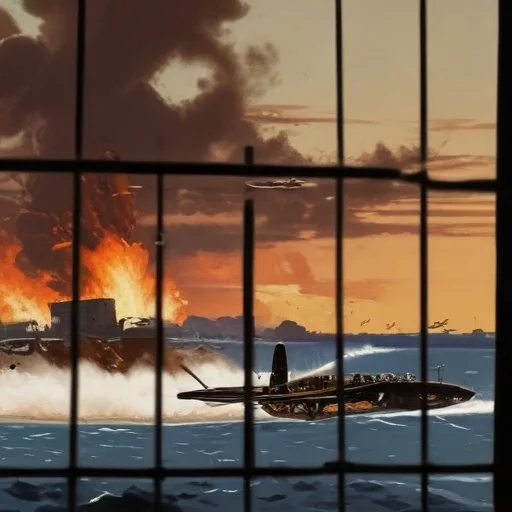
The Japanese attack was a textbook example of strategic planning and execution. Under the cover of darkness, six Japanese aircraft carriers, led by Admiral Isoroku Yamamoto, had crept within striking distance of Pearl Harbor, avoiding detection by the U.S. Navy's radar and patrols. At dawn, 353 Japanese fighters, bombers, and torpedo planes took to the skies, descending upon the unsuspecting American fleet like a swarm of deadly wasps.
The attack on Pearl Harbor left the U.S. Pacific Fleet reeling, with four battleships sunk, three damaged, and hundreds of aircraft destroyed or damaged. The Americans suffered 2,403 casualties, including 1,178 wounded and 1,925 missing or killed. Japan lost 29 planes, five midget submarines, and 64 servicemen.
The attack on Pearl Harbor galvanized American public opinion, with outrage and patriotism sweeping the nation. President Franklin D. Roosevelt's address to the U.S. Congress, in which he called the attack a "date which will live in infamy," was met with a near-unanimous declaration of war against Japan. The United States had officially entered World War II, joining the Allied forces in a global conflict that would ultimately claim millions of lives.
Survivors of the attack on Pearl Harbor would go on to share harrowing tales of sacrifice, bravery, and survival. One such story is that of Mess Attendant Third Class Doris Miller, who helped rescue wounded sailors and manned an anti-aircraft gun, earning him the Navy Cross and a place in American history.
Today, the USS Arizona Memorial at Pearl Harbor honors the lives lost during the attack, with a striking white monument suspended above the sunken battleship. The memorial is a poignant reminder of the devastating consequences of war and the importance of honoring our fallen heroes.
The attack on Pearl Harbor remains one of the most pivotal moments in American history, a devastating surprise attack that drew the United States into World War II. As we reflect on this fateful day, we are reminded of the importance of vigilance, honor, and sacrifice, and the enduring power of the human spirit in the face of adversity.
The attack on Pearl Harbor was not an isolated incident, but rather a culmination of decades of rising tensions between the United States and Japan. The Japanese had been expanding their empire in East Asia, and the U.S. had been responding with economic sanctions and embargoes. The Japanese needed access to Southeast Asia's oil and resources, but the U.S. Pacific Fleet stood in their way. The surprise attack was meant to weaken the U.S. enough to prevent it from interfering with Japanese expansion.
The U.S. had been monitoring Japanese naval movements, but a series of miscommunications and intel failures led to the devastating surprise. The Japanese had also been simulating attacks on Pearl Harbor in their training exercises, indicating that they had been planning this operation for some time.
The U.S. response was swift and decisive, with President Roosevelt declaring that the attack was a "date which will live in infamy." The U.S. would go on to declare war on Japan, and eventually on Germany and Italy as well. The attack on Pearl Harbor drew the U.S. into World War II, and the global conflict would shape the course of world history for decades to come.
Admiral Isoroku Yamamoto was the mastermind behind the attack on Pearl Harbor. A seasoned naval officer and strategist, Yamamoto had studied at Harvard University and was known for his innovative tactics. He believed that a surprise attack on the U.S. Pacific Fleet was the only way to prevent the U.S. from interfering with Japanese expansion in East Asia.
Yamamoto was a complex figure, with a deep appreciation for Western culture and a strong sense of duty to his country. He was opposed to war with the U.S., but he believed that it was necessary to secure Japan's interests. His leadership and tactical genius made the attack on Pearl Harbor a success, but at a great cost.
Yamamoto's legacy is still debated among historians today, with some viewing him as a heroic figure and others as a ruthless militarist. Regardless, his role in the attack on Pearl Harbor cannot be overstated.The attack on Pearl Harbor was a pivotal moment in the history of World War II, but it was not an isolated incident. In the months leading up to the attack, the Japanese had been making aggressive moves in East Asia, invading Indochina and threatening the Dutch East Indies.
The U.S. had been responding with economic sanctions, including an oil embargo that had severely limited Japan's ability to wage war. The Japanese had been seeking alternative sources of oil, but the U.S. had been blocking their efforts.
The situation was volatile, with both sides engaging in a series of provocative actions. The Japanese had been simulating attacks on Pearl Harbor in their training exercises, and the U.S. had been monitoring their naval movements. It was only a matter of time before the situation escalated into conflict.
The attack on Pearl Harbor had a profound impact on American culture, with the incident becoming a symbol of national sacrifice and resolve. The phrase "Remember Pearl Harbor" became a rallying cry, and the incident was used to mobilize public support for the war effort.
The attack also led to a wave of anti-Japanese sentiment in the U.S., with many Americans calling for revenge against Japan. This sentiment was reflected in the popular culture of the time, with films and propaganda posters often depicting the Japanese as barbaric and ruthless.
The attack on Pearl Harbor continues to be remembered today, with the incident featured prominently in popular culture and historical narratives. It remains a powerful symbol of American patriotism and sacrifice.The attack on Pearl Harbor was a testament to the power of military technology, with the Japanese using a range of innovative tactics and weapons to devastating effect. The use of aircraft carriers, dive bombers, and torpedo planes allowed the Japanese to launch a surprise attack on the U.S. Pacific Fleet, catching the Americans off guard.
The attack also highlighted the importance of radar and intelligence gathering, with the Japanese using clever tactics to evade detection by the U.S. Navy's radar systems. The U.S. response to the attack was hampered by a series of technological failures, including a lack of radar coverage and inadequate communication systems.
The lessons learned from the attack on Pearl Harbor would go on to shape the course of military technology in the decades that followed, with the U.S. investing heavily in radar, intelligence gathering, and naval aviation.