


The Battle of Guadalcanal, a pivotal campaign fought on the Solomon Islands from August 1942 to February 1943, is renowned for marking a crucial shift in the balance of power in the Pacific Theater during World War II. This brutal six-month battle ended in a decisive Allied victory, crippling the Japanese war machine and paving the way for the eventual defeat of Imperial Japan.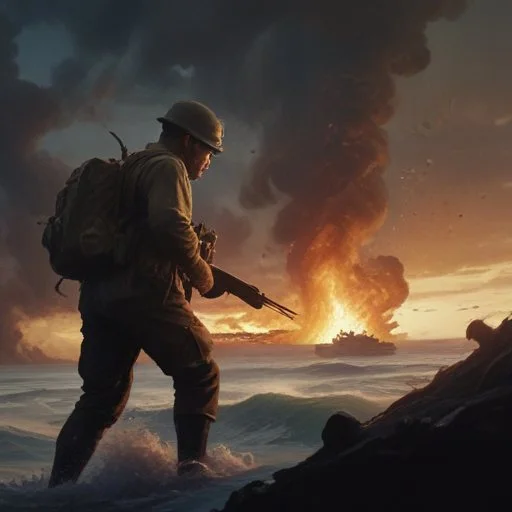
In the early months of 1942, Japanese forces swept across the Pacific, capturing key territories and threatening to sever the vital supply lines between the United States and Australia. To stem the tide of Japanese aggression, the United States launched a series of amphibious landings on the Solomon Islands, with the intention of securing the strategic airfield on Guadalcanal and disrupting Japanese supply lines.
The battle unfolded in three distinct phases:
The Battle of Guadalcanal had far-reaching consequences for the course of the war:
The Battle of Guadalcanal had a profound impact on American culture and society:
The battle was not without controversy, as criticisms emerged over the Allies' handling of the campaign:
"The enemy is a toughest opponent we've met so far. He's well-trained, well-equipped, and has a strong will to fight."
General Alexander Vandegrift"Guadalcanal was the turning point of the war in the Pacific. If we had not been victorious, it would have taken a much longer time to win the war."
General Douglas MacArthurA visual representation of the battle's key events and milestones:
| August 7, 1942 | Marines land on Guadalcanal |
| September 13, 1942 | Japanese forces launch first major counterattack |
| November 12, 1942 | Battle of Savo Island; Japanese sink USS Hornet |
| February 7, 1943 | Japanese forces withdraw from Guadalcanal |
The Battle of Guadalcanal inspired a generation of Americans, including a young John F. Kennedy, who would later become the 35th President of the United States:
"The courage and sacrifice of the Marines on Guadalcanal inspired me to enlist in the Navy and serve my country during World War II."
John F. KennedyThe Battle of Guadalcanal was a complex and multifaceted campaign that involved a series of amphibious landings, intense jungle fighting, and brutal naval battles. One of the most significant aspects of the battle was the innovative use of combined arms tactics by the Allies. The integration of air, land, and sea power allowed the Allies to gain a decisive advantage over the Japanese, who were forced to rely on more traditional tactics.
The Allied commanders, led by Vice Admiral Frank Fletcher and Lieutenant General Alexander Vandegrift, demonstrated exceptional flexibility and adaptability in the face of unexpected Japanese resistance. By rapidly adjusting their tactics and redeploying their forces, the Allies were able to overcome the initial Japanese advantage and secure a crucial foothold on the island.
The battle also saw the introduction of new military technologies, including the use of radar-guided artillery and amphibious tractors. These innovations significantly enhanced the Allies' combat capabilities and allowed them to overcome the challenging terrain and weather conditions on Guadalcanal.

Lieutenant General Alexander Vandegrift, the commander of the 1st Marine Division, played a crucial role in the Allied victory at Guadalcanal. A seasoned military leader with a reputation for bravery and tactical genius, Vandegrift possessed a deep understanding of the Japanese military mindset and was able to outmaneuver and outflank his opponents at every turn.
Vandegrift's leadership style was characterized by his emphasis on speed, surprise, and decisive action. He was a hands-on commander who led from the front, often exposing himself to danger in order to inspire his troops and gauge the battlefield situation.
Despite facing intense pressure and criticism from his superiors, Vandegrift remained resolute and focused, driving his troops forward with unyielding determination and energy. His unwavering commitment to the mission and his unshakeable confidence in his troops ultimately proved decisive in the Allied victory.
The Battle of Guadalcanal took place against the backdrop of a rapidly shifting global geopolitical landscape. The Japanese attack on Pearl Harbor in December 1941 had drawn the United States into the war, and the Allies were desperate to halt the Japanese advance in the Pacific.
The Solomon Islands, with their strategic location and vital airfields, were a crucial prize in the battle for control of the Pacific. The Allies knew that if they could secure the islands, they would be able to launch a series of counterattacks against Japanese-held territories and ultimately threaten the Japanese mainland.
The Guadalcanal campaign was therefore a pivotal moment in the war, marking a decisive shift in the balance of power in the Pacific and setting the stage for the ultimate defeat of Japan.
The Battle of Guadalcanal had a profound impact on American culture and society. The heroic performance of the Marines on Guadalcanal inspired a wave of patriotic fervor, with the public rallying behind the war effort and embracing the sacrifices of the military.
The battle also had a significant impact on the development of American popular culture. The exploits of the Marines on Guadalcanal inspired a wave of films, books, and songs, cementing the Marines' reputation as an elite fighting force.
The battle also helped to promote a sense of national unity and purpose, as Americans from all walks of life came together to support the war effort and celebrate the Allied victory.
The Battle of Guadalcanal provides a unique window into the military history of World War II. The campaign generated a vast array of artifacts and documents, including diaries, letters, and photographs, which provide a firsthand account of the battle.
One of the most fascinating artifacts from the battle is the diary of Lieutenant Colonel Lewis Burwell "Chesty" Puller, a legendary Marine Corps officer who played a key role in the campaign. Puller's diary provides a vivid and intimate account of the battle, offering insights into the thoughts and feelings of the Marines as they fought to secure the island.
The artifacts and documents from the Battle of Guadalcanal are a testament to the bravery and sacrifice of the soldiers who fought and died on the island. They serve as a powerful reminder of the human cost of war and the importance of preserving our military heritage.