


The iconic image of the American flag being raised atop Mount Suribachi, and the 36-day bloodbath that preceded it, are etched in the collective memory of World War II history. The Battle of Iwo Jima, fought between February 19 and March 26, 1945, was a brutal and decisive campaign that saw 30,000 United States Marines clash with entrenched Japanese forces on a tiny volcanic island in the Pacific.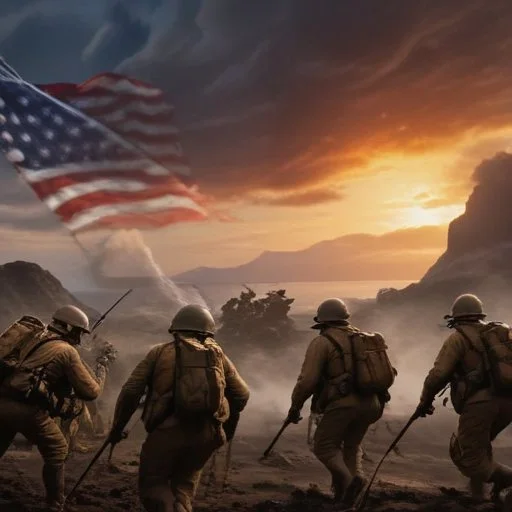
The strategic importance of Iwo Jima, located approximately 660 miles south of mainland Japan, cannot be overstated. The island's airfields, particularly Airfield No. 1, were crucial for the Allies' bombing campaign against Japan. The Japanese, aware of the island's significance, had heavily fortified it with a labyrinth of tunnels, bunkers, and artillery emplacements.
The battle unfolded in three distinct phases:
The Battle of Iwo Jima was a decisive victory for the Allies, securing a crucial airbase for launching bombing raids against mainland Japan. The campaign's outcome had far-reaching consequences:
The Battle of Iwo Jima has left an indelible mark on popular culture, inspiring films, literature, and art. The campaign's significance extends beyond the military sphere, underscoring the human cost of war and the importance of sacrifice:
The Battle of Iwo Jima was not without controversy, with debate surrounding the campaign's strategic relevance and the harsh treatment of Japanese prisoners:
The heroism and sacrifice exhibited during the Battle of Iwo Jima have been recognized through various awards and honors:
The Battle of Iwo Jima paved the way for the eventual invasion of Japan, and its significance extends to the broader context of World War II and beyond:
In conclusion, the Battle of Iwo Jima stands as a testament to the bravery and sacrifice of the soldiers who fought on both sides. The iconic images and intense fighting that characterized the battle have etched a lasting imprint on our collective understanding of World War II, while its lessons continue to resonate in the present day.
The origins of the Battle of Iwo Jima can be traced back to the early days of World War II. In 1944, the Allies had made significant gains in the Pacific Theater, capturing territories such as Guadalcanal, Tarawa, and Saipan. However, as they pushed closer to the Japanese mainland, it became apparent that a strategic airbase was needed to launch bombing raids against Japan.
The island of Iwo Jima, located approximately 660 miles south of mainland Japan, was identified as the ideal location for an airbase. The Japanese, aware of the island's significance, had heavily fortified it with a labyrinth of tunnels, bunkers, and artillery emplacements. General Douglas MacArthur, the Supreme Commander of the Allied Forces in the Pacific, knew that capturing Iwo Jima would provide a crucial stepping stone for the eventual invasion of Japan.
In July 1944, the Joint Chiefs of Staff approved Operation Detachment, a plan to capture Iwo Jima and construct an airbase on the island. The operation was led by Vice Admiral Richmond Kelly Turner, with Major General Harry Schmidt commanding the ground forces. After months of intense planning and preparation, the invasion force set sail for Iwo Jima on February 16, 1945.

Lieutenant General Tadamichi Kuribayashi, commander of the Japanese garrison on Iwo Jima, is often referred to as the "defender of Iwo Jima." Born in 1897, Kuribayashi graduated from the Imperial Japanese Army Academy and went on to serve as a cavalry officer in the Japanese Army.
In 1944, Kuribayashi was appointed commander of the Japanese garrison on Iwo Jima, where he oversaw the construction of the island's defenses. Kuribayashi was a highly respected and innovative commander who implemented unconventional tactics, such as burrowing tunnels and hiding artillery emplacements underground, to counter the Allies' superior firepower.
Despite being vastly outnumbered and outgunned, Kuribayashi's forces put up a fierce resistance against the Allied invasion. His leadership and tactical genius earned him a reputation as one of Japan's most brilliant generals of World War II.
The cultural impact of the Battle of Iwo Jima extends far beyond the military sphere. The iconic image of the American flag being raised atop Mount Suribachi has become a symbol of American sacrifice and resilience. The photograph, taken by Associated Press photographer Joe Rosenthal, is one of the most enduring images of World War II.
The battle has inspired numerous films, literature, and art, including the 1949 film "Sands of Iwo Jima" starring John Wayne, and James Bradley's 2000 book "Flags of Our Fathers." The United States Marine Corps War Memorial, dedicated in 1954, features a 32-foot-tall bronze statue of the Marines raising the flag on Mount Suribachi.
The artifacts recovered from the Battle of Iwo Jima provide a unique window into the experiences of the soldiers who fought on both sides. The Iwo Jima Museum of History, located on the island, houses a vast collection of artifacts, including personal belongings, weaponry, and documents.
One of the most significant artifacts is the original flag raised on Mount Suribachi, which is now on display at the National Museum of the Marine Corps in Quantico, Virginia. Other notable artifacts include Lieutenant General Kuribayashi's personal diary, which provides insight into the Japanese commander's thoughts and feelings during the battle.
The artifacts also shed light on the daily lives of the soldiers, including their uniforms, equipment, and personal effects. These artifacts serve as a poignant reminder of the human cost of war and the sacrifices made by those who fought on Iwo Jima.