


The Battle of Iwo Jima, fought from February 19 to March 26, 1945, will forever be etched in the annals of history as one of the most pivotal moments of World War II. And within that battle, one image stands tall – literally – as a symbol of hope, freedom, and American determination: the raising of the American flag on Mount Suribachi.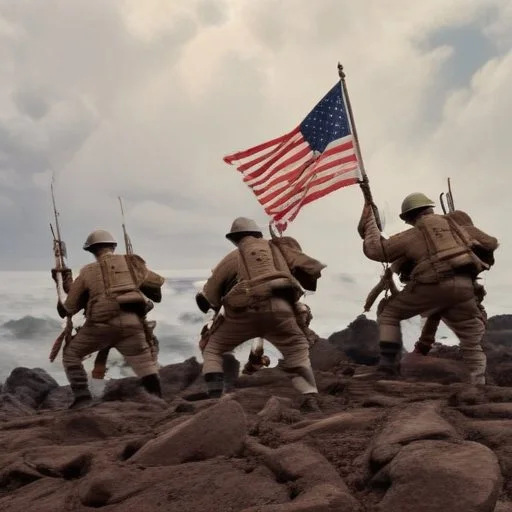
As the patrol reached the top, they found a Japanese radio antenna and a battered Japanese flag. Lieutenant Schrier ordered the American flag to be raised, and at 10:30 a.m., the Stars and Stripes fluttered in the Pacific breeze. The momentous act was captured by Joe Rosenthal's camera, producing one of the most iconic images of the 20th century.
The capture of Mount Suribachi and the raising of the American flag marked a critical turning point in the Battle of Iwo Jima. The event boosted American morale, signifying the imminent defeat of Japanese forces on the island. The photograph also became a powerful symbol of American determination and sacrifice, galvanizing the home front and inspiring a nation.
The flag-raising on Mount Suribachi has inspired countless works of art, literature, and film. From John Wayne's iconic portrayal of Sergeant Stryker in "The Sands of Iwo Jima" (1949) to Clint Eastwood's "Flags of Our Fathers" (2006), the event has been etched into the American cultural consciousness.
The flag-raising on Mount Suribachi shares parallels with other pivotal moments in military history, such as the planting of the Union Jack on Mount Everest in 1953 and the raising of the Soviet flag on the Reichstag in Berlin in 1945. Each of these events symbolized a nation's military prowess and resolve, while also transcending borders to represent humanity's pursuit of freedom and progress.
The heroism and sacrifice of the Marines who fought on Iwo Jima continue to inspire generations of Americans. The flag-raising on Mount Suribachi serves as a poignant reminder of the importance of patriotism, courage, and camaraderie in the face of overwhelming adversity.
The flag-raising on Mount Suribachi remains an enduring symbol of American strength, resilience, and determination, a testament to the bravery and sacrifice of the United States Marine Corps during World War II.
The Battle of Iwo Jima was a pivotal moment in World War II, but its significance extends beyond the war itself. The island of Iwo Jima was a strategic location, lying approximately halfway between Tokyo and the Mariana Islands, which made it an ideal spot for the Allies to launch bombing raids on mainland Japan. The capture of the island would provide a crucial airbase for the Allies, allowing them to launch more frequent and intense bombing missions against Japan.
The Japanese, however, were well aware of the island's importance and had heavily fortified it. The defenders, led by General Tadamichi Kuribayashi, had built an intricate network of tunnels, bunkers, and artillery emplacements, making it a formidable stronghold. The American military leadership recognized the challenge ahead, and the invasion was meticulously planned and rehearsed.
The amphibious assault on February 19, 1945, was preceded by a massive naval and aerial bombardment, aiming to soften up the Japanese defenses. Despite the intense preparations, the initial landing was met with fierce resistance, and the Americans suffered heavy casualties in the first few days of fighting. However, the Marine Corps' superior training, tactics, and sheer determination ultimately prevailed, and the island was gradually wrested from Japanese control.
Harlon Block, one of the six Marines who raised the American flag on Mount Suribachi, was a Texan who enlisted in the Marine Corps in 1943. Born on September 6, 1924, Block grew up in a ranching family and was an avid athlete, playing football and basketball in high school.
Block's Marine Corps career was marked by distinction, as he quickly rose through the ranks and became a sergeant. He was part of the 28th Regiment, 5th Marine Division, which was tasked with capturing Mount Suribachi during the Battle of Iwo Jima.
Tragically, Block's life was cut short on March 1, 1945, when he was killed in action during the intense fighting around Mount Suribachi. His bravery and sacrifice, however, will always be remembered, and his name has become synonymous with the iconic flag-raising moment.
The flag-raising on Mount Suribachi has had an enduring impact on American culture, inspiring countless works of art, literature, and film. The image has been reproduced, parodied, and reinterpreted in various forms, becoming an instantly recognizable symbol of American patriotism and determination.
In the years following the war, the flag-raising image was used in various forms of propaganda, including posters, stamps, and war bonds. It also inspired numerous works of literature, including James Bradley's bestselling book "Flags of Our Fathers," which tells the story of the six Marines who raised the flag.
The image has also been referenced in popular culture, appearing in films, television shows, and music. From Clint Eastwood's 2006 film "Flags of Our Fathers" to the iconic opening credits of the TV show "The West Wing," the flag-raising on Mount Suribachi continues to inspire and captivate audiences.
The American flag raised on Mount Suribachi was not the original flag intended for the task. The first flag, which was smaller and more worn, was replaced shortly after the iconic photograph was taken, as it was deemed too small to be seen from afar.
The replacement flag, which was larger and more visible, was sewn by Marie Pierson, a Marine Corps seamstress. The flag was made of cotton and measured 56 inches by 96 inches, making it easier to see from a distance.
Today, the original flag and its replacement are preserved and displayed at the National Museum of the Marine Corps in Quantico, Virginia. The flags serve as a poignant reminder of the bravery and sacrifice of the Marines who fought on Iwo Jima.
The Battle of Iwo Jima was a critical moment in the Pacific War, marking a significant shift in the balance of power in favor of the Allies. The capture of the island provided a crucial airbase for the Allies, allowing them to launch more frequent and intense bombing missions against Japan.
The Japanese, realizing the strategic importance of Iwo Jima, had heavily fortified the island, making it a formidable stronghold. The American victory, however, demonstrated the Allies' superior military power and marked a turning point in the war.
The flag-raising on Mount Suribachi symbolized the American determination to defeat Japan, and it boosted morale on the home front, galvanizing the nation behind the war effort. The image became an iconic symbol of American strength and resolve, transcending borders to represent humanity's pursuit of freedom and progress.