


The Battle of Iwo Jima, fought from February 19 to March 26, 1945, is remembered as one of the bloodiest and most iconic battles of World War II. The capture of Mount Suribachi, where six American Marines famously raised the Stars and Stripes, was a pivotal moment in the war, marking a crucial step towards the eventual defeat of Japan.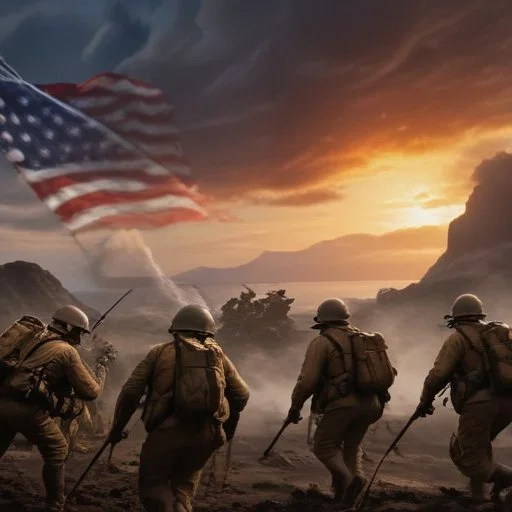
Iwo Jima, a tiny volcanic island located halfway between Tokyo and the Mariana Islands, was a strategic location in the Pacific Theater. The Japanese military had heavily fortified the island, with a complex network of tunnels, bunkers, and artillery emplacements. The Allies needed to capture the island to provide a vital airbase for their bombers, which would bring Japan within striking distance.
The capture of Iwo Jima provided a vital airbase for the Allies, allowing B-29 bombers to conduct raids on mainland Japan with ease. The island's proximity to Japan also made it an ideal location for fighter aircraft, which could provide air support for future invasions.
The battle was one of the bloodiest of the war, with over 26,000 American casualties, including nearly 7,000 deaths. The Japanese lost almost all of their 22,000 defenders, with only 216 prisoners taken.
The iconic image of the American flag-raising on Mount Suribachi, captured by Associated Press photographer Joe Rosenthal, became an enduring symbol of American determination and sacrifice during World War II.
The battle also spawned several famous quotes, including "Uncommon valor was a common virtue" from Admiral Chester W. Nimitz, and "Among the men who fought on Iwo Jima, uncommon valor was a common virtue" from General Alexander Vandegrift.
The Battle of Iwo Jima is often compared to the Battle of Okinawa, another brutal and pivotal battle fought in the Pacific Theater. Both battles marked a turning point in the war, as the Allies pushed towards the Japanese mainland.
While both battles were fiercely contested, Iwo Jima's unique geography and Japanese fortifications made it one of the most challenging battles of the war.
One of the most famous personal accounts of the battle is that of John Bradley, one of the six Marines who raised the American flag on Mount Suribachi. Bradley's story was immortalized in James Bradley's bestselling book, "Flags of Our Fathers."
The capture of Iwo Jima paved the way for the eventual invasion of Japan, which ultimately led to the country's surrender and the end of World War II.
The battle also marked a significant shift in the balance of power in the Pacific, as the Allies gained a strategic foothold in the region.
The Battle of Iwo Jima was awarded 27 Medals of Honor, the highest number awarded for any single battle in American history.
The Battle of Iwo Jima has been the subject of numerous books, films, and documentaries, ensuring that its legacy continues to inspire and educate future generations.
The bravery and sacrifice of the American forces on Iwo Jima serve as a powerful reminder of the importance of perseverance and determination in the face of overwhelming odds.
The battle's legacy continues to inspire and motivate people around the world, serving as a testament to the enduring power of human spirit and sacrifice.
The Battle of Iwo Jima was a culmination of years of strategic planning by the Allied forces. The island's location was crucial, as it provided a vital airbase for B-29 bombers to conduct raids on mainland Japan. The Allies had been searching for a location to establish a forward operating base, and Iwo Jima's proximity to Japan made it an ideal location.
In the months leading up to the battle, the Allies conducted extensive reconnaissance missions, gathering intelligence on the Japanese defenses and troop movements. This information was used to plan a coordinated attack, involving naval gunfire, airstrikes, and amphibious landings.
The Japanese, aware of the island's strategic importance, had heavily fortified Iwo Jima with a complex network of tunnels, bunkers, and artillery emplacements. They had also stationed a garrison of over 22,000 troops, led by General Tadamichi Kuribayashi, to defend the island.
Major General Harry Schmidt, commander of the 5th Marine Division, played a crucial role in the planning and execution of the Battle of Iwo Jima. Schmidt was a seasoned veteran, with extensive experience in amphibious warfare, and was handpicked by Admiral Raymond Spruance to lead the invasion.
Schmidt's leadership was instrumental in the success of the battle, as he coordinated the efforts of the various branches of the military, ensuring a unified command structure. His experience and tactical genius were also crucial in overcoming the formidable Japanese defenses.
The Battle of Iwo Jima is often compared to the Battle of Okinawa, another brutal and pivotal battle fought in the Pacific Theater. While both battles were fiercely contested, Iwo Jima's unique geography and Japanese fortifications made it one of the most challenging battles of the war.
Unlike Okinawa, which was a larger island with more diverse terrain, Iwo Jima was a small, volcanic island with limited scopes for maneuverability. The Japanese defenders took advantage of this, using the island's rugged terrain to their advantage. This made the battle more intense and brutal, with both sides suffering heavy casualties.
The Battle of Iwo Jima had a profound impact on American culture, symbolizing the country's determination and sacrifice during World War II. The iconic image of the American flag-raising on Mount Suribachi, captured by Associated Press photographer Joe Rosenthal, became an enduring symbol of American patriotism.
The battle also spawned several famous quotes, including "Uncommon valor was a common virtue" from Admiral Chester W. Nimitz, which became a rallying cry for the American people. The battle's legacy continues to inspire and motivate people around the world, serving as a testament to the power of human spirit and sacrifice.
The Battle of Iwo Jima was extensively documented by photographers and reporters, with over 200 journalists present on the island during the battle. The iconic flag-raising photograph, taken by Joe Rosenthal, is one of the most enduring images of World War II.
The flag itself, which was raised on Mount Suribachi, is now housed at the National Museum of the Marine Corps in Quantico, Virginia. The museum also houses other artifacts from the battle, including personal belongings of the Marines who fought on Iwo Jima.