


The Battle of Stalingrad, one of the most decisive and brutal conflicts of World War II, will forever be remembered for the daring counterattack launched by the Soviet Union forces under General Georgy Zhukov, codenamed Operation Uranus. This masterstroke of military strategy turned the tide of the battle in favor of the Soviets, encircling and ultimately defeating the German Sixth Army.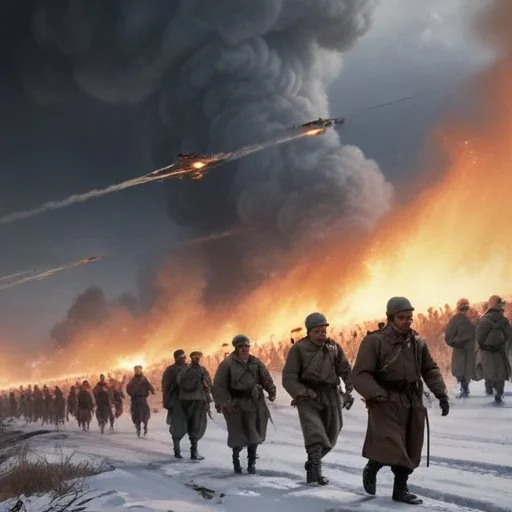
In the summer of 1942, the German Army, led by Adolf Hitler, embarked on a campaign to capture the city of Stalingrad (now Volgograd), a strategic stronghold on the Volga River. The German Sixth Army, under the command of General Friedrich Paulus, made rapid advances, pushing the Soviet forces back and besieging the city. However, the Soviets, determined to defend their motherland, refused to surrender.
General Georgy Zhukov, a seasoned military commander and one of the most prominent figures of the Soviet war effort, was instrumental in planning and executing Operation Uranus. Zhukov's military genius and unwavering determination played a crucial role in the success of the counterattack.
The success of Operation Uranus had far-reaching consequences, marking a significant turning point in the war. The defeat of the German Sixth Army led to:
The Battle of Stalingrad, and Operation Uranus in particular, holds a special place in Soviet and Russian cultural heritage. The heroic defense of the city and the triumphant counterattack symbolize the resilience and determination of the Soviet people.
"We will defend Stalingrad, or die in the attempt!" - General Georgy Zhukov, in a message to the Soviet troops before the launch of Operation Uranus.
Operation Uranus was a testament to the Soviet Union's ability to adapt and innovate in the face of adversity. This counterattack, along with other notable battles, such as the Battle of Moscow and the Siege of Leningrad, demonstrated the Soviet war effort's capacity for resilience and triumph in the face of overwhelming odds.
The Battle of Stalingrad, and the daring Operation Uranus counterattack, will forever be etched in the annals of history as a testament to the bravery, strategic genius, and unwavering determination of the Soviet Union and its people.
General Friedrich Paulus, the commander of the German Sixth Army, played a crucial role in the Battle of Stalingrad. Although he was a skilled military strategist, Paulus was often at odds with Adolf Hitler, who constantly intervened in military decisions. This tension would ultimately contribute to the German defeat. Paulus's leadership style was marked by caution and hesitation, which sometimes slowed down the German advance. Despite this, he remained committed to the battle, even when the situation became increasingly dire.

The Volga River, which runs through the city of Stalingrad, held significant cultural and symbolic meaning for the Soviet people. It was often referred to as the "Mother Volga," symbolizing the lifeblood of the Soviet nation. The battle for Stalingrad, therefore, was not only a military struggle but also a fight to protect the heart of the Soviet Union. The Volga River also played a crucial role in the Soviet war effort, serving as a vital transportation route for supplies and troops. The river's significance was further underscored by the Soviet Union's ability to maintain control over it, despite the German army's best efforts to capture the city.
The success of Operation Uranus was a testament to the Soviet Union's ability to adapt and innovate in the face of adversity. This counterattack, along with other notable battles, such as the Battle of Moscow and the Siege of Leningrad, demonstrated the Soviet war effort's capacity for resilience and flexibility. In contrast, the German military, despite its initial successes, struggled to adapt to the changing circumstances on the Eastern Front. This inflexibility ultimately contributed to their defeat at Stalingrad and elsewhere.

Stalingrad's location on the Volga River made it a crucial hub for transportation and communication between the Caucasus region and western Russia. Control of the city was essential for the German army to secure access to the oil fields of the Caucasus, which were critical to their war effort. Furthermore, Stalingrad's proximity to the Turkish border made it a vital strategic location for the Soviet Union, as it allowed them to maintain trade and communication links with the Middle East.
The Battle of Stalingrad had far-reaching economic consequences for both the Soviet Union and Germany. The Soviet Union's victory ensured the continued production of military equipment and supplies, while the German defeat led to a significant decline in their industrial production and war effort. The battle also disrupted the German economy, as the loss of the Sixth Army and the subsequent retreat led to a shortage of labor and resources. This had a devastating impact on the German war effort, ultimately contributing to their defeat.