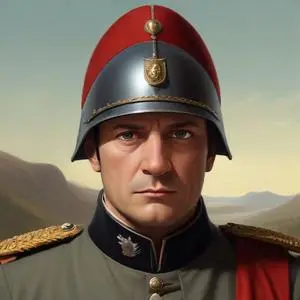
Friedrich Paulus: The German Generalfeldmarschall Who Surrendered at Stalingrad
The Infamous Surrender of the 6th Army
Friedrich Paulus is best known for his pivotal role in one of the most significant battles of World War II: the Battle of Stalingrad. As the commander of the German 6th Army, Paulus led his troops into the Battle of Stalingrad, which lasted from July 1942 to February 1943, only to ultimately surrender to the Soviet forces, marking a major turning point in the war.
Rise Through the Ranks
Born on September 23, 1890, in Guxhagen, Germany, Paulus came from a family of modest means. His father was a treasurer, and Paulus initially attempted to secure a cadetship in the Imperial German Navy, but was unsuccessful. He briefly studied law at Marburg University before joining the German Army in 1910. Paulus saw action in World War I, fighting in France and the Balkans, and by the time World War II broke out, he had risen through the ranks to major general.
Planning the Invasion of the Soviet Union
In 1940, Paulus was named deputy chief of the German Army General Staff, where he played a significant role in planning the invasion of the Soviet Union, Operation Barbarossa. His experience and knowledge of the Soviet military helped shape the German strategy, but ultimately, the operation ended in disaster.
The Battle of Stalingrad
In 1942, Paulus was given command of the 6th Army, despite lacking significant field experience. He led the drive to Stalingrad, but the Soviet counteroffensive encircled the German forces, leading to a prolonged and brutal battle. As the situation grew increasingly dire,
Adolf Hitler prohibited attempts to break out or capitulate, and the German defense was slowly worn down.
The Surrender
On January 31, 1943, the day he was informed of his promotion to field marshal by Hitler, Paulus surrendered to the Soviet forces. This marked the first time a German field marshal had been captured alive. Hitler expected Paulus to take his own life, but Paulus refused, citing his duty to his troops.
Life in Captivity and Later Years
During his imprisonment, Paulus became a vocal critic of the Nazi regime and joined the Soviet-sponsored National Committee for a Free Germany. After the war, he moved to East Germany, where he worked in military history research. Paulus spent the remainder of his life in Dresden, passing away on February 1, 1957.
Legacy and Impact
Paulus's surrender at Stalingrad marked a significant shift in the balance of power in World War II, and it remains one of the most infamous moments in military history. While his actions were widely criticized by the Nazi regime, Paulus's decision to surrender likely saved the lives of thousands of German soldiers. His later criticism of the Nazi regime and his work in military history research cemented his legacy as a complex and multifaceted figure.
Interesting Facts
- Paulus was known for his analytical mind and his ability to interpret complex military data.
- He was one of the few high-ranking German officers who spoke out against the Nazi regime.
- Paulus's surrender at Stalingrad led to a significant shift in the Soviet-German War, with the Soviet Union gaining the upper hand.
Conclusion
Friedrich Paulus's life and career were marked by controversy and complexity. From his early days as a promising young officer to his later years as a vocal critic of the Nazi regime, Paulus remained a fascinating figure. His surrender at Stalingrad will forever be etched in history as a turning point in World War II, and his legacy continues to be felt today.
FAQ
What was Friedrich Paulus role in World War II?
Friedrich Paulus was a German general during World War II, and he is best known for his command of the Sixth Army during the Battle of Stalingrad. He was responsible for leading the armys operations in the city and was ultimately forced to surrender in 1943.
What was the significance of Friedrich Paulus surrender at Stalingrad?
Friedrich Paulus surrender at Stalingrad was a major turning point in World War II, as it marked the first time a German field marshal had surrendered. It was a significant blow to German morale and led to a shift in the balance of power on the Eastern Front.
What were Friedrich Paulus final years like?
After his surrender, Friedrich Paulus was imprisoned by the Soviet Union until 1953. He then lived in East Germany, where he became a vocal critic of the Nazi regime and advocated for German-Soviet reconciliation. He died in 1957.
What was Friedrich Paulus early military career like?
Friedrich Paulus graduated from the Prussian Military Academy in 1910 and served in World War I. He remained in the military during the interwar period and rose through the ranks, becoming a general in 1939.
How is Friedrich Paulus remembered today?
Friedrich Paulus is remembered as a complex figure, both a skilled military leader and a loyal servant of the Nazi regime. His surrender at Stalingrad has been the subject of much debate and analysis, and he is often seen as a symbol of the German armys hubris and defeat.