


On the heels of the partially successful Vyborg-Petrozavodsk Offensive, the Soviet Union issued an ultimatum to Finland: surrender unconditionally or face the consequences. But the Finnish government, undaunted by the looming threat, refused to back down, setting the stage for a perilous game of resistance and defiance.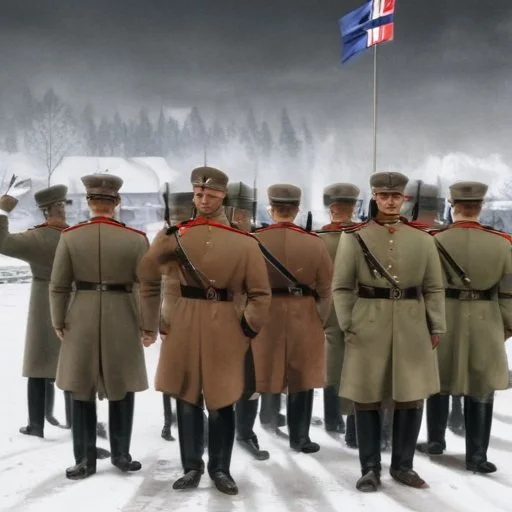
In the tumultuous landscape of World War II, Finland found itself in a precarious position. Having signed the Moscow Peace Treaty in 1940, Finland was forced to cede significant territory to the Soviet Union. However, as the war raged on, Finland's ties to Nazi Germany strengthened, much to the chagrin of the Soviet Union. The Continuation War, fought between Finland and the Soviet Union from 1941 to 1944, was a direct result of these shifting allegiances.
The Finnish government's refusal to surrender had significant consequences. Despite being vastly outnumbered and outgunned, Finland's military managed to hold off the Soviet Union's advances, albeit at great cost. The war ultimately ended in September 1944, with Finland agreeing to the Moscow Armistice. While Finland lost significant territory and faced heavy reparations, its defiance in the face of Soviet demands had secured its independence.
The Continuation War and Finland's subsequent defiance had a profound impact on Finnish culture and society. The war effort became a symbol of national pride, with many Finns seeing it as a struggle for independence and self-determination. The war also led to increased national unity, as Finns rallied around their government and military.
"We will not yield, we will not surrender. We will fight until the end, for our country, our freedom, and our people." - Carl Gustaf Mannerheim
One Finnish soldier's account of the Vyborg-Petrozavodsk Offensive paints a vivid picture of the war's brutality: "We were outnumbered, outgunned, and exhausted. But we refused to give up. We fought for every inch of land, for every tree, for every rock. We fought for Finland."
The Finnish government's refusal to surrender had far-reaching implications for Finland's post-war reconstruction. The nation's defiance in the face of Soviet demands earned it a level of international respect, paving the way for Finland's integration into the global community.
The Finnish government awarded the Mannerheim Cross, Finland's highest military honor, to several soldiers and officers who demonstrated exceptional bravery during the Continuation War.
The Continuation War was not without its controversies. Accusations of war crimes and human rights abuses were leveled against both Finnish and Soviet forces. While these allegations tarnished the war's legacy, they also served as a catalyst for post-war reform and reconciliation.
The story of Finland's defiance in the face of Soviet demands serves as a powerful testament to the human spirit's capacity for resilience and determination. In the face of overwhelming odds, Finland's leaders and soldiers refused to yield, inspiring generations to come.
In conclusion, the Finnish government's refusal to surrender to Soviet demands during the Continuation War remains a powerful symbol of national pride and defiance. Despite the war's devastating consequences, Finland's unwavering spirit continues to inspire and motivate people around the world.
The Continuation War was fought against the backdrop of a delicate balance of power in Europe. The Soviet Union's push into Finland was part of a larger strategy to expand its territory and secure its borders. Meanwhile, Nazi Germany's influence in the region was growing, and Finland's alliance with Germany was a key factor in the Soviet Union's decision to issue an ultimatum. The war was a complex web of alliances and rivalries, with Finland caught in the middle.
The war also had significant implications for the global balance of power. The Soviet Union's aggression in Finland was seen as a test of the Western powers' resolve, and the Finnish government's defiance was viewed as a beacon of resistance against Soviet expansionism. The war ultimately contributed to the formation of the Eastern Bloc and the Cold War, as the Soviet Union solidified its grip on Eastern Europe.
The Continuation War had a profound impact on Finnish culture and identity. The war effort became a symbol of national pride, with many Finns seeing it as a struggle for independence and self-determination. The war also led to increased national unity, as Finns rallied around their government and military.
The war influenced Finnish art, literature, and music, with many artists and writers drawing inspiration from the conflict. The war also led to a resurgence of interest in Finnish folklore and mythology, as people sought to connect with their cultural heritage.
Today, the Continuation War is remembered as a defining moment in Finnish history, and its legacy continues to shape Finnish identity and culture.
The Continuation War was one of several conflicts fought on European soil during World War II. While it shared some similarities with other wars, such as the Soviet Union's aggression and the theme of resistance against occupation, it also had some unique characteristics.
Compared to the war on the Eastern Front, the Continuation War was a relatively small conflict, with fewer troops and less territory at stake. However, the war was significant in its own right, as it was one of the few instances of a smaller power resisting the Soviet Union's military might.
The Continuation War also had some parallels with the Winter War, fought between Finland and the Soviet Union in 1939-1940. Both wars were fought over territory and sovereignty, and both saw Finland resisting Soviet aggression. However, the Continuation War was fought in a vastly different geopolitical context, with the Soviet Union's power and influence greatly expanded.
Carl Gustaf Mannerheim was a Finnish military leader and statesman who played a crucial role in the Continuation War. As Commander-in-Chief of the Finnish Defense Forces, Mannerheim was instrumental in shaping Finland's military strategy and leading the country's resistance against the Soviet Union.
Mannerheim was a complex figure, known for his bravery, strategic thinking, and unwavering commitment to Finland's independence. He was also a skilled diplomat, able to navigate the treacherous waters of international politics and maintain relationships with key allies.
Throughout the war, Mannerheim remained a symbol of Finnish resistance, inspiring his troops and rallying the nation behind the war effort. His leadership and vision helped to secure Finland's independence, and he remains one of the most revered figures in Finnish history.
The Soviet ultimatum to Finland, issued on June 1944, is a significant artifact of the Continuation War. The ultimatum, which demanded Finland's unconditional surrender, was a key moment in the conflict, marking the beginning of the Soviet Union's push into Finnish territory.
The document itself is a stark reflection of the Soviet Union's aggressive intentions, with its language and tone conveying a sense of urgency and menace. The ultimatum's demands were sweeping, requiring Finland to cede significant territory and accept Soviet occupation.
Today, the Soviet ultimatum is preserved in the Finnish National Archives, serving as a powerful reminder of the war's significance and the bravery of the Finnish people in the face of overwhelming odds.