


The largest naval battle in history, the Battle of Leyte Gulf, marks a crucial turning point in World War II, as the Imperial Japanese Navy makes a last-ditch effort to regain control of the war. Fought from October 23 to October 26, 1944, this four-day battle sees the Japanese launch a complex, multipronged assault on the Allied forces, in a bid to break through the American naval blockade and secure a vital supply route.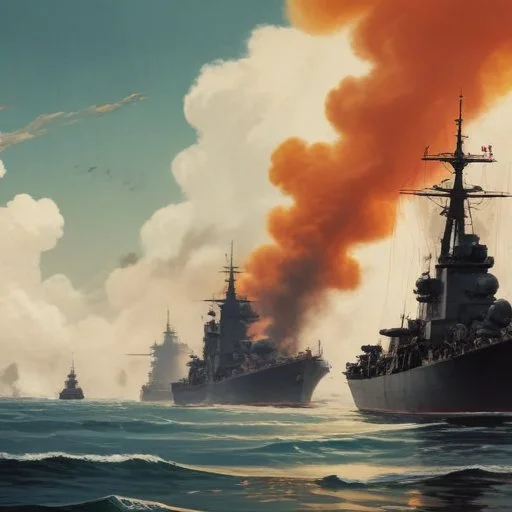
In the autumn of 1944, the Japanese Empire, once seemingly invincible, is reeling from a string of defeats. With their supply lines stretched thin and their air power dwindling, the Japanese Navy, under the command of Admiral Soemu Toyoda, concocts a daring plan to turn the tide of the war. The plan, dubbed "Sho-1," involves a series of simultaneous attacks on the Allied forces, aimed at breaking through the American naval blockade and securing a vital supply route through the Philippines.
At the heart of the battle are two men: Admiral William F. Halsey Jr., commander of the U.S. Third Fleet, and Vice Admiral Takeo Kurita, commander of the Japanese Center Force. Halsey, a seasoned veteran of the Pacific War, is tasked with protecting the Allied invasion force, while Kurita, a skilled tactician, is determined to pierce the American defenses and secure a vital victory for the Japanese.
As the two forces clash, the battle rages across the seas, with four separate engagements taking place simultaneously. The Japanese Southern Force, led by Vice Admiral Shoji Nishimura, attempts to break through the Surigao Strait, while the Northern Force, led by Vice Admiral Jisaburo Ozawa, launches a diversionary attack on the U.S. Third Fleet. Meanwhile, the American escort carriers, tasked with protecting the invasion force, find themselves outnumbered and outgunned by the Japanese Center Force.
The Battle of Leyte Gulf is a crushing defeat for the Japanese Navy, with four aircraft carriers, three battleships, and numerous smaller vessels lost. The Allies, though shaken, emerge victorious, having protected the invasion force and secured a vital foothold in the Philippines. The battle marks a decisive turning point in the war, as the Japanese Empire begins its slow and painful decline.
The Battle of Leyte Gulf serves as a testament to the bravery and sacrifice of all those who fought, on both sides of the conflict. Today, the battle is remembered as a shining example of naval warfare, with its complex tactics and daring gambles studied by military strategists around the world. As we reflect on this pivotal moment in history, we are reminded of the enduring importance of courage, determination, and sacrifice in the face of overwhelming odds.
As the war raged on, the Japanese Navy's strategy shifted from a traditional "decisive battle" approach to a more unconventional "death ride" tactic, where ships and sailors would be sacrificed to inflict maximum damage on the enemy. This shift in strategy was a result of the Japanese Navy's dwindling resources and the Allies' increasingly strong naval blockade.
This desperate gamble was evident in the Battle of Leyte Gulf, where the Japanese Navy committed almost its entire fleet, including its last remaining aircraft carriers, to a single, high-stakes battle. The outcome was a foregone conclusion, but the Japanese Navy's bravery and sacrifice would go down in history as one of the most daring and tragic naval battles of all time.

Vice Admiral Takeo Kurita, commander of the Japanese Center Force, was a skilled tactician and a veteran of the Pacific War. Born in 1889, Kurita graduated from the Imperial Japanese Naval Academy and went on to serve in various capacities, including as a naval attaché in the United States and as a commander of the Japanese Navy's cruiser division.
Kurita's leadership during the Battle of Leyte Gulf was marked by a series of bold decisions, including his decision to press on towards the Philippines despite being outgunned and outnumbered. His bravery and determination earned him the respect of his enemies, who would later describe him as a "formidable foe."
The Battle of Leyte Gulf was a clash of two vastly different naval strategies. The Japanese Navy, led by Admiral Soemu Toyoda, favored a more traditional approach, relying on battleships and cruisers to engage the enemy in a close-quarters battle. In contrast, the U.S. Navy, led by Admiral William F. Halsey Jr., had adopted a more modern approach, relying on aircraft carriers and destroyers to launch aerial attacks and protect its convoys.
This contrast in strategies would play a decisive role in the battle, as the U.S. Navy's superior air power and mobility allowed it to outmaneuver and outgun the Japanese Navy. The battle would serve as a harbinger of the future of naval warfare, where aircraft carriers would become the primary capital ships.

The Battle of Leyte Gulf took place against the backdrop of a broader struggle for control of Southeast Asia. The Philippines, with its strategic location and abundant resources, was a crucial prize in the war, and the Allies were determined to retake the islands from the Japanese.
The battle was also influenced by the larger geopolitical context, as the Allies and Axis powers jockeyed for position in the final months of the war. The Japanese Navy's last-ditch effort to regain control of the Philippines was seen as a desperate attempt to stave off defeat, while the Allies' victory would pave the way for the eventual invasion of Japan.
Historians have long debated the significance of the Battle of Leyte Gulf, with some arguing that it marked a decisive turning point in the war and others seeing it as a last-gasp effort by a dying empire.
One school of thought holds that the battle was a Pyrrhic victory for the Allies, as the Japanese Navy's sacrifice had bought time for the Japanese Army to regroup and prepare for a final defense of the Japanese homeland. Others argue that the battle marked a decisive shift in the balance of power, as the Allies' superior resources and strategy would eventually wear down the Japanese defenses.