


On February 14, 1945, the city of Dresden, Germany, was transformed into a blazing inferno as the British Royal Air Force and the United States Army Air Forces unleashed a devastating firebombing campaign. This fateful night would forever be etched in history as one of the most destructive and deadly air raids of World War II, leaving behind a scarred landscape and a legacy of controversy.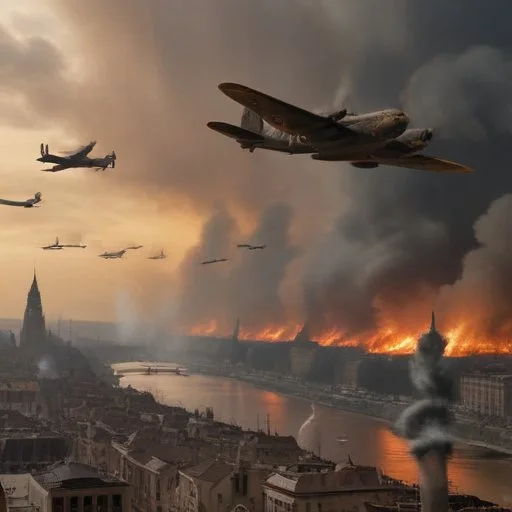
Dresden, a city steeped in art, architecture, and culture, was an unlikely target for the Allies. Known as the "Florence on the Elbe," Dresden was home to exquisite baroque palaces, opera houses, and museums, earning it a reputation as one of Europe's most beautiful cities. However, its strategic location made it a crucial hub for German war efforts, and the Allies saw it as a key target to cripple the enemy's ability to wage war.
On the night of February 14, a fleet of over 800 British Lancaster bombers, accompanied by 300 USAAF bombers, descended upon Dresden, dropping a combined 3,900 tons of high-explosive bombs and incendiary devices. The city's defenses were quickly overwhelmed, and a firestorm of unprecedented proportions erupted, fueled by the densely packed wooden buildings and narrow streets.
The bombing campaign was precision-planned to create maximum destruction. The British bombers dropped high-explosive bombs to blow out windows and doors, followed by the American bombers releasing incendiary devices to ignite the exposed structures. The resulting Inferno engulfed the city, generating hurricane-force winds that spread the flames and made escape impossible for those trapped inside.
The bombing of Dresden resulted in one of the highest civilian casualty rates of World War II. Estimates vary, but it's believed that between 25,000 to 50,000 people lost their lives in the raid, with many more injured or displaced. The city's infrastructure was reduced to rubble, leaving survivors to navigate the treacherous landscape of smoldering ruins and twisted metal.
The destruction was so complete that it would take years for Dresden to rebuild and recover. The city's cultural heritage was irreparably damaged, with many priceless art pieces and historical artifacts lost forever in the flames.
The bombing of Dresden remains one of the most controversial actions of World War II, with critics arguing that the attack was excessive and indiscriminate. The debate continues to this day, with some believing that the bombing was a necessary evil to hasten the war's end, while others see it as a war crime that targeted a largely civilian population.
The raid has also been shrouded in mystery, with questions surrounding the true motivations behind the attack and the role of high-ranking officials in planning the operation. The Dresden bombing has become a lightning rod for discussions on the ethics of war and the morality of civilian casualties.
The bombing of Dresden left an indelible mark on the survivors, many of whom suffered unimaginable trauma and loss. One such survivor, Margret Fröhlich, recalled the horrors of that night: "The screams of the people, the cries of the children, the roar of the flames... It was like the end of the world."
Another survivor, Victor Klemperer, a Jewish professor who lived in Dresden, wrote extensively about the bombing in his diary: "The night was a single, long-drawn-out scream of terror... The city was a furnace, a huge, burning tomb."
The bombing of Dresden served as a harbinger of the devastating power of aerial warfare, foreshadowing the atomic bombings of Hiroshima and Nagasaki later that year. The raid also underscored the importance of preserving cultural heritage in times of conflict, as the world witnessed the destruction of a city steeped in history and beauty.
The legacy of the Dresden bombing continues to resonate today, serving as a poignant reminder of the human cost of war and the importance of promoting peace and diplomacy in international relations.
The city of Dresden was not only a cultural hub but also a strategic location for the German war effort. The city was home to several key military installations, including a major rail yard, airfields, and a significant military command center. The Allies had been monitoring the city's military activities, and intelligence reports suggested that Dresden was a crucial hub for German troop movements and supply lines.
In the months leading up to the bombing, the Allies had been conducting a series of strategic bombing campaigns against German cities, targeting industrial and military installations. Dresden, however, was considered a "virgin target" – a city that had not been heavily bombed before, making it an attractive target for the Allies.
The bombing of Dresden was also seen as an opportunity to demonstrate the Allies' military might and to weaken the German people's morale. The Allies believed that a devastating attack on a cultural center like Dresden would have a profound psychological impact on the German population, eroding their will to continue fighting.

Arthur "Bomber" Harris, the British Air Chief Marshal, was a key figure in the planning and execution of the Dresden bombing campaign. Harris was a strong advocate for area bombing, believing that targeting civilian populations and industrial centers was the most effective way to weaken the enemy's war effort.
Harris's tenure as Air Chief Marshal was marked by controversy, and he was criticized for his aggressive bombing campaigns. Despite this, he remained a strong supporter of the Dresden bombing, viewing it as a necessary evil to bring a swift end to the war.
Harris's role in the Dresden bombing has been the subject of much debate, with some historians arguing that he exercised excessive zeal in pushing for the bombing campaign.
The bombing of Dresden is often compared to the atomic bombings of Hiroshima and Nagasaki, which occurred later that year. While both events were devastating in their scope and impact, there are significant differences between the two.
Unlike Hiroshima and Nagasaki, which were primarily military targets, Dresden was a cultural and civilian center. The bombing of Dresden was also part of a larger campaign of area bombing, whereas the atomic bombings were tactical strikes aimed at specific military targets.
Despite these differences, all three events serve as powerful reminders of the devastating consequences of war and the importance of promoting peace and diplomacy in international relations.

The bombing of Dresden had a profound impact on the city's cultural heritage, with many priceless art pieces and historical artifacts lost forever in the flames. The Zwinger Palace, a stunning example of Baroque architecture, was destroyed, along with several other cultural landmarks.
The bombing also had a significant impact on the city's musical heritage, with the iconic Semper Opera House being severely damaged. The opera house, which had hosted some of the most renowned performers in Europe, was left in ruins, its rich cultural history seemingly lost forever.
In the years following the bombing, Dresden worked to rebuild and restore its cultural heritage, but the loss was still deeply felt, and the city would never be the same.
The bombing of Dresden was a highly political event, with the Allies seeking to weaken the German war effort and undermine the Nazi regime. The bombing was also seen as a way to demonstrate the Allies' military might and to exert pressure on the German government to surrender.
The bombing campaign was heavily influenced by political considerations, with the British and American governments debating the merits of targeting civilian populations. The bombing of Dresden was ultimately approved by British Prime Minister Winston Churchill, who saw it as a necessary evil to bring a swift end to the war.
The political fallout from the bombing was significant, with many questioning the morality of targeting civilian populations and the long-term consequences of such actions.