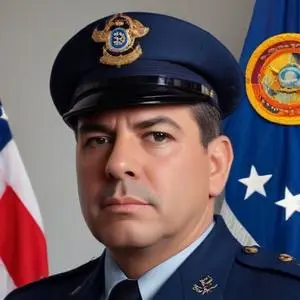
Curtis LeMay: The Architect of Strategic Bombing
Known for Controversial yet Effective Campaigns
Curtis LeMay, a US Air Force general, is renowned for implementing a series of controversial yet effective strategic bombing campaigns in the Pacific theater of World War II. His tactics, although criticized for their brutality, significantly contributed to the Allied forces' victory and shaped the dynamics of modern warfare.
Early Life and Military Career
Born on November 15, 1906, in Columbus, Ohio, LeMay joined the United States Army Air Corps in 1929 while studying civil engineering at Ohio State University. He rose through the ranks, becoming a major by the time of Japan's attack on Pearl Harbor in December 1941.
World War II and the Pacific Theater
LeMay's military career gained momentum during World War II, where he commanded the 305th Bombardment Group and the 3rd Air Division in the European theater. In August 1944, he was transferred to the China Burma India Theater, where he planned and executed a massive firebombing campaign against Japanese cities, including the infamous attack on Tokyo. This campaign, although controversial, significantly weakened Japan's war efforts.
Post-War Era and the Berlin Airlift
Following the war, LeMay was assigned to command USAF Europe, where he played a crucial role in coordinating the Berlin Airlift, a massive effort to supply West Berlin during the Soviet Union's blockade.
Strategic Air Command and the Cold War
LeMay served as commander of the Strategic Air Command (SAC) from 1948 to 1957, presiding over the transition to an all-jet aircraft force with a strong emphasis on nuclear weapons delivery. This period marked the inception of the Cold War, and LeMay's leadership played a pivotal role in shaping the US military's response to the Soviet threat.
Chief of Staff of the Air Force and Later Years
As Chief of Staff of the Air Force from 1961 to 1965, LeMay called for the bombing of Cuban missile sites during the Cuban Missile Crisis and advocated for a sustained bombing campaign against North Vietnam during the Vietnam War. After retiring from the Air Force in 1965, LeMay agreed to serve as Alabama Governor
George Wallace's running mate on the American Independent Party ticket in the 1968 United States presidential election.
Philosophical Contributions and Beliefs
LeMay's military philosophy was shaped by his belief in the importance of airpower in modern warfare. He was a strong proponent of strategic bombing, advocating for the use of aerial campaigns to weaken enemy nations and pave the way for ground offensives. Although criticized for his tactics, LeMay remained unwavering in his conviction that airpower held the key to military success.
Awards and Honors
- Distinguished Service Medal with three oak leaf clusters
- Legion of Merit
- Distinguished Flying Cross with two oak leaf clusters
- Air Force Commendation Medal
- French Legion of Honor
Legacy and Impact on Modern Society
Curtis LeMay's legacy is complex, marked by both praise and criticism. While his strategic bombing campaigns remain controversial, they undeniably contributed to the Allied forces' victory in World War II. His leadership in the post-war era and his role in shaping the US military's response to the Cold War have left an indelible mark on modern military strategy.
Curtis LeMay's story serves as a testament to the complexities of war and the difficult choices faced by military leaders. While his actions may be subject to interpretation, his impact on modern warfare is undeniable.
Personal Milestones and Key Life Events
- November 15, 1906: Born in Columbus, Ohio
- 1929: Joined the United States Army Air Corps
- 1941: Became a major
- 1944: Transferred to the China Burma India Theater
- 1948-1957: Commanded the Strategic Air Command
- 1961-1965: Served as Chief of Staff of the Air Force
- 1968: Ran as Alabama Governor George Wallace's running mate
- October 1, 1990: Passed away
Trivia and Fun Facts
- LeMay was known for his rugged, no-nonsense demeanor, earning him the nickname "Iron Ass."
- He was a strong advocate for the development of the B-52 bomber.
- LeMay was an avid outdoorsman and enjoyed hunting and fishing.
Influence on Pop Culture
LeMay's persona has been referenced in various forms of media, including films, literature, and television shows. His controversial yet effective tactics have made him a fascinating figure, captivating the imagination of writers and filmmakers alike.
Curtis LeMay's story serves as a testament to the complexities of war and the difficulties faced by military leaders. While his actions may be subject to interpretation, his impact on modern warfare is undeniable.
FAQ
What is Curtis LeMays most notable military achievement?
Curtis LeMays most notable military achievement is his leadership during World War II, where he played a crucial role in the development of the United States strategic bombing campaign.
What is Curtis LeMays role in the development of the US Air Force?
Curtis LeMay played a significant role in the development of the United States Air Force, serving as its Vice Chief of Staff and later as Chief of Staff, modernizing the force and shaping its strategic doctrine.
What awards and recognition did Curtis LeMay receive?
Curtis LeMay received numerous awards and recognition for his military service, including the Distinguished Service Medal, Legion of Merit, and the French Croix de Guerre.
How did Curtis LeMay impact air power doctrine?
Curtis LeMays impact on air power doctrine was profound, as he helped develop the concept of strategic bombing and advocated for the importance of air power in modern warfare.
What is Curtis LeMays legacy in the US military?
Curtis LeMays legacy in the US military is one of innovative leadership and strategic vision, shaping the course of modern air power and inspiring future generations of military leaders.