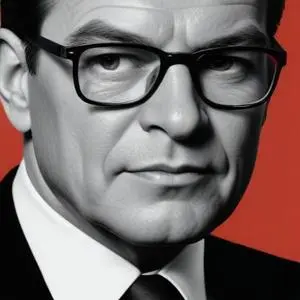
A Life of Controversy and Complexity: Robert McNamara
The Architect of the Vietnam War
Robert McNamara is perhaps best known for his role as the eighth United States Secretary of Defense, serving from 1961 to 1968 under Presidents
John F. Kennedy and
Lyndon B. Johnson. His tenure was marked by a significant escalation of the United States' involvement in the Vietnam War, which would go on to become one of the most controversial and divisive conflicts in American history.
A Life of Service
Born on June 9, 1916, in San Francisco, California, McNamara graduated from the University of California, Berkeley, and later earned an MBA from Harvard Business School. During World War II, he served in the United States Army Air Forces, where he quickly rose through the ranks and became a statistician. After the war, he was recruited by
Henry Ford II to work at the Ford Motor Company, where he became part of a group of young executives known as the "Whiz Kids." This experience would shape his approach to management and decision-making, which he would later apply to his role in the government.
Rise to Power
In 1961, McNamara was appointed Secretary of Defense by President Kennedy, a role that would cement his legacy as a shrewd and calculating strategist. He quickly became a close adviser to the President, advocating for the use of a blockade during the Cuban Missile Crisis. He also championed a Cold War defense strategy of flexible response, which anticipated the need for military responses short of massive retaliation.
Vietnam and Controversy
McNamara's role in the Vietnam War is a controversial and complex chapter in his life. He presided over a significant buildup of U.S. troops in South Vietnam, which would eventually escalate into a full-scale conflict. McNamara's policies were shaped by his belief in the "domino theory," which posited that if South Vietnam fell to communism, other governments in the region would follow suit. However, his actions were also driven by a desire to prove himself as a strong and decisive leader, which would lead to catastrophic consequences for the United States and Vietnam.
Later Life and Reflections
In 1968, McNamara resigned as Secretary of Defense, citing the toll that the war was taking on his personal life. He later went on to serve as the President of the World Bank, where he focused on reducing poverty and promoting economic development in developing countries. In his later years, McNamara became increasingly critical of his own role in the Vietnam War, acknowledging that he had made mistakes and that the war had been a tragic mistake.
Legacy and Impact
Robert McNamara's legacy is complex and multifaceted. While he is widely regarded as one of the most influential and accomplished public servants of the 20th century, he is also remembered for his role in the Vietnam War, which remains a source of pain and controversy for many Americans. Despite this, his contributions to the field of policy analysis and his commitment to public service are undeniable.
Personal Milestones and Key Life Events
- June 9, 1916: Born in San Francisco, California
- 1937: Graduated from the University of California, Berkeley
- 1939: Earned an MBA from Harvard Business School
- 1941: Entered the United States Army Air Forces during World War II
- 1946: Recruited by Henry Ford II to work at the Ford Motor Company
- 1961: Appointed Secretary of Defense by President Kennedy
- 1968: Resigned as Secretary of Defense
- 1968-1981: Served as President of the World Bank
- July 6, 2009: Passed away at the age of 93
Quotes and Memorable Sayings
- "The fog of war is not a metaphor; it's a real thing."
- We "damned erred" in our estimate of the Vietnam War.
Historical Context and Legacy
Robert McNamara's life and legacy are inextricably linked to the tumultuous events of the 1960s. His role in shaping U.S. foreign policy and his contributions to the field of policy analysis are undeniable. However, his legacy is also marked by controversy and tragedy, serving as a reminder of the complexities and uncertainties of human decision-making.
FAQ
What were Robert McNamaras accomplishments as US Secretary of Defense?
Robert McNamara served as the 8th US Secretary of Defense from 1961 to 1968, playing a key role in shaping US foreign policy during the Cold War era. He is known for his instrumental role in the Cuban Missile Crisis and his early support for the Vietnam War.
What was Robert McNamaras role in the Ford Motor Company?
Before entering politics, Robert McNamara was a successful businessman who rose through the ranks to become the first non-Ford family member to become President of the Ford Motor Company in 1960.
What were Robert McNamaras views on the Vietnam War?
Robert McNamara initially supported the Vietnam War, but later became a vocal critic of the conflict, stating that it was a mistake and that the US had failed to understand the nature of the war.
What was Robert McNamaras role in the World Bank?
After leaving the Defense Department, Robert McNamara served as President of the World Bank from 1968 to 1981, where he focused on poverty reduction and international development.
What was Robert McNamaras legacy?
Robert McNamaras legacy is complex and controversial, marked by both significant achievements and criticisms of his role in the Vietnam War and his policies as Secretary of Defense.