


The Blitz, a merciless bombing campaign by the German Luftwaffe, shook the very foundations of Britain, leaving behind a trail of devastation, death, and destruction that would haunt the nation for decades to come. For 50 consecutive nights, starting on September 7, 1940, the Luftwaffe rained down terror on London and other major British cities, targeting civilians, factories, and infrastructure with ruthless precision.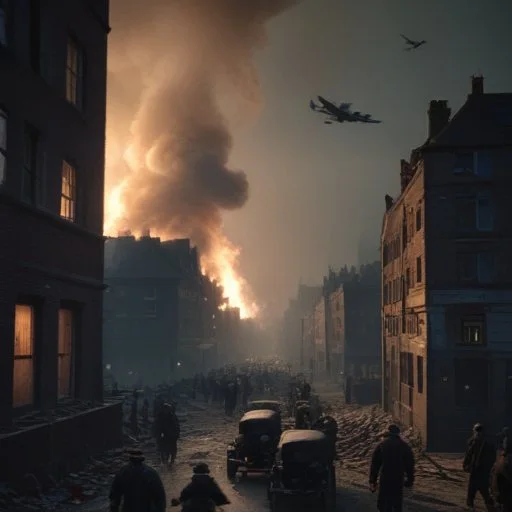
The Blitz was a tactical shift in the German war strategy, employing terror bombing to break the British spirit and hasten surrender. The Luftwaffe's air campaign was designed to cripple Britain's industrial and economic infrastructure, paving the way for a potential invasion. Hermann Göring, the Luftwaffe's commander-in-chief, orchestrated the campaign, confident that his air force could bring Britain to its knees.
The Blitz claimed the lives of over 43,000 civilians, injured countless others, and left more than a million people homeless. The relentless bombing raids reduced entire city blocks to rubble, leaving behind a landscape of destruction and despair. London's historic landmarks, such as Buckingham Palace and the Tower of London, were not spared, and the city's cultural heritage was forever scarred.
The Blitz had a profound impact on British culture and society. The shared experience of terror and resilience forged a sense of national unity and resolve. The Blitz spirit, as it came to be known, inspired a wave of patriotic fervor, with Britons from all walks of life rallying behind the war effort. The Blitz also shaped the country's literary and artistic landscape, inspiring works such as Winston Churchill's epic speeches, George Orwell's essays, and the iconic wartime posters.
The Blitz marked a turning point in World War II, convincing the British government to reorganize its defense strategy and prioritize the development of radar technology. The Blitz also spurred significant advancements in urban planning, reconstruction, and emergency services. Today, the Blitz remains an important chapter in Britain's wartime history, a testament to the nation's resilience and determination in the face of overwhelming adversity.
As the Blitz raged on, the British government faced immense pressure to respond to the German aerial assault. Prime Minister Winston Churchill, known for his unwavering resolve, played a crucial role in rallying the nation and coordinating the war effort. His leadership during this period was marked by a series of iconic speeches, including the famous "We shall fight on the beaches" address, which helped to galvanize British resistance.
In addition to Churchill's leadership, the British government also implemented a range of measures to mitigate the impact of the Blitz. These included the evacuation of children from urban areas, the establishment of air raid shelters, and the introduction of blackout regulations to reduce the risk of accidental bombing.

Hermann Göring, the Luftwaffe's commander-in-chief, was the mastermind behind the Blitz. A ruthless and cunning strategist, Göring was convinced that his air force could bring Britain to its knees. Despite his confidence, however, Göring's tactics ultimately proved to be flawed, and the Blitz failed to achieve its strategic objectives.
Göring's leadership style was marked by a combination of arrogance and recklessness, which often led him to underestimate the resilience of the British people. His decision to shift the focus of the Blitz from military targets to civilian populations was a tactical mistake that ultimately backfired.
The Blitz had a profound impact on British culture, inspiring a wave of patriotic fervor and artistic expression. Writers such as George Orwell and J.B. Priestley drew on their experiences of the Blitz to produce works that captured the spirit of British resilience.
The Blitz also influenced the development of British music, with songs such as "We'll Meet Again" and "Run Rabbit Run" becoming anthems of the time. The era also saw the emergence of a new generation of British artists, including the painter Henry Moore, who responded to the devastation of the Blitz by creating powerful works that reflected the mood of the nation.

The Blitz had a devastating impact on the British economy, causing widespread destruction of industrial and commercial infrastructure. The bombing of factories and warehouses disrupted production, leading to shortages of essential goods and services.
In addition to the direct economic costs of the Blitz, the campaign also had a significant indirect impact on the British economy. The need to divert resources to rebuild and repair damaged infrastructure drew funds away from other areas of the economy, leading to a slowdown in growth and development.
The Blitz marked a significant turning point in the development of radar technology, as the British government recognized the need for more effective air defense systems. The introduction of radar technology enabled the British to detect and respond to German bombers more effectively, reducing the impact of the Blitz.
The Blitz also spurred innovation in other areas, including the development of incendiary bombs and nighttime fighter aircraft. The campaign drove the development of new technologies and tactics, many of which remained in use long after the end of World War II.