


In one of the most surprising and deceitful diplomatic maneuvers in history, Nazi Germany and the Soviet Union signed the Molotov-Ribbentrop Pact on August 23, 1939, a non-aggression treaty that included a secret protocol dividing Eastern European countries into German and Soviet spheres of influence.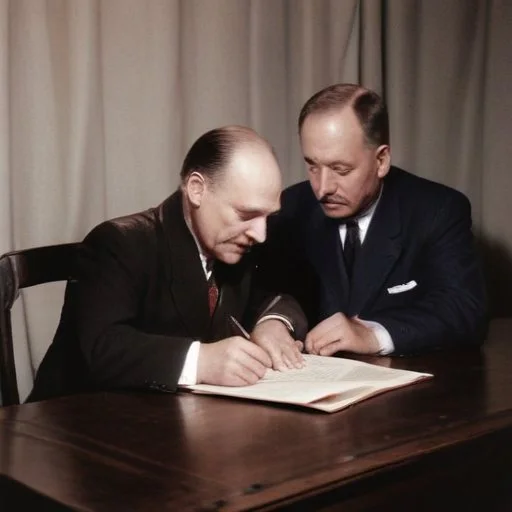
This pact, named after the foreign ministers of Germany and the Soviet Union, Joachim von Ribbentrop and Vyacheslav Molotov, would have far-reaching consequences, ultimately leading to the invasion of Poland and the outbreak of World War II.
In the years leading up to World War II, Germany and the Soviet Union had been engaged in a propaganda war, with each side accusing the other of aggression and warmongering. However, behind the scenes, both countries were seeking to expand their territories and secure strategic interests.
The Molotov-Ribbentrop Pact was the culmination of months of secret negotiations between Germany and the Soviet Union, during which they discussed the possibility of a mutual non-aggression treaty.
The Molotov-Ribbentrop Pact itself was a public document, outlining the terms of the non-aggression treaty between Germany and the Soviet Union. However, the secret protocol, which was not made public until after the war, revealed the true extent of the pact's consequences.
According to the secret protocol, Poland, Finland, Estonia, Latvia, Lithuania, and Romania were divided into German and Soviet spheres of influence, with the two powers agreeing to respect each other's territorial claims.
The Molotov-Ribbentrop Pact had far-reaching consequences, including the invasion of Poland, the occupation of Eastern Europe, and the ultimate outbreak of World War II.
The pact also led to a period of uneasy cooperation between Germany and the Soviet Union, during which they collaborated on military operations and coordinated their foreign policy.
The Molotov-Ribbentrop Pact had significant cultural and social implications, particularly in the countries that were divided into German and Soviet spheres of influence.
In Poland, the pact led to the displacement of millions of people, the destruction of cities and towns, and the loss of cultural heritage.
The Molotov-Ribbentrop Pact was widely condemned by the international community, with many seeing it as a cynical and opportunistic agreement between two authoritarian regimes.
In Germany and the Soviet Union, the pact was presented as a necessary measure to protect national security and promote peace, but the true extent of the secret protocol remained hidden from the public.
"The treaty and the protocol are based on the axiom that the U.S.S.R. and Germany, being the greatest countries of Europe, have a common interest in seeing to it that as much as possible of the territory of Poland be incorporated into the U.S.S.R." - Vyacheslav Molotov
"The Molotov-Ribbentrop Pact was a typical example of the manner in which the Soviet Union and Germany used each other, and subsequently double-crossed each other." - Winston Churchill
The Molotov-Ribbentrop Pact is often compared to other instances of cynical and opportunistic diplomacy, such as the Hitler-Stalin Pact of 1940, which saw Germany and the Soviet Union divide Eastern Europe into their respective spheres of influence.
However, the Molotov-Ribbentrop Pact remains one of the most significant and far-reaching examples of such diplomacy, with its consequences still felt today.
The Molotov-Ribbentrop Pact had a profound impact on the course of World War II, leading to the invasion of Poland, the occupation of Eastern Europe, and ultimately, the defeat of Nazi Germany.
The pact also contributed to the development of the Cold War, as the Soviet Union and the West engaged in a struggle for ideological and strategic influence.
In conclusion, the Molotov-Ribbentrop Pact was a pivotal event in world history, representing a moment of cynical and opportunistic diplomacy that had far-reaching consequences for the world.
Joachim von Ribbentrop, the German Foreign Minister, played a crucial role in negotiating the Molotov-Ribbentrop Pact. Born in 1893, Ribbentrop was a career diplomat who rose to prominence in the Nazi Party. He was known for his cunning and ambition, which made him a key player in Hitler's government. Ribbentrop's close relationship with Hitler and his ability to negotiate with the Soviets made him an ideal candidate to lead the German delegation in the secret talks.
Ribbentrop's role in the pact's negotiation was instrumental in shaping its terms. He was able to convince the Soviets to agree to the secret protocol, which divided Eastern Europe into German and Soviet spheres of influence. Ribbentrop's diplomatic skills and knowledge of Soviet politics made him a valuable asset to Hitler's government.
Despite his importance in the Nazi regime, Ribbentrop's later years were marked by decline and defeat. He was tried and executed for war crimes at the Nuremberg Trials in 1946.

The Molotov-Ribbentrop Pact can be compared to the 1935 Ethiopian Pact, which was a treaty of mutual assistance between Italy and France. Both pacts were secretive in nature, with the true extent of their agreements hidden from the public. Both pacts also involved the division of territories, with the Italian-French pact dividing Ethiopia into spheres of influence.
However, there are also significant differences between the two pacts. The Molotov-Ribbentrop Pact was a non-aggression treaty, whereas the Ethiopian Pact was a treaty of mutual assistance. The Molotov-Ribbentrop Pact also had far-reaching consequences, leading to the invasion of Poland and the outbreak of World War II.
Despite these differences, both pacts demonstrate the willingness of authoritarian regimes to engage in cynical and opportunistic diplomacy. Both pacts were driven by a desire for territorial expansion and a willingness to sacrifice the interests of smaller nations.
The Molotov-Ribbentrop Pact was shaped by the complex geopolitics of Eastern Europe in the late 1930s. The pact was a response to the rising tensions between Germany and the Soviet Union, which had been engaged in a propaganda war since the early 1930s. The pact was also driven by the threat of Bolshevism and the fear of communist expansion in Europe.
The pact's secret protocol, which divided Eastern Europe into German and Soviet spheres of influence, was a key factor in shaping the region's geopolitics. The protocol created a de facto alliance between Germany and the Soviet Union, which lasted until the German invasion of the Soviet Union in 1941.
The Molotov-Ribbentrop Pact had significant implications for the region's smaller nations, which were forced to choose between German and Soviet influence. The pact ultimately led to the occupation of Eastern Europe, which would last for decades.

The Molotov-Ribbentrop Pact was signed on August 23, 1939, in Moscow. The pact's original document is a significant historical artifact, offering insights into the diplomatic strategies of the two regimes. The document is written in German and Russian, with two originals signed by Ribbentrop and Molotov.
The pact's secret protocol, which was not made public until after the war, is also an important historical artifact. The protocol outlines the division of Eastern Europe into German and Soviet spheres of influence, providing insight into the strategic thinking of the two regimes.
Together, the pact and its secret protocol provide a unique window into the diplomatic history of World War II. They offer a glimpse into the cynical and opportunistic diplomacy that characterized the era, and the devastating consequences that followed.
The Molotov-Ribbentrop Pact had significant economic implications for the countries involved. The pact's secret protocol, which divided Eastern Europe into German and Soviet spheres of influence, led to the exploitation of natural resources and the imposition of trade agreements favorable to the two regimes.
The pact also led to the transfer of goods and resources between Germany and the Soviet Union, including oil, grain, and machinery. This economic cooperation was essential to the war efforts of both countries, providing them with the resources needed to fuel their military campaigns.
The pact's economic implications were not limited to Germany and the Soviet Union. The occupation of Eastern Europe led to the exploitation of local resources, the imposition of forced labor, and the disruption of trade networks. The pact's economic legacy would be felt for decades, shaping the region's economic development and integration into the global economy.