


Rome, the Eternal City, was left smoldering and battered on a fateful summer day in 1943, as more than 500 Allied aircraft unleashed a devastating barrage of bombs, inflicting thousands of casualties and etching a dark chapter in the annals of World War II history. This brutal assault, one of the largest and most destructive of the war, would forever change the face of Rome and leave an indelible mark on the Italian people.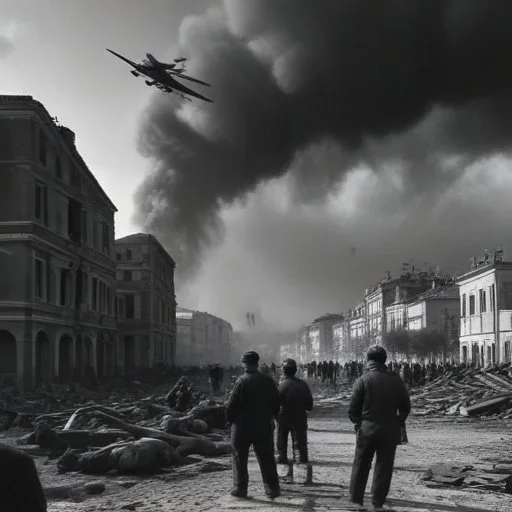
In the summer of 1943, the Allies were gaining momentum in their push against the Axis powers. With the North African campaign won, attention turned to Italy, and Rome, the capital city, was a key target. The Allies sought to weaken the Italian war effort, disrupt supply lines, and pave the way for an eventual invasion of the Italian mainland.
On July 19, 1943, the Allies launched Operation Vulcan, a massive bombing campaign targeting Rome's transportation hubs, military installations, and industrial centers. The attack involved an armada of B-17 and B-24 bombers, escorted by fighter planes, which took to the skies from bases in North Africa and Sicily. The roar of engines, the scream of sirens, and the thunder of explosions shook the city as bombs rained down on civilians and military targets alike.
The bombing of Rome was nothing short of catastrophic. Entire neighborhoods were reduced to rubble, historic landmarks were damaged or destroyed, and thousands of civilians were killed or wounded. The exact number of casualties remains unknown, but estimates put the dead at over 3,000, with many more left homeless and destitute. The once-vibrant streets of Rome were now a smoldering, rubble-strewn battleground, with death and destruction lurking around every corner.
Among the victims were many innocent civilians, including women, children, and the elderly. The bombing also took a devastating toll on Rome's cultural heritage, with many historic buildings, churches, and landmarks damaged or destroyed. The Basilica of San Lorenzo, a 2,000-year-old architectural treasure, was among the many casualties of the bombing.
The bombing of Rome had far-reaching consequences, both militarily and politically. The Italian government, already reeling from the Allied invasion of Sicily, was further weakened, and the Italian people were left to wonder if their war effort was doomed. The bombing also marked a turning point in the war, as the Allies continued their push into Italy, eventually leading to the surrender of Italian forces in September 1943.
One eyewitness, Italian journalist and writer, Ignazio Silone, recalled the bombing: "The city was in flames, the screams of the people, the cries of the wounded, the dying... It was as if the very fabric of humanity had been torn apart."
The Allied bombing of Rome remains one of the most controversial and devastating events of World War II. While the military importance of the bombing is undeniable, the human cost and cultural devastation cannot be overstated. Today, as we reflect on the horrors of war, we are reminded of the importance of preserving our cultural heritage and the sanctity of human life.
The bombing of Rome serves as a poignant reminder of the devastating consequences of war, a reminder that echoes through the ages, a warning to future generations of the importance of diplomacy, dialogue, and peace.
The bombing of Rome on July 19, 1943, is well-documented through archival records, photographs, and personal accounts. One of the most striking artifacts from that day is a series of aerial photographs taken by Allied reconnaissance planes, which provide a chilling visual record of the devastation. These photographs, now housed at the National Archives in Washington D.C., offer a unique perspective on the scale of the destruction, showing entire city blocks reduced to rubble and smoke billowing from the ruins.
In addition to these photographs, several personal diaries and letters from eyewitnesses have been preserved, offering a more intimate and humanizing perspective on the bombing. The diary of a young Italian girl, Maria Rossi, provides a poignant account of the bombing, detailing the fear and chaos as she and her family sought shelter in a nearby church.

The environmental impact of the bombing of Rome was significant, with the destruction of buildings and infrastructure leading to widespread pollution and environmental degradation. The bombing destroyed several industrial sites, including a major oil refinery, which spilled thousands of gallons of oil into the Tiber River. The resulting pollution had a devastating impact on the local ecosystem, with many species of fish and wildlife affected.
In the aftermath of the bombing, the Allies launched a major cleanup effort, deploying teams of engineers and environmental specialists to assess and mitigate the environmental damage. However, the full extent of the environmental impact was not fully understood until many years later, and efforts to restore the affected areas are still ongoing today.
Historians have long debated the strategic significance of the Allied bombing of Rome, with some arguing that it was a necessary evil in the fight against fascism, while others have questioned its military efficacy. The bombing has been characterized as a symbol of the Allies' resolve to defeat the Axis powers, but also as a brutal and indiscriminate act of war that terrorized civilian populations.
One of the most influential historians to write about the bombing of Rome is the Italian historian, Renzo De Felice, who argued that the bombing was a turning point in the war, marking a shift in the balance of power in favor of the Allies. De Felice's work has been widely praised for its nuance and depth, but has also been criticized for its perceived bias towards the Italian perspective.

The cultural impact of the bombing of Rome was profound, with the destruction of historic landmarks and cultural institutions leaving deep scars on the city's psyche. The bombing of the Basilica of San Lorenzo, a 2,000-year-old architectural treasure, was particularly devastating, symbolizing the loss of Italy's rich cultural heritage.
In the aftermath of the bombing, the Italian government launched a major cultural reconstruction effort, aimed at restoring the city's damaged landmarks and preserving its cultural heritage. The effort was led by a team of architects, historians, and art conservators, who worked tirelessly to repair and restore the damaged buildings and artworks.
The political impact of the bombing of Rome was significant, with the Italian government facing intense pressure to surrender in the aftermath of the attack. The bombing marked a turning point in the war, as the Allies' military campaign in Italy gained momentum and the Italian people began to question their country's continued involvement in the conflict.
In the weeks following the bombing, the Italian government was plagued by infighting and political maneuvering, as different factions vied for power and influence. The bombing had exposed deep divisions within the Italian government, and ultimately contributed to the collapse of the fascist regime in September 1943.