


In the midst of World War II, the city of Belgrade, the capital of Serbia, was a battleground for freedom. On October 20, 1944, the Soviet Red Army and Yugoslav Partisans joined forces to liberate the city from the grip of Nazi Germany, marking a pivotal moment in the war.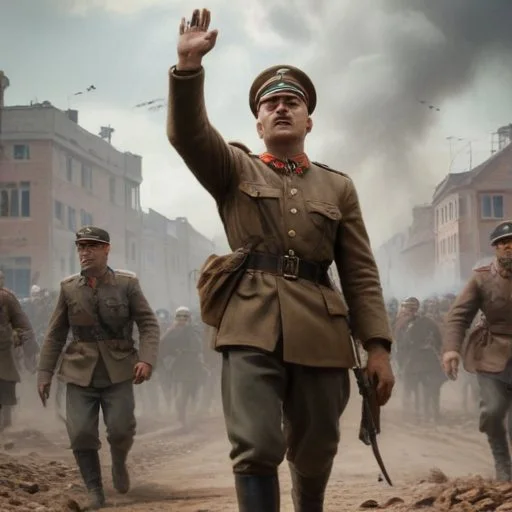
Belgrade, a city with a rich history and cultural heritage, had been under German occupation since 1941. The Nazi regime had imposed a reign of terror, suppressing the city's population and exploiting its resources. The people of Belgrade lived in constant fear, their daily lives dictated by the whims of their oppressors.
The Soviet Red Army, led by General Fyodor Tolbukhin, and the Yugoslav Partisans, led by Josip Broz Tito, were unlikely allies in the fight for Belgrade's freedom. Despite their differences, they shared a common goal: to defeat the Nazi forces and bring liberation to the city.
The joint forces launched a massive assault on the city on October 14, 1944. The 11-day battle was fierce and intense, with both sides suffering heavy losses. The Soviet Red Army's superior firepower and the Yugoslav Partisans' guerrilla tactics ultimately proved too much for the German Wehrmacht, and on October 20, the city was finally free.
The liberation of Belgrade was a significant turning point in the war, marking a crucial victory for the Allies and paving the way for the eventual defeat of Nazi Germany. The city's liberation also had a profound impact on the Yugoslav people, who saw it as a symbol of their country's resilience and determination.
The liberation of Belgrade marked the beginning of a new era of freedom and independence for the Yugoslav people. Tito's Partisans went on to establish a socialist government, while the Soviet Red Army continued to play a key role in the region.
The liberation of Belgrade has been immortalized in Yugoslav folklore, with songs, poems, and stories celebrating the bravery and sacrifice of those who fought for the city's freedom. The event has also been commemorated in monuments, museums, and annual celebrations.
The liberation of Belgrade serves as a powerful reminder of the importance of unity and cooperation in the face of adversity. It also highlights the resilience and determination of people fighting for their freedom and independence.
In the end, the liberation of Belgrade stands as a testament to the human spirit, a beacon of hope in the darkest of times, and a reminder that even in the face of overwhelming oppression, freedom and independence are always within reach.
The liberation of Belgrade had a profound impact on the cultural fabric of Yugoslavia. It marked a resurgence of national identity and pride, as the country began to rebuild and assert its independence. The event inspired a wave of artistic expression, with writers, poets, and musicians creating works that celebrated the bravery and sacrifice of those who fought for freedom.
In the years that followed, the city of Belgrade became a hub of cultural activity, with theaters, museums, and galleries sprouting up to showcase the country's rich cultural heritage. The liberation also led to a renewed interest in folk music and dance, as people sought to connect with their cultural roots.

Fyodor Tolbukhin, the Soviet General who led the Red Army's 3rd Ukrainian Front in the battle for Belgrade, was a seasoned military commander with a reputation for toughness and strategic brilliance. Born in 1894, Tolbukhin rose through the ranks of the Soviet military, serving in World War I and later becoming a key figure in the Soviet war effort during World War II.
Despite his stern demeanor, Tolbukhin was known for his compassion and concern for his troops, often visiting the front lines to boost morale and offer guidance. His leadership played a crucial role in the liberation of Belgrade, and he went on to play a key role in the Soviet push into Eastern Europe.
The liberation of Belgrade took place against the backdrop of a rapidly shifting geopolitical landscape. As the war turned in favor of the Allies, the Soviet Union was expanding its influence in Eastern Europe, while the Western powers were seeking to counterbalance Soviet power.
In this context, the liberation of Belgrade marked a significant milestone in the Soviet Union's emergence as a dominant force in the region. It cemented the Soviet-Yugoslav alliance and paved the way for the establishment of socialist governments throughout Eastern Europe.

The battle for Belgrade was a brutal and intense conflict that lasted for 11 days. The Soviet Red Army, led by General Tolbukhin, launched a series of powerful artillery bombardments to weaken the German defenses, while the Yugoslav Partisans, led by Josip Broz Tito, launched guerrilla attacks to disrupt German supply lines.
The German forces, led by General Maximilian von Weichs, put up fierce resistance, but they were ultimately no match for the combined might of the Soviet and Yugoslav forces. On October 20, 1944, the city of Belgrade was finally liberated, marking a major turning point in the war.
The liberation of Belgrade offers a powerful teaching tool for educators seeking to explore the themes of freedom, resistance, and cooperation. By examining the complex historical context of the event, students can gain a deeper understanding of the human experience and the importance of standing up against oppression.
Moreover, the liberation of Belgrade provides a unique opportunity to explore the role of women in wartime, as many Yugoslav women played a crucial role in the resistance movement. By incorporating these perspectives, educators can create a more nuanced and inclusive understanding of this pivotal event in world history.