


In January 1943, the tide of World War II shifted in favor of the Allies as troops of the British Eighth Army, led by General Bernard Montgomery, captured the strategic city of Tripoli in Libya from the German-Italian Panzer Army. This pivotal victory marked a significant milestone in the North African Campaign, sealing the fate of the Axis powers and paving the way for the Allies' eventual triumph in Africa.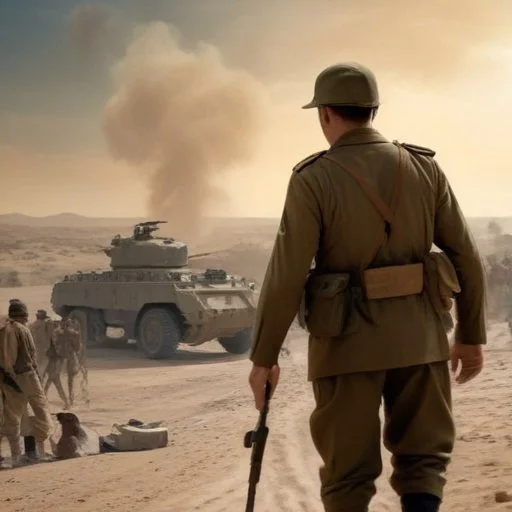
Tripoli, the capital city of Libya, held immense strategic value due to its proximity to the Mediterranean coast and its role as a crucial supply route for both the Axis and Allied forces. The city's capture would grant the victor control over the North African coastline, enabling them to launch further attacks and secure vital resources.
The British Eighth Army, composed of troops from the United Kingdom, Australia, New Zealand, and India, launched a series of attacks against the German-Italian Panzer Army, which had been dug in around Tripoli. After weeks of intense fighting, the Allies finally breached the city's defenses on January 23, 1943.
The capture of Tripoli by the British Eighth Army serves as a testament to the bravery and determination of the Allied forces, who fought against overwhelming odds to secure a crucial victory in the North African Campaign. This pivotal moment in World War II history continues to inspire generations, reminding us of the importance of perseverance and cooperation in the face of adversity.
Image: British troops entering Tripoli, January 1943. (Public Domain)
Rommel's tactical prowess and adaptability earned him the respect of his enemies and the admiration of his comrades. His innovative use of combined forces, including infantry, artillery, and armor, allowed him to outmaneuver and outgun his opponents.
Rommel's experience in the North African Campaign made him acutely aware of the importance of logistics and supply lines. He skillfully exploited the weaknesses of the Allied forces, using his knowledge of the desert terrain to launch surprise attacks and disrupt their supply chains.
Despite his eventual defeat at Tripoli, Rommel's strategic genius and military accomplishments continue to inspire and influence military leaders to this day.

The North African Campaign, including the Battle of Tripoli, was part of a larger global struggle for power and resources. The Axis powers, led by Germany and Italy, sought to expand their territories and secure vital resources, such as oil and strategic ports.
The Allies, primarily consisting of the United States, the United Kingdom, and the Soviet Union, fought to prevent Axis expansion and protect their own interests. The outcome of the North African Campaign would have far-reaching implications for the balance of power in Europe, the Middle East, and beyond.
The North African Campaign, including the Battle of Tripoli, had a devastating impact on the region's environment. The widespread destruction of infrastructure, the depletion of natural resources, and the displacement of local populations all contributed to a lasting environmental legacy.
The war effort also led to the introduction of non-native species, such as the prickly acacia tree, which would go on to outcompete native vegetation and alter the ecosystem.
The environmental consequences of the war serve as a reminder of the need for sustainable practices and responsible resource management in times of conflict.

Historians have long debated the significance of the Fall of Tripoli, with some arguing that it marked a decisive turning point in the North African Campaign, while others see it as part of a larger, more complex struggle.
Some scholars have emphasized the role of individual leaders, such as Montgomery and Rommel, in shaping the outcome of the battle, while others have highlighted the importance of broader structural factors, such as logistics and supply chains.
The ongoing debate surrounding the Fall of Tripoli serves as a reminder of the complexity and nuance of historical interpretation.
The Tripoli War Diary, a collection of documents and records compiled by the British Eighth Army, provides a unique insight into the planning and execution of the Battle of Tripoli.
The diary, which includes detailed accounts of military operations, intelligence reports, and strategic assessments, offers a behind-the-scenes look at the Allied forces' decision-making process.
Historians and researchers can use the Tripoli War Diary to gain a deeper understanding of the military strategy and tactics employed during the battle, as well as the challenges and opportunities faced by the Allied forces.