


The bombardment of Cherbourg by United States Navy and British Royal Navy ships on June 25, 1944, marked a crucial turning point in the Battle of Cherbourg, as Allied forces fought to reclaim Western Europe from German occupation. This joint operation, which unleashed a barrage of firepower on German defenses, paved the way for United States Army units to capture the strategic port city, securing a vital supply route for the war effort.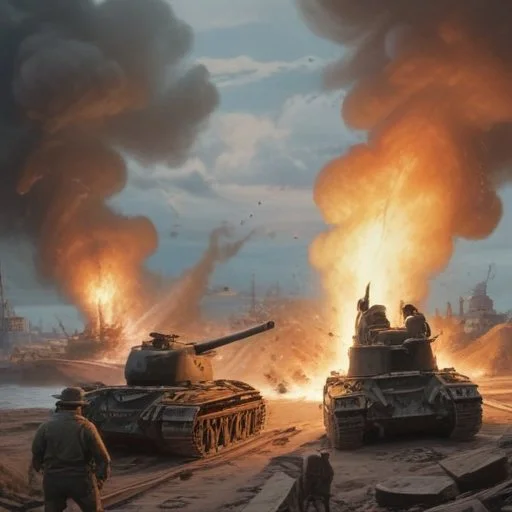
Since the D-Day landings on June 6, 1944, Allied forces had been pushing northward through Normandy, making slow but steady progress against German resistance. The capture of Cherbourg, a heavily fortified port city, was essential to secure a reliable supply route for the Allied troops. However, the Germans had turned Cherbourg into a fortress, with extensive fortifications, mines, and artillery emplacements, making it a formidable obstacle.
On June 25, 1944, a fleet of 14 United States Navy and British Royal Navy ships, including battleships, cruisers, and destroyers, assembled off the coast of Cherbourg. Under the command of Rear Admiral Morton L. Deyo, the naval force began a relentless bombardment of the city, firing over 1,200 tons of ammunition in a period of just over two hours. The ships targeted German fortifications, artillery emplacements, and troop concentrations, softening up the enemy's defenses.
Rear Admiral Morton L. Deyo, a seasoned naval officer, led the Allied naval forces during the bombardment. Major General J. Lawton Collins, commander of the U.S. VII Corps, was responsible for the ground troops that followed up on the naval bombardment.
The naval bombardment of Cherbourg had a profound impact on the Battle of Cherbourg. The relentless shelling weakened German fortifications, allowing American troops to capture the city with relative ease. The fall of Cherbourg secured a vital supply route for the Allied forces, enabling them to push deeper into Western Europe.
"It was like the end of the world," recalled Major General Collins, describing the intensity of the bombardment. "The earth shook, and the air was filled with the screams of artillery and the crash of bombs."
The capture of Cherbourg played a significant role in the Allied advance through Western Europe. The secure supply route enabled the Allies to maintain a steady flow of men and materials, ultimately contributing to the defeat of Germany.
The bombardment of Cherbourg remains an important chapter in the history of World War II, a testament to the bravery and determination of the Allied forces in the face of overwhelming odds.
The naval bombardment of Cherbourg was not the first time the city had been shelled. During the Napoleonic Wars, Cherbourg was bombarded by the British Navy in 1812, and again in 1855 during the Crimean War. This prior history of bombardment likely influenced the German decision to heavily fortify the city, making the Allied forces' task even more challenging.
In addition to the naval guns, the Allied forces also employed bombing raids to weaken the German defenses. On June 22, 1944, just three days before the naval bombardment, a fleet of 375 bombers dropped over 1,000 tons of explosives on Cherbourg, targeting the city's airfields, fortifications, and port facilities.
Rear Admiral Morton L. Deyo, the commander of the Allied naval forces during the bombardment, was a seasoned naval officer with a long history of service. Born in 1886, Deyo graduated from the United States Naval Academy in 1907 and went on to serve in both World War I and World War II. He played a crucial role in the Allied victory, earning the Navy Cross for his bravery and leadership during the bombardment.
Deyo's experience and expertise were instrumental in planning and executing the naval bombardment. His ability to coordinate the efforts of the American and British navies ensured a unified and effective attack that caught the Germans off guard.
The naval bombardment of Cherbourg shares some similarities with other famous bombardments in history, such as the Japanese attack on Pearl Harbor in 1941. Both attacks involved a surprise assault by a naval force, aimed at weakening the enemy's defenses and gaining a strategic advantage.
However, there are also significant differences between the two events. The attack on Pearl Harbor was a surprise attack on a peaceful naval base, while the bombardment of Cherbourg was a deliberate assault on a heavily fortified city occupied by enemy forces.

The USS Arkansas, one of the battleships involved in the bombardment, had been retrofitted with new 14-inch guns in 1942. These guns were capable of firing 1,400-pound shells over 23 miles, making them a formidable addition to the Allied naval forces.
The German fortifications at Cherbourg, including the massive battery at Fort du Roule, were designed to withstand even the heaviest naval bombardment. However, the Allied forces' surprise attack and sheer volume of firepower ultimately proved too much for the German defenses.
The location of Cherbourg made it a crucial strategic location for both the Allies and the Germans. The city's port facilities were essential for supplying the Allied forces pushing into Western Europe, while also providing a potential entry point for German reinforcements.
The fall of Cherbourg marked a significant shift in the balance of power in Western Europe, as the Allies gained a vital foothold in the region. The city's capture paved the way for the Allied advance into France and ultimately contributed to the defeat of Germany.