


In the midst of World War I, the German Army perpetrated an act of cultural vandalism, deliberately setting ablaze the historic library of the Catholic University of Leuven, reducing centuries of accumulated knowledge to ashes. This senseless destruction resulted in the loss of hundreds of thousands of irreplaceable volumes, including priceless Gothic and Renaissance manuscripts, leaving an indelible scar on the face of human civilization.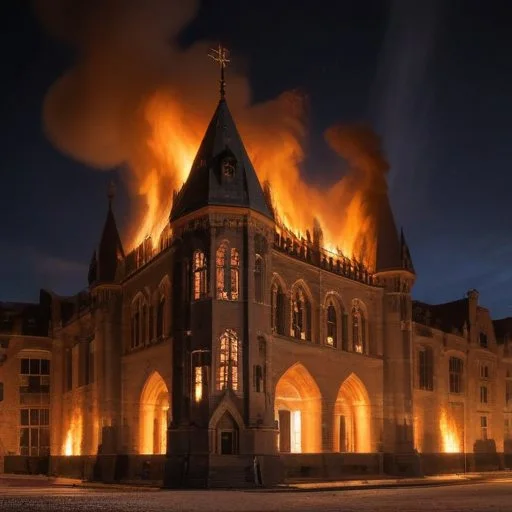
The Catholic University of Leuven, founded in 1425, was a revered institution of higher learning, boasting a library that was a treasure trove of knowledge. The university's library was a testament to the city's rich cultural heritage, housing a vast collection of rare manuscripts, books, and artifacts. The library's significance extended beyond the academic community, serving as a symbol of Leuven's identity and a beacon of intellectual pursuits.
On August 25, 1914, German troops, under the command of General von Lüttichau, stormed into Leuven, intent on capturing the city. In a calculated act of aggression, they deliberately targeted the university's library, setting fire to the building and its contents. The flames engulfed the structure, consuming everything in their path. The library's precious contents, including rare manuscripts and books, were destroyed, leaving nothing but smoldering ruins.
The destruction of the library had far-reaching consequences, affecting not only the academic community but also the cultural landscape of Europe. The loss of these irreplaceable artifacts was a devastating blow to the preservation of human knowledge, erasing centuries of intellectual achievements.
The international community condemned the German Army's actions, with many viewing it as a barbaric act of cultural vandalism. The destruction of the library galvanized public opinion, solidifying opposition to Germany's aggressive expansion and strengthening the resolve of Allied forces.
The destruction of the library had a profound impact on the cultural and social fabric of Europe. The loss of these historical artifacts was a palpable reminder of the devastating consequences of war, underscoring the importance of preserving cultural heritage.
In the aftermath of the war, international efforts were made to rebuild and restore cultural institutions, recognizing the significance of preserving knowledge and cultural artifacts for future generations.
"The destruction of the library of the Catholic University of Leuven is a crime against humanity." - Woodrow Wilson, 28th President of the United States
Father Pierre Louis Maere, a librarian at the university, recounts the heart-wrenching scene: "I saw the flames rising from the library, and I knew that our heritage was being destroyed. It was as if the soul of our university was being torn apart."
The destruction of the library served as a catalyst for the development of international laws and conventions aimed at protecting cultural heritage during times of conflict. The Hague Convention of 1954 and the 1977 Additional Protocols to the Geneva Conventions are direct responses to the wanton destruction of cultural artifacts during World War I.
The tragic event also led to the establishment of the League of Nations, precursor to the United Nations, which emphasized the importance of preserving cultural heritage and promoting international cooperation.
Below is a visual representation of the events leading up to and following the destruction of the library:
| August 1914 | German troops capture Leuven |
| August 25, 1914 | Destruction of the library |
| September 1914 | Allied forces retake Leuven |
| 1954 | Hague Convention establishes laws protecting cultural heritage |
This tragic event serves as a poignant reminder of the devastating consequences of war and the importance of preserving cultural heritage for future generations.
The Catholic University of Leuven's library was not only a treasure trove of knowledge but also a cultural institution that reflected the city's rich heritage. The library's collection was a testament to the region's historical significance, featuring works from the Renaissance, Gothic, and Baroque periods.
The library was also a hub of intellectual activity, attracting scholars and researchers from across Europe. Its destruction was a devastating blow to the academic community, as it erased centuries of accumulated knowledge and wiped out a vital part of Europe's cultural heritage.
Moreover, the library was a symbol of Leuven's identity and a source of national pride.
General von Lüttichau, the commander of the German troops, was the mastermind behind the destruction of the library. A seasoned military officer, von Lüttichau was driven by a sense of military necessity and a disregard for cultural heritage.
His actions were driven by a belief that the destruction of cultural institutions would weaken the enemy's morale and facilitate German victory.
Von Lüttichau's actions were widely condemned by the international community, earning him the reputation as a barbaric and ruthless commander.The destruction of the library had far-reaching consequences for European cultural heritage. The loss of irreplaceable artifacts and manuscripts was a devastating blow to the preservation of human knowledge and cultural identity.
The destruction of cultural institutions during wartime became a pressing concern, prompting international efforts to protect cultural heritage during conflicts.
The tragedy also raised awareness about the importance of cultural preservation, leading to increased efforts to safeguard cultural institutions and artifacts.

The destruction of the library sparked widespread international condemnation, with many countries criticizing Germany's actions as barbaric and senseless.
The event led to a diplomatic crisis, straining relations between Germany and other European powers.
The incident also galvanized public opinion, solidifying opposition to Germany's aggressive expansion and strengthening the resolve of Allied forces.
The destruction of the library had significant economic implications, both in the short and long term. The loss of cultural institutions and artifacts led to a decline in tourism, a vital sector of Leuven's economy.
The reconstruction efforts also placed a significant burden on the city's finances, diverting resources from other essential services.
The destruction of cultural heritage also impacted the local economy, as artisans and craftsmen who relied on the library's resources were left without a primary source of income.