Leaders sign Dayton Agreement, ending Bosnian War
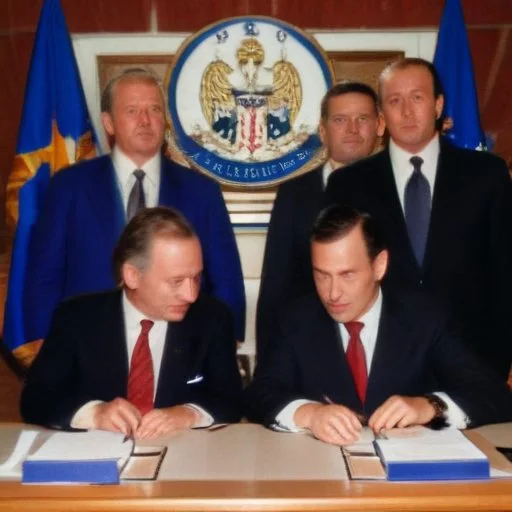
The leaders of the Federal Republic of Yugoslavia, Croatia, and Bosnia and Herzegovina put their signatures on the Dayton Agreement, effectively ending the devastating Bosnian War that ravaged the region for three long years. This historic accord, brokered by the United States, established a fragile peace, dividing Bosnia and Herzegovina into two entities, with the Federation of Bosnia and Herzegovina on one side and the Republika Srpska on the other. The agreement aimed to restore order, promote cooperation, and set the stage for reconstruction.
The Dayton Agreement: A Fragile Peace in the Balkans
A New Chapter in the Yugoslav Wars
The Dayton Agreement, signed on December 14, 1995, in Paris, marked a crucial turning point in the tumultuous Yugoslav Wars, bringing a semblance of peace to the war-torn region after three years of brutal conflict. This historic accord, brokered by the United States, effectively ended the devastating Bosnian War, paving the way for a fragile peace and a new era of cooperation in the Balkans.
Historical Background: A Complex Web of Ethnic Tensions
The Yugoslav Wars, triggered by the dissolution of Yugoslavia, were a complex phenomenon, fueled by deep-seated ethnic tensions and nationalist sentiment. The death of
Josip Broz Tito in 1980 marked the beginning of the end of Yugoslavia, as the country's six republics and two autonomous provinces began to simmer with discontent. The Bosnian War, which raged from 1992 to 1995, was the most brutal of these conflicts, pitting Bosniaks (Bosnian Muslims), Croats, and Serbs against each other in a maelstrom of violence.
Key Figures Involved: The Architects of Peace
The Dayton Agreement was the culmination of months of intense diplomatic efforts, led by a triumvirate of key figures:
- Richard Holbrooke, the chief American negotiator, played a crucial role in brokering the agreement.
- French President Jacques Chirac and British Prime Minister John Major provided critical support to the negotiating process.
- The leaders of the Federal Republic of Yugoslavia, Croatia, and Bosnia and Herzegovina – Slobodan Milošević, Franjo Tuđman, and Alija Izetbegović, respectively – put their signatures on the accord.
Timeline of Events: A Path Toward Peace
The road to the Dayton Agreement was long and arduous:
- August 1995: NATO launches Operation Deliberate Force, a bombing campaign against Bosnian Serb forces, in response to the Srebrenica massacre.
- September 1995: The United States, in conjunction with European powers, launches a diplomatic initiative to end the war.
- November 1995: The Dayton peace talks begin, with Holbrooke leading the American delegation.
- December 14, 1995: The Dayton Agreement is signed in Paris, marking a significant milestone in the Yugoslav Wars.
Major Outcomes and Impacts: A New Era in the Balkans
The Dayton Agreement had far-reaching consequences:
- The war in Bosnia and Herzegovina came to an end, bringing a welcome respite to the conflict-weary region.
- The agreement established a delicate balance of power, dividing Bosnia and Herzegovina into two entities: the Federation of Bosnia and Herzegovina and the Republika Srpska.
- The Office of the High Representative (OHR) was created to oversee the implementation of the agreement and promote cooperation between the entities.
Cultural and Social Influences: A Region in Flux
The Dayton Agreement had significant cultural and social implications:
- The agreement marked a shift from ethnic nationalism to a more pragmatic, cooperative approach, paving the way for a fragile peace.
- The region began to rebuild, with international aid pouring in to support reconstruction efforts.
- A new generation of leaders emerged, committed to promoting reconciliation and fostering a sense of national identity.
In conclusion, the Dayton Agreement was a landmark event in the Yugoslav Wars, bringing a measure of peace to a war-torn region. While its legacy is complex and multifaceted, it marked a crucial turning point in the history of the Balkans, paving the way for a new era of cooperation and reconstruction.
Rich Historical Review
The negotiations leading up to the Dayton Agreement were marked by intense diplomatic efforts and a series of dramatic events. One such event was the walkout of the Bosnian Serb delegation, led by Radovan Karadžić, on November 23, 1995. This move threatened to derail the entire negotiating process, but Richard Holbrooke's prompt intervention and a series of secret meetings managed to bring the parties back to the table.
Another crucial aspect of the negotiations was the role of the Contact Group, comprising the United States, the United Kingdom, France, Germany, and Russia. This grouping provided a unified front and helped to maintain pressure on the warring parties to reach a settlement.

Detailed Character Insight
Richard Holbrooke: The Chief Architect of Peace
Richard Holbrooke, the chief American negotiator, played a crucial role in brokering the Dayton Agreement. A seasoned diplomat with extensive experience in the Balkans, Holbrooke brought a unique combination of tenacity, intelligence, and charm to the negotiating process. His ability to forge relationships with key figures, including Slobodan Milošević and Franjo Tuđman, was instrumental in bringing the parties to the table.
Cultural Significance Study
The Dayton Agreement had a profound impact on the cultural landscape of the Balkans. The agreement marked a shift away from ethnic nationalist sentiment and towards a more pragmatic, cooperative approach. This, in turn, paved the way for a flourishing of cultural exchange and cooperation between the various ethnic groups.
The agreement also facilitated the return of refugees and displaced persons, allowing them to rebuild their lives and communities. This, in turn, contributed to a renewed sense of cultural identity and a deeper appreciation for the region's rich cultural heritage.

Rich Political Insight
The Dayton Agreement was a significant milestone in the broader context of international relations. The agreement marked a turning point in the Yugoslav Wars, paving the way for a new era of cooperation and diplomacy in the Balkans.
The agreement also highlighted the importance of multilateral diplomacy, demonstrating that even the most intractable conflicts could be resolved through sustained diplomatic efforts and cooperation between major powers.
Study of Economic Impact
The Dayton Agreement had significant economic implications for the region. The cessation of hostilities and the establishment of a fragile peace paved the way for a massive influx of international aid and investment.
The agreement also facilitated the reconstruction of key infrastructure, including roads, bridges, and utilities, which in turn helped to stimulate economic growth and development.


