


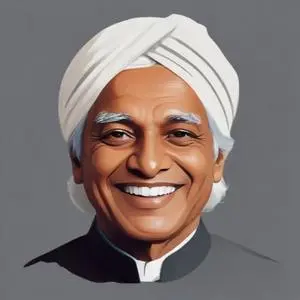
Indian engineer, academic, and politician who served as the 11th President of India, known for his contributions to the development of India's space program and missile technology. He's also a renowned author and inspirational figure.
A. P. J. Abdul Kalam, affectionately known as the "Missile Man of India," was a pioneering aerospace scientist and statesman who left an indelible mark on India's Scientific and Technological landscape. With a career spanning over four decades, Kalam was instrumental in shaping India's civilian space programme and military missile development efforts, making him a celebrated figure in the country's history.
Born on October 15, 1931, in Rameswaram, Tamil Nadu, India, Kalam was raised in a Tamil Muslim family. His father, Jainulabdeen Marakayar, was a boat owner and imam of a local mosque, while his mother, Ashiamma, was a homemaker. Kalam's early education took place in Rameswaram, where he developed a passion for learning and innovation.
Kalam's remarkable journey in the field of aerospace engineering began when he joined the Defence Research and Development Organisation (DRDO) in 1958. He worked on various projects, including the development of India's first satellite launch vehicle, the SLV-III. His exceptional talent and dedication earned him the opportunity to lead the country's prestigious space programme, including the development of the Polar Satellite Launch Vehicle (PSLV) and the Agni missile system.
In 2002, Kalam was elected as the 11th President of India, a position he held until 2007. During his tenure, he was affectionately referred to as the "People's President" due to his commitment to education, scientific innovation, and social welfare. He played a crucial role in shaping India's foreign policy and fostered stronger ties with various nations.
Kalam was a recipient of numerous prestigious awards and honors, including the Bharat Ratna, India's highest civilian honor, the Padma Bhushan, and the Padma Vibhushan. He was also honored with several international awards, such as the International von Karman Wings Award and the Hoover Medal.
Kalam was a strong advocate for education and social welfare. He was involved in various initiatives aimed at promoting literacy, healthcare, and rural development. His book, "Wings of Fire," became an inspiration to millions of young Indians, motivating them to pursue careers in science, technology, engineering, and mathematics (STEM).
During his presidential tenure, Kalam faced certain controversies, particularly related to the 2005 India-US Civil Nuclear Agreement. However, his commitment to transparency and accountability helped mitigate these issues.
A. P. J. Abdul Kalam's remarkable life and achievements have left an indelible mark on India's scientific and cultural landscape. His vision, perseverance, and dedication to education and innovation continue to inspire generations of Indians and people around the world. His legacy serves as a testament to the power of human endeavor and the importance of nurturing talent and creativity.
Kalam's passing on July 27, 2015, was met with an outpouring of grief and tributes from across the nation and the world. His funeral ceremony, held in his hometown of Rameswaram, was attended by thousands, including national-level dignitaries, who came to pay their respects to this extraordinary individual.
93 Years Old
The 13th Prime Minister of India, a renowned economist who led the country through a period of rapid economic growth and liberalization, implementing reforms that transformed India's economy. He is credited with helping to lift millions of people out of poverty.
79 Years Old
The first female President of the Indian National Congress, leading the party to a landslide victory in 2004, and playing a crucial role in shaping India's political landscape.
56 Years Old
Indian National Congress leader and scion of the Nehru-Gandhi family, known for his efforts to revitalize the party and promote social justice.
91 Years Old
The first female President of India, serving from 2007 to 2012, known for her efforts to empower women and the underprivileged. She played a significant role in shaping India's foreign policy and promoting education.
90 Years Old
The 13th President of India, a seasoned politician and journalist, served as the head of state from 2012 to 2017, playing a key role in shaping the country's economy and foreign policy. He's known for his diplomatic skills and ability to build consensus.
75 Years Old
The Chief Minister of Gujarat and 14th Prime Minister of India, a prominent figure in Indian politics, known for his economic reforms and nationalist agenda. He has been a dominant force in Indian politics for over two decades.
Born in 1924
A renowned Indian poet and politician who served as the country's 10th Prime Minister, known for his efforts to strengthen India's economy and improve relations with neighboring countries.
Born in 1889
India's first Prime Minister, a key figure in the country's struggle for independence from British rule, and a champion of democracy and secularism. He played a crucial role in shaping modern India's government and economy.
