


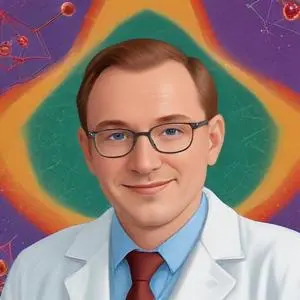
Developed crystallographic electron microscopy, allowing for the determination of the three-dimensional structure of biological molecules, and made significant contributions to our understanding of the structure of viruses and chromatin.
Aaron Klug, a British biophysicist and chemist, is renowned for his development of crystallographic electron microscopy, a groundbreaking technique that enabled the structural elucidation of biologically important nucleic acid-protein complexes. This pioneering work earned him the 1982 Nobel Prize in Chemistry, cementing his legacy as a trailblazer in the field of molecular biology.
Born on August 11, 1926, in Želva, Lithuania, to Jewish parents Lazar and Bella Klug, Aaron's family emigrated to South Africa when he was just two years old. His educational journey began at Durban High School, where he was inspired by Paul de Kruif's book "Microbe Hunters" to pursue microbiology.
Klug's academic trajectory took a fascinating turn when he shifted his focus from microbiology to physics and mathematics. He graduated with a Bachelor of Science degree from the University of the Witwatersrand in Johannesburg and later earned his Master of Science degree at the University of Cape Town, studying physics under the guidance of Reginald W. James.
A 1851 Research Fellowship from the Royal Commission for the Exhibition of 1851 enabled Klug to move to England, where he completed his PhD in research physics at Trinity College, Cambridge in 1953. This marked the beginning of his illustrious career, which would be characterized by seminal contributions to the field of molecular biology.
In 1953, Klug joined Birkbeck College in the University of London, where he worked alongside chemist and X-ray crystallographer Rosalind Franklin in the lab of crystallographer John Bernal. This collaboration sparked a lifelong interest in the study of viruses, and he made significant discoveries regarding the structure of the tobacco mosaic virus.
In 1962, Klug moved to the newly built Medical Research Council (MRC) Laboratory of Molecular Biology (LMB) in Cambridge, where he developed crystallographic electron microscopy. This innovative technique involves combining a sequence of two-dimensional images of crystals taken from different angles to produce three-dimensional structures.
This groundbreaking approach enabled Klug to elucidate the structures of biologically important nucleic acid-protein complexes, paving the way for a deeper understanding of the molecular mechanisms underlying life processes.
Klug's contributions to science were recognized with numerous awards and honors, including the 1982 Nobel Prize in Chemistry, the Copley Medal (1985), and the Louisa Gross Horwitz Prize (1981).
Aaron Klug's work has had a profound impact on our understanding of molecular biology, and his development of crystallographic electron microscopy has opened up new avenues for research in fields such as virology, genetics, and structural biology.
Klug's legacy extends beyond his scientific contributions, inspiring generations of scientists with his passion for discovery and his commitment to advancing human knowledge.
Through his remarkable journey, Aaron Klug has left an indelible mark on the scientific community, ensuring that his work will continue to shape our understanding of the intricate complexities of life.
Aaron Klug was a member of the Hashomer Hatzair Jewish Zionist youth movement in South Africa and maintained a strong connection to his Jewish heritage throughout his life.
Klug passed away on November 20, 2018, leaving behind a rich legacy that continues to inspire scientists and scholars around the world.
Born in 1916
Pioneering scientist who discovered the structure of DNA, revolutionizing our understanding of genetics and life itself.
98 Years Old
Discovered the structure of DNA, revolutionizing our understanding of genetics and earning a Nobel Prize. Pioneering work in molecular biology has far-reaching implications for medicine and beyond.
Born in 1920
A British scientist who contributed significantly to the discovery of the structure of DNA, providing high-quality X-ray crystallography images that helped James Watson and Francis Crick develop their famous model.
Born in 1916
A Nobel Prize-winning physicist and biologist who contributed significantly to the discovery of the structure of DNA, using X-ray crystallography to produce the first clear images of the molecule.
Born in 1901
Pioneering chemist and peace activist who won two unshared Nobel Prizes, one for chemistry and one for peace, for his groundbreaking work on the nature of the chemical bond and his tireless efforts to promote nuclear disarmament.
Born in 1914
Pioneering crystallographer who unraveled the structure of hemoglobin, revolutionizing our understanding of biological molecules. His work paved the way for major advances in medicine and biochemistry.
Born in 1917
Pioneering biochemist and crystallographer who determined the structure of myoglobin, a protein in muscle cells, and was awarded the Nobel Prize in Chemistry in 1962.
Born in 1910
A pioneering scientist who deciphered the structures of biomolecules like insulin and vitamin B12, revolutionizing our understanding of biology and medicine.
