


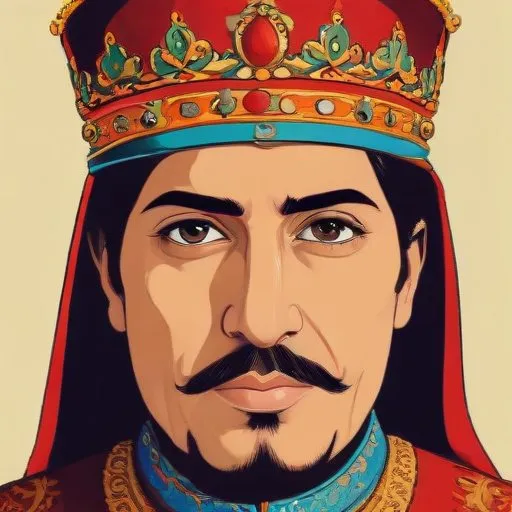
The Qajar crown prince of Persia was a reform-minded leader who modernized the Persian army and introduced Western-style education, making him a key figure in 19th-century Persian history. He's also known for his diplomatic efforts to maintain Persian independence amidst European colonialism.
Abbas Mirza, the Qajar crown prince of Iran, is remembered for his military prowess and his role in shaping the country's history during the tumultuous periods of the Russo-Persian Wars and the Ottoman-Persian War.
Born on August 26, 1789, in Nava, Mazandaran, Abbas Mirza was a younger son of Fath Ali Shah. However, due to his mother's royal birth, he was decreed by his father to succeed him.
At the tender age of 10, Abbas Mirza was named governor-beglarbeg of the Azerbaijan region of Persia in 1798. This early appointment marked the beginning of his rise to power and set the stage for his future military endeavors.
Abbas Mirza's military career was marked by his reputation as a skilled commander. He played a crucial role in the Russo-Persian War of 1804-1813 and the Russo-Persian War of 1826-1828, as well as the Ottoman-Persian War of 1821-1823.
During his military campaigns, Abbas Mirza implemented modernization initiatives, aiming to strengthen Persia's armed forces and institutions. Although his efforts ultimately proved disastrous for Persia, his legacy as a modernizer remains significant.
The Russo-Persian Wars resulted in the signing of the Treaty of Gulistan in 1813 and the Treaty of Turkmenchay in 1828. These treaties marked a turning point in history, as Persia lost significant territories, including the South Caucasus and parts of the North Caucasus, to Russia.
Abbas Mirza's military failures and the subsequent treaties had far-reaching consequences for Persia, shaping the country's borders and its relationships with neighboring powers.
Abbas Mirza was known for his literary tastes and his relatively simple life. Despite his military setbacks, he remained a respected figure in Persia, and his legacy continues to influence the country's history.
Abbas Mirza's untimely death on October 25, 1833, came before his father's, a rare occurrence in Persia's royal history.
Abbas Mirza's military campaigns and modernization efforts had a profound impact on Persia's development, shaping the country's relationship with neighboring powers and influencing its institutional frameworks.
Although his legacy is complex and multifaceted, Abbas Mirza remains an important figure in Persia's history, a testament to the country's resilience and adaptability in the face of adversity.
Born in 1772
The second ruler of the Qajar dynasty, he's known for his military campaigns, administrative reforms, and cultural achievements, including the development of Persian literature and art. He also established Tehran as the capital of Iran.
Born in 1898
The last ruler of the Qajar dynasty, he's known for his attempts to modernize Persia and his country's tumultuous relationship with European powers during his reign.
Born in 1878
Modernized Iran's infrastructure, military, and education system, while suppressing democratic movements and dissent.
Born in 1919
The last monarch of the Pahlavi dynasty, ruling Iran from 1941 until the 1979 revolution, known for his modernization efforts and close ties to the West. His regime was marked by controversy, including a CIA-backed coup and brutal suppression of dissent.
87 Years Old
The last empress of Iran, known as the queen of hearts, was a fashion icon and patron of the arts, supporting Iranian culture and women's rights. She was a symbol of elegance and refinement in a tumultuous era.
